
Revision summary
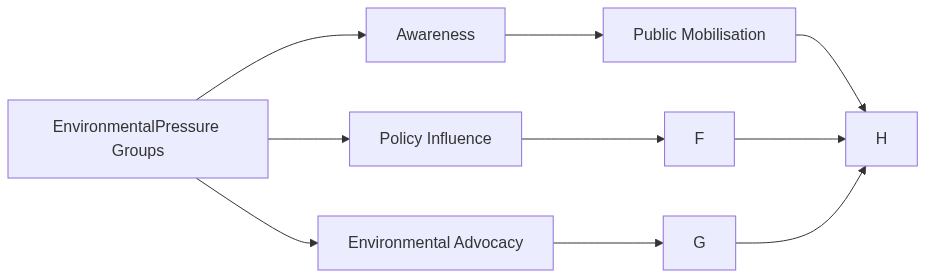
Environmental pressure groups organise to change ecological decisions of State and firms. Awareness: Chipko, Silent Valley, CSE and climate networks. Policy: EPA, FRA, NGT, EIA contests, PESA and mining consent. Advocacy: Mehta cases, Godavarman, Niyamgiri, Narmada and later climate-rights litigation. Limits: urban bias versus FRA communities, science errors, FCRA chill; they are one constitutional voice, not the ministry.
Model answer
Copper italics in this answer — like this — are the key facts. Each one is unpacked in the Facts & figures rail.
Introduction
Environmental pressure groups are non-state, voluntary and community-driven collectives of citizens, scientists and activists that mobilise public opinion, influence government policies and advocate environmental protection, without seeking to capture political power. In India, their democratic basis lies in Article 19(1)(c), while Articles 48A and 51A(g) provide constitutional support for environmental protection.
Body
Raising Environmental Awareness
Environmental pressure groups convert complex ecological issues into public concerns and build an informed environmental constituency.
- Scientific awareness: The Centre for Science and Environment (CSE) publishes research and pollution data, monitors environmental regulation and informs public debate.
- Grassroots mobilisation: The Chipko Movement, 1973 and Appiko Movement, 1983 connected forest conservation with local livelihoods and created mass ecological consciousness.
- Youth and digital mobilisation: Campaigns such as Magical Mangroves use social media to engage young people on wetlands, coastal ecosystems and climate vulnerabilities.
- Art and public communication: The Green India Campaign uses murals and street art to communicate messages on afforestation, water conservation and climate action.
Influencing Public Policies
Pressure groups influence the policy cycle by identifying problems, generating research, participating in consultations and demanding legislative change.
- Policy research: TERI and Greenpeace India provide research and policy inputs on renewable energy, pollution control and carbon intensity.
- Forest rights: The Campaign for Survival and Dignity mobilised tribal communities and contributed to the demand for the Forest Rights Act, 2006, strengthening community rights over forests.
- Environmental Impact Assessment: Groups participate in EIA public consultations, bringing local concerns regarding health, ecology and livelihoods into environmental-clearance decisions.
- Circular economy: Environmental advocacy has contributed to stronger Plastic Waste Management Rules and E-Waste Management Rules, including Extended Producer Responsibility (EPR).
Advocating for Environmental Protection
Pressure groups combine judicial advocacy with grassroots resistance to protect ecosystems and environmental rights.
- Judicial advocacy: Through PILs under Articles 32 and 226, groups have pushed courts to strengthen environmental jurisprudence.
- M.C. Mehta v. Union of India (1987): The Shriram Oleum Gas Leak case established the Absolute Liability Principle for hazardous industries.
- Vellore Citizens’ Welfare Forum (1996): Strengthened the Polluter Pays and Precautionary Principles in Indian environmental law.
- NGT Act, 2010: Created a specialised forum that environmental groups can use for speedy environmental remedies.
- M.K. Ranjitsinh v. Union of India (2024): The Supreme Court recognised a right to be free from the adverse effects of climate change, linking climate protection with Articles 14 and 21.
- Niyamgiri Hills: The 2013 Supreme Court ruling gave Gram Sabhas a decisive role in deciding on mining affecting the religious and forest rights of the Dongria Kondh.
- Narmada Bachao Andolan: Combined grassroots mobilisation and litigation to highlight ecological damage and displacement caused by large dams.
- Hasdeo Arand: Chhattisgarh Bachao Andolan mobilised against coal mining and exposed concerns regarding forged Gram Sabha consent.
Limitations
Their role must nevertheless remain accountable and balanced.
- Environment–development conflict: Groups may be criticised as obstructive when environmental advocacy delays infrastructure or energy projects.
- Urban/elite bias: Vocal urban groups may sometimes overshadow the livelihood concerns of tribal and rural communities.
- Funding constraints: FCRA regulation has created difficulties for some organisations dependent on foreign environmental funding.
- Scientific or representational limitations: Pressure groups may not always represent the entire spectrum of ecological, economic and livelihood interests.
Flow diagram
Conclusion
Environmental pressure groups strengthen Indian environmental governance by informing citizens, influencing policy and holding the State and private actors accountable. From Chipko and Niyamgiri to PILs and the NGT, they have expanded environmental protection beyond government action alone. Their greatest contribution lies in bringing grassroots knowledge, scientific evidence and environmental rights into public decision-making, while remaining balanced with legitimate developmental and livelihood concerns.
Quick related
Students also ask
-
"In contemporary development models, decision-making and problem-solving responsibilities are not located close to the source of information and execution defeating the objectives of development." Critically evaluate.
Next question on this syllabus topic (2025 · Q17). View answer →
-
Are all environmental groups NGOs?
No. Some are unions, student bodies, or village sanghams without an FCRA number. The pressure is the organised claim, not the registration.
-
Does PIL replace democracy?
It can overreach. It also fills a gap when regulators sleep. The cure is a working EIA and a hearing, not a ban on writs.
Same topic · past papers
UPSC has asked this before
These previous-year questions sit on the same topic. Open one to practise the earlier ask.
More from this topic
Q15 · UPSC Mains 2026 · GS II · 15 marks · Solution
To what extent do pressure groups, social movements and corporate lobbies deepen pluralistic democracy in India by representing excluded interests? Analyse whether the growing convergence of corporate wealth and political power poses a threat to the autonomy of formal democratic institutions.
Governance and Policy
• Civil society groups and grassroots movements go beyond periodic elections to channel marginalized voices into policy spaces. • Social movements on tribal rights and environmental protection have successfully forced the state to create protective legislation. • Representation is uneven due to a severe resource asymmetry between well-funded corporate lobbies and unorganized labor. • Some interest groups act as elite fronts, subverting public welfare for narrow sectarian gains. • Corporate financial dominance through opaque funding creates severe risks of policy capture and quid pro quo corruption. • Strengthening transparency in political funding and reinforcing regulatory autonomy are essential to safeguard democratic governance.
Q12 · UPSC Mains 2026 · GS II · 15 marks · Solution
What is meant by judicial legislation? In this context, discuss the verdicts of the apex court allowing "passive euthanasia" and a "living will".
Governance and Policy
• Judicial legislation occurs when courts create binding rules to fill policy voids caused by legislative inaction. • The Supreme Court legalized passive euthanasia under Article 21, recognizing the right to die with dignity. • The *Common Cause* (2018) judgment permitted the withdrawal of life support for terminally ill patients with strict medical safeguards. • A living will is an advanced medical directive allowing individuals to pre-state their treatment preferences before incapacitation. • The Supreme Court simplified living will procedures in 2023, replacing complex magistrate approvals with basic notary attestation. • While court guidelines provide immediate relief, they underscore the need for a comprehensive parliamentary statute on end-of-life care. • Codifying these judicial norms through formal legislation ensures democratic legitimacy, ethical debate, and administrative clarity.
Q6 · UPSC Mains 2026 · GS II · 10 marks · Solution
Does India's tribal development policy reflect the aspirations for a socially grounded and equity-based governance? Justify your answer.
Governance and Policy
• India's tribal policy balances constitutional protections with socio-economic development goals. • Fifth and Sixth Schedules provide decentralized autonomy and safeguard tribal lands. • Articles 275(1) and 335 ensure grants-in-aid and reservations to bridge gaps. • PESA (1996) and FRA (2006) mark shifts toward rights-based and culturally sensitive governance. • Gram sabhas are empowered over minor forest produce and community forest rights. • Implementation is hindered by forced displacement without consent and bureaucratic inertia. • True equity requires empowering local institutions rather than relying solely on welfare delivery.