
Revision summary
Social capital is trust and networks; for women it makes legal rights usable. NRLM, Kudumbashree, Jeevika, SEWA and reserved panchayat chairs are Indian examples. Bonding kin networks can constrain; bridging groups can open credit and voice. Courts and the 106th Amendment change rules; SHGs and ASHA cadres change practice. Networks complement the State; they do not replace land title, wages or policing.
Model answer
Copper italics in this answer — like this — are the key facts. Each one is unpacked in the Facts & figures rail.
Introduction
Social capital refers to the networks, trust, shared norms and cooperation that enable people to act collectively. For women, it complements formal rights and welfare schemes by converting rights on paper into usable social, economic and political power. Thus, SHGs, women’s collectives, Panchayati Raj institutions and professional networks act as force multipliers for gender equity and empowerment.
Body
Social Capital as a Complement to Formal Rights
- Bridging the implementation gap: Constitutional provisions and schemes provide formal opportunities, but networks help women actually access and exercise them.
- Example: Articles 14, 15 and 16, the 73rd Amendment, the 106th Amendment, POSH and NRLM provide formal support, while SHGs and women’s networks create the confidence and collective strength to use these rights.
- Bonding vs bridging capital: Bonding networks create solidarity within a group, while bridging networks connect women to institutions, markets and wider opportunities.
- Example: A caste or kinship network may reinforce restrictive norms, whereas a mixed SHG can connect women to credit, markets and political voice.
Economic Empowerment and Financial Inclusion
- Social collateral: SHGs replace the absence of individual collateral with mutual trust, savings, peer monitoring and collective bargaining.
- Example: Kudumbashree, Jeevika and SEWA demonstrate how women’s collectives can create savings, bank linkages, livelihoods and a stronger public identity.
- Asset and income security: Collective economic activity increases women’s bargaining power within households and communities.
- Example: Women’s SHGs under NRLM transform individual beneficiaries into organised economic actors rather than isolated recipients of welfare.
Social Justice and Community Welfare
- Collective problem-solving: Women’s networks can convert social solidarity into community-level welfare and protection.
- Example: Women-led community grain banks, such as the Anaaj Bank model in Madhya Pradesh, use collective contributions to support vulnerable households.
- Changing social norms: Peer networks create community pressure against practices that harm women and families.
- Example: Aabha Sakhis have used peer influence to encourage legal electricity connections and regular bill payment while gaining greater social recognition.
- Protection from violence: Collective action can strengthen women’s ability to confront violence, exploitation and local insecurity.
- Example: Marginalised women’s grassroots mobilisation in Bihar demonstrates how collective networks can be converted into community protection and crisis response.
Political Empowerment and Voice
- From representation to participation: Reservation creates political representation, but social capital helps women develop confidence, networks and institutional knowledge to exercise actual power.
- Example: The 73rd Amendment created reserved seats in Panchayati Raj institutions; women’s networks can help elected representatives move from symbolic presence towards effective decision-making.
- Breaking proxy politics: Collective support can challenge the Sarpanch Pati phenomenon by strengthening the authority of elected women representatives.
- Political leadership: Repeated participation in SHGs and local institutions creates leadership experience that can spill over into formal politics.
Gender Equity through Assets, Rights and Opportunities
- Equity requires more than equal treatment: Women’s historical disadvantages require access to assets, voice, safety and institutional support.
- Social capital strengthens legal empowerment: Legal reforms become more meaningful when women have networks that help them claim and enforce their rights.
- Example: Vineeta Sharma strengthened daughters’ coparcenary rights, but awareness, collective support and willingness to assert those rights determine their practical impact.
- Example: Secretary, Ministry of Defence v. Babita Puniya advanced gender equality in the armed forces, showing how legal rights can challenge institutional barriers.
Psychosocial Empowerment and Entrepreneurship
- Peer mentoring: Women’s networks provide confidence, knowledge, emotional support and business guidance where formal institutions may be inaccessible.
- Example: The Biz Sakhi model uses community-based women mentors to provide psychosocial support, life skills and entrepreneurial guidance.
- Collective economic identity: Traditional women-led institutions can provide resilience during economic and social crises.
- Example: Nupi Keithel in Manipur demonstrates how women’s long-standing economic and organisational solidarity can sustain livelihoods.
Limitations
- Social capital can also reproduce inequality: Not every network is emancipatory.
- Example: Caste panchayats, khaps and restrictive kinship networks may enforce patriarchal norms and constrain women’s choices.
- Credit is not ownership: SHG-based microcredit may improve income but cannot substitute for land, property and secure employment.
- State remains indispensable: Social capital cannot replace functioning schools, childcare, policing, legal protection or secure property rights.
Flow diagram
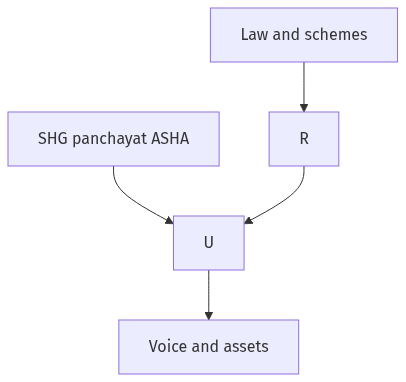
Conclusion
Women’s social capital acts as a bridge between gender equity and substantive empowerment. Formal laws and schemes create opportunities, while SHGs, collectives and political networks provide the trust, agency and collective voice required to use them. However, social capital should complement rather than replace the State: rights provide the foundation, institutions provide guarantees, and collective networks convert them into everyday empowerment.
Quick related
Students also ask
-
"With the waning of globalization, post-Cold War world is becoming a site of sovereign nationalism." Elucidate.
Next question on this syllabus topic (2025 · Q10). View answer →
-
Is an SHG enough for empowerment?
It is a start for credit and meeting. Equity still needs property, wages, safety and a say in the panchayat budget.
-
Can social capital be regressive?
Yes. Caste panchayats and honour networks are social capital with a gender penalty. The test is whether the network expands a woman’s exit options.
Same topic · past papers
UPSC has asked this before
These previous-year questions sit on the same topic. Open one to practise the earlier ask.
More from this topic
Q15 · UPSC Mains 2026 · GS II · 15 marks · Solution
To what extent do pressure groups, social movements and corporate lobbies deepen pluralistic democracy in India by representing excluded interests? Analyse whether the growing convergence of corporate wealth and political power poses a threat to the autonomy of formal democratic institutions.
Governance and Policy
• Civil society groups and grassroots movements go beyond periodic elections to channel marginalized voices into policy spaces. • Social movements on tribal rights and environmental protection have successfully forced the state to create protective legislation. • Representation is uneven due to a severe resource asymmetry between well-funded corporate lobbies and unorganized labor. • Some interest groups act as elite fronts, subverting public welfare for narrow sectarian gains. • Corporate financial dominance through opaque funding creates severe risks of policy capture and quid pro quo corruption. • Strengthening transparency in political funding and reinforcing regulatory autonomy are essential to safeguard democratic governance.
Q12 · UPSC Mains 2026 · GS II · 15 marks · Solution
What is meant by judicial legislation? In this context, discuss the verdicts of the apex court allowing "passive euthanasia" and a "living will".
Governance and Policy
• Judicial legislation occurs when courts create binding rules to fill policy voids caused by legislative inaction. • The Supreme Court legalized passive euthanasia under Article 21, recognizing the right to die with dignity. • The *Common Cause* (2018) judgment permitted the withdrawal of life support for terminally ill patients with strict medical safeguards. • A living will is an advanced medical directive allowing individuals to pre-state their treatment preferences before incapacitation. • The Supreme Court simplified living will procedures in 2023, replacing complex magistrate approvals with basic notary attestation. • While court guidelines provide immediate relief, they underscore the need for a comprehensive parliamentary statute on end-of-life care. • Codifying these judicial norms through formal legislation ensures democratic legitimacy, ethical debate, and administrative clarity.
Q6 · UPSC Mains 2026 · GS II · 10 marks · Solution
Does India's tribal development policy reflect the aspirations for a socially grounded and equity-based governance? Justify your answer.
Governance and Policy
• India's tribal policy balances constitutional protections with socio-economic development goals. • Fifth and Sixth Schedules provide decentralized autonomy and safeguard tribal lands. • Articles 275(1) and 335 ensure grants-in-aid and reservations to bridge gaps. • PESA (1996) and FRA (2006) mark shifts toward rights-based and culturally sensitive governance. • Gram sabhas are empowered over minor forest produce and community forest rights. • Implementation is hindered by forced displacement without consent and bureaucratic inertia. • True equity requires empowering local institutions rather than relying solely on welfare delivery.