
Revision summary
The 73rd and 74th Amendments create panchayats and municipalities with the Eleventh and Twelfth Schedules. Good local governance needs functions, funds and functionaries, plus live Gram Sabhas and ward committees. Merger helps peri-urban planning, tax and utilities. Merger hurts rural voice, PESA areas and the distinct 73rd settlement. Article 243Q already invents the nagar panchayat as a half-merge. Metropolitan planning committees can share utilities without killing the Gram Sabha. The test is the peri-urban belt, not a nationwide glue.
Model answer
Copper italics in this answer — like this — are the key facts. Each one is unpacked in the Facts & figures rail.
Introduction
- Local bodies are the third stratum after the 73rd and 74th Amendments: panchayats for the village, municipalities for the town. Good governance at that level is water, streets, primary health, schools, property tax and a grievance that does not need a yatra to the Secretariat. Whether rural and urban bodies should merge is the question the census town and the peri-urban belt ask every decade.
Body
Local bodies and good governance
The schedules are live only when functions, funds and functionaries move with them.
- Peg: Articles 243G and 243W, the Eleventh and Twelfth Schedules, and State conformity Acts name the functions; the three Fs decide whether the name is real.
- Peg: Where State Finance Commissions are timely, property tax is collected, and the Gram Sabha or ward committee actually sits, local bodies cut the last-mile gap that line departments cannot.
- Peg: Failures are familiar: parallel schemes that skip the panchayat, MP/MLA local-area funds that recreate a second executive, delayed elections, and a CEO who answers to the State more than to the elected chair.
- Peg: Urban bodies add planning, building bye-laws and transport; rural bodies add land, forests-as-livelihood and MGNREGA — the skill-sets are not identical.
Gains from merger
Census towns and villages glued to a municipal edge already share sewers, labour markets and crime.
- Peg: A nagar panchayat or a municipal merger can unify master plans and stop the jurisdiction shrug over a drain.
- Peg: A wider tax base and a city bus on the village road are real planning gains.
- Peg: Climate drainage and solid waste do not honour the 73rd/74th line; some States have folded peri-urban panchayats into corporations for that reason.
Costs of merger
The 73rd Amendment was a rural political settlement, not a waiting room for a corporation.
- Peg: Merge into a municipal corporation and the farmer’s vote is diluted by an urban density that does not live on that land.
- Peg: PESA Gram Sabhas in Scheduled Areas are a further bar: merger without a Fifth Schedule conversation is a constitutional slight.
- Peg: Forced municipalisation is also a tax event — property tax, trade licence — that villages may not have asked for.
- Peg: The workable line is statutory agglomeration where the census already has: metropolitan planning committees (Article 243ZE) that actually meet, nagar panchayats for transitional areas, and shared utilities without extinguishing the Gram Sabha.
Flow diagram
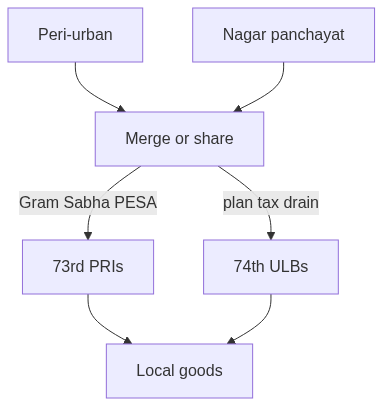
Conclusion
Local bodies govern well when the three Fs are real. Merging rural and urban houses can fix peri-urban mess. It can also erase a rural constitutional identity. Transitional forms beat a single nationwide glue.
Quick related
Students also ask
-
Public charitable trusts have the potential to make India's development more inclusive as they relate to certain vital public issues. Comment.
Next question on this syllabus topic (2024 · Q6). View answer →
-
Did the Constitution require two separate local systems?
Yes, two chapters. It also invented the nagar panchayat because it knew the village-city line moves.
-
Is merger the same as urbanisation?
No. People can urbanise in a census town while the panchayat still exists. Merger is a legal death of one body.
Same topic · past papers
UPSC has asked this before
These previous-year questions sit on the same topic. Open one to practise the earlier ask.
-
2023 · Q3 · GS II · 10 marks
"The states in India seem reluctant to empower urban local bodies both functionally as well as financially." Comment. -
2026 · Q2 · GS II · 10 marks
"Women as a class neither belong to a minority group nor are they regarded as forming a backward class." In the light of this statement, discuss the evolution of women's reservation from local bodies to Parliament.
More from this topic
Q15 · UPSC Mains 2026 · GS II · 15 marks · Solution
To what extent do pressure groups, social movements and corporate lobbies deepen pluralistic democracy in India by representing excluded interests? Analyse whether the growing convergence of corporate wealth and political power poses a threat to the autonomy of formal democratic institutions.
Governance and Policy
• Civil society groups and grassroots movements go beyond periodic elections to channel marginalized voices into policy spaces. • Social movements on tribal rights and environmental protection have successfully forced the state to create protective legislation. • Representation is uneven due to a severe resource asymmetry between well-funded corporate lobbies and unorganized labor. • Some interest groups act as elite fronts, subverting public welfare for narrow sectarian gains. • Corporate financial dominance through opaque funding creates severe risks of policy capture and quid pro quo corruption. • Strengthening transparency in political funding and reinforcing regulatory autonomy are essential to safeguard democratic governance.
Q12 · UPSC Mains 2026 · GS II · 15 marks · Solution
What is meant by judicial legislation? In this context, discuss the verdicts of the apex court allowing "passive euthanasia" and a "living will".
Governance and Policy
• Judicial legislation occurs when courts create binding rules to fill policy voids caused by legislative inaction. • The Supreme Court legalized passive euthanasia under Article 21, recognizing the right to die with dignity. • The *Common Cause* (2018) judgment permitted the withdrawal of life support for terminally ill patients with strict medical safeguards. • A living will is an advanced medical directive allowing individuals to pre-state their treatment preferences before incapacitation. • The Supreme Court simplified living will procedures in 2023, replacing complex magistrate approvals with basic notary attestation. • While court guidelines provide immediate relief, they underscore the need for a comprehensive parliamentary statute on end-of-life care. • Codifying these judicial norms through formal legislation ensures democratic legitimacy, ethical debate, and administrative clarity.
Q6 · UPSC Mains 2026 · GS II · 10 marks · Solution
Does India's tribal development policy reflect the aspirations for a socially grounded and equity-based governance? Justify your answer.
Governance and Policy
• India's tribal policy balances constitutional protections with socio-economic development goals. • Fifth and Sixth Schedules provide decentralized autonomy and safeguard tribal lands. • Articles 275(1) and 335 ensure grants-in-aid and reservations to bridge gaps. • PESA (1996) and FRA (2006) mark shifts toward rights-based and culturally sensitive governance. • Gram sabhas are empowered over minor forest produce and community forest rights. • Implementation is hindered by forced displacement without consent and bureaucratic inertia. • True equity requires empowering local institutions rather than relying solely on welfare delivery.