
Revision summary
India is not a NATO member and does not need NATO expansion for its own charter. A cohesive US–Europe can free US focus and technology for the Indo-Pacific, which helps India versus China. Quad, Malabar, France in the Indian Ocean, and iCET-type talks are the practical examples. The Russia–West split after 2022 hurts India’s energy and S-400-type defence links. Opinion: partly true as an indirect gain, false as a blanket; keep strategic autonomy.
Model answer
Copper italics in this answer — like this — are the key facts. Each one is unpacked in the Facts & figures rail.
Introduction
NATO is a North Atlantic alliance; India is not a member and does not seek to be one. A stronger US–Europe partnership can still serve Indian interests in the Indo-Pacific and on technology, while it can hurt Indian interests wherever it hardens a Russia–West split that India does not join.
Body
Why the statement is partly true
- A Europe that is secure and aligned with the United States can free American military and diplomatic attention for the Indo-Pacific, where India faces China on the Line of Actual Control and at sea.
- Stronger trans-Atlantic capacity in defence production, semiconductors, and export controls can widen India’s access to technology through the Quad, iCET-type US–India initiatives, and European Indo-Pacific strategies (France in the Indian Ocean, EU connectivity).
- NATO’s own documents after 2022 named China as a challenge to Alliance interests; that shift, even if secondary to Russia, overlaps with India’s China problem without making India a NATO partner.
- Examples: logistics and foundation agreements with the United States, Malabar with Quad navies, and growing defence-industrial talk with France and the United Kingdom all sit more easily when Washington and European capitals are not divided.
Why the statement is overstated
- India needs discounted energy, fertiliser, and legacy defence from Russia, including the S-400 system; a NATO–Russia war and sanctions raise CAATSA-type and payment risks for New Delhi.
- NATO expansion is a European choice about European security; it is not designed for Indian continental defence and can inflame a bloc politics that Non-Alignment and later multi-alignment tried to avoid.
- A tighter US–Europe partnership can export extra-territorial sanctions, carbon border taxes, and technology-denial lists that hit Indian industry even when India is not the target.
- Strategic autonomy means India will buy from France, train with the US Navy, and still sit in the Shanghai Cooperation Organisation and BRICS; NATO cohesion does not dissolve those other tables.
- Example: after 2022 India increased oil imports from Russia while remaining a Quad member; that mix would be harder if “working well” meant copying NATO’s Russia policy.
Opinion
- The statement works well for India only as an indirect Indo-Pacific and technology effect, not as a general rule.
- India should welcome a capable trans-Atlantic West that balances China and shares defence technology, and should refuse any expectation that New Delhi join NATO’s Russia policy or host an Asian NATO.
- The useful Indian stance is issue-based partnership with the United States and Europe, plus continued Russia and Global South channels.
Flow diagram
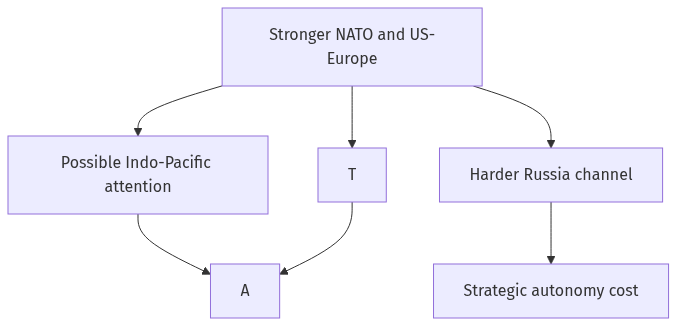
Conclusion
NATO expansion and a stronger US–Europe partnership help India where they free Western capacity for the Indo-Pacific and for technology. They do not work well as a package India must sign, because Russian energy and defence, and strategic autonomy, still structure Indian choices.
Quick related
Students also ask
-
'Sea is an important Component of the Cosmos'. Discuss in the light of the above statement the role of the IMO(International Maritime Organisation) in protecting environment and enhancing maritime safety and security.
Next question on this syllabus topic (2023 · Q20). View answer →
-
Should India join NATO?
No. NATO’s Article 5 area is the North Atlantic. India’s threats are continental and Indo-Pacific, and its Russia ties do not fit NATO discipline.
-
Does NATO expansion automatically contain China?
No. NATO’s core mission remains Europe and Russia. China language in NATO text is secondary. India’s China problem is still solved in Asia, not in Brussels.
Same topic · past papers
UPSC has asked this before
These previous-year questions sit on the same topic. Open one to practise the earlier ask.
-
2022 · Q3 · GS II · 10 marks
To what extent, in your opinion, as the decentralisation of power in India changed the governance landscape at the grassroots? -
2019 · Q9 · GS II · 10 marks
'The time has come for India and Japan to build a strong contemporary relationship, one involving global and strategic partnership that will have a great significance for Asia and the world as a whole.' Comment.
More from this topic
Q20 · UPSC Mains 2026 · GS II · 15 marks · Solution
"China's Belt and Road Initiative (BRI) has transformed South Asia from a regional space into a theatre of great power competition." Analyse the strategic implications of the BRI for India's security and regional influence in South Asia.
India and its Neighbourhood
China's Belt and Road Initiative has turned South Asia into a zone of great-power rivalry, not just a regional neighbourhood. Ports like Gwadar and Hambantota raise fears of maritime encirclement and pressure on Indian Ocean trade routes. CPEC through Pakistan-Occupied Kashmir directly challenges India's sovereignty and adds a two-front security worry. Debt-heavy Chinese projects in Sri Lanka and Maldives have pushed smaller neighbours to hedge between Beijing and New Delhi. India must respond with trusted connectivity—Chabahar, BIMSTEC, Neighbourhood First aid, and Indo-Pacific partnerships—so development does not come with strategic dependence on China.
Q19 · UPSC Mains 2025 · GS II · 15 marks · Solution
"Energy security constitutes the dominant kingpin of India's foreign policy, and is linked with India's overarching influence in Middle Eastern countries." How would you integrate energy security with India's foreign policy trajectories in the coming years?
India and its Neighbourhood
Imported crude and LNG make energy the hard core of India’s Middle East policy, alongside diaspora and ports. UAE CEPA, I2U2, IMEC and Chabahar are the diplomatic frame around tankers. Risks: Hormuz, Red Sea, Iran sanctions, OPEC+ and over-reliance on any one discount supplier. Future integration: diversified barrels and routes, Gulf green-hydrogen partnerships, naval sea-lane policy, multi-alignment among regional rivals. The kingpin should shrink as the energy mix greener; it cannot be wished away this decade.
Q9 · UPSC Mains 2025 · GS II · 10 marks · Solution
India-Africa digital partnership is achieving mutual respect, co-development and long-term institutional partnerships. Elaborate.
India and its Neighbourhood
The partnership runs on Pan-African e-Network heritage, ITEC training, IAFS, and newer DPI (payments, identity, document rails). Co-development means African adaptation and AU working groups, not a vendor dump. Respect means data under African law, unlike a back-doored hardware grid. Limits: power and connectivity, summit-without-follow-through, and China’s larger cable footprint. Score the relationship by live hospital and payment links.