
Revision summary
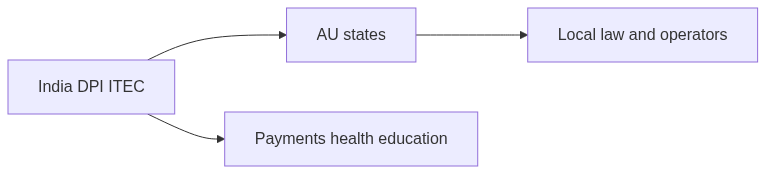
The partnership runs on Pan-African e-Network heritage, ITEC training, IAFS, and newer DPI (payments, identity, document rails). Co-development means African adaptation and AU working groups, not a vendor dump. Respect means data under African law, unlike a back-doored hardware grid. Limits: power and connectivity, summit-without-follow-through, and China’s larger cable footprint. Score the relationship by live hospital and payment links.
Model answer
Copper italics in this answer — like this — are the key facts. Each one is unpacked in the Facts & figures rail.
Introduction
India–Africa relations have evolved from anti-colonial solidarity to practical South–South cooperation. The digital partnership reflects this transition by combining India’s Digital Public Infrastructure, capacity-building experience and affordable technology with African ownership and local adaptation. Thus, it seeks to move beyond a donor–recipient model towards mutual respect, co-development and durable institutional partnerships.
Body
Mutual respect
- Equal partnership: India’s approach emphasises sharing public digital tools while allowing African countries to retain control over their policies and data, rather than creating a donor–recipient hierarchy.
- Example: The Pan-African e-Network created early institutional links through tele-education and tele-medicine, demonstrating technology-sharing for African capacity building.
- Capacity building over dependency: India focuses on training African officials, technicians and professionals so that digital systems can be operated locally.
- Example: ITEC remains an important channel for training African officials and technicians.
- Respect for local laws: Digital cooperation increasingly recognises African legal and regulatory frameworks rather than treating Africa merely as a technology market.
- Example: Cooperation is framed around African data laws, cybersecurity and lawful access, avoiding a “data-colony” model.
Co-development
- From technology transfer to adaptation: The partnership increasingly involves African institutions adapting digital solutions to their own administrative and developmental requirements.
- Example: India’s Digital Public Infrastructure approach offers modular solutions such as UPI-like payments, identity systems and digital-document rails rather than dependence on a single proprietary vendor.
- Digital financial inclusion: Indian payment architecture can be adapted to African financial ecosystems to promote low-cost and interoperable digital payments.
- Example: NPCI International works with partner countries to explore UPI-like fast-payment interoperability.
- Knowledge and institutional co-creation: Cooperation extends beyond technology to joint working groups, satellite applications and cybersecurity capacity building.
- Example: AU–India working groups, ISRO cooperation and cyber-capacity-building initiatives provide institutional platforms for joint problem-solving.
Long-term institutional partnerships
- Institutional continuity: The relationship is supported by established platforms rather than being limited to individual technology projects.
- Example: India–Africa Forum Summits (IAFS) provide a continuing political framework for cooperation, while ITEC provides an enduring capacity-building channel.
- Digital infrastructure and connectivity: Long-term cooperation includes digital infrastructure, satellite applications and other technological foundations necessary for sustained digital transformation.
- African institutional ownership: Long-term success depends on African governments, operators and institutions participating in implementation rather than merely receiving finished Indian products.
- Multi-sector application: The partnership connects digital technology with health, education, payments and governance, making it developmental rather than purely commercial.
- Example: The Pan-African e-Network’s tele-medicine and tele-education links demonstrate how digital cooperation can directly serve public welfare.
Challenges
- Digital infrastructure gap: Poor connectivity, electricity shortages and weak last-mile infrastructure can limit the effectiveness of digital initiatives.
- Implementation gap: Some initiatives risk remaining at the level of MOUs and summit declarations without sustained execution.
- Competitive environment: China has a much larger digital infrastructure and cable footprint, creating intense competition for influence.
- Need for genuine co-ownership: Simply exporting Indian platforms without adequate African parliamentary scrutiny, local capacity and regulatory adaptation could reproduce the dependency that the partnership seeks to avoid.
Thus, the partnership’s success should be judged not merely by agreements signed, but by functioning payment, health, education and governance links operated with African ownership.
Flow diagram
Conclusion
The India–Africa digital partnership represents a distinctive model of South–South cooperation in which technology is combined with training, local adaptation and institutional ownership. The Pan-African e-Network, ITEC, DPI and NPCI International illustrate the movement from technology transfer towards co-development. Going forward, reliable connectivity, African ownership and sustained implementation will determine whether this partnership becomes a genuinely co-owned digital development model rather than another technology-export arrangement.
Quick related
Students also ask
-
"Energy security constitutes the dominant kingpin of India's foreign policy, and is linked with India's overarching influence in Middle Eastern countries." How would you integrate energy security with India's foreign policy trajectories in the coming years?
Next question on this syllabus topic (2025 · Q19). View answer →
-
Is this just brand UPI?
UPI is the visible 2020s piece. The older piece is education, health links and training. Both have to run to count as partnership.
-
How is this different from BRI digital projects?
Scale and hardware differ. India’s pitch is public rails and training with local legal control; delivery must match the pitch.
Same topic · past papers
UPSC has asked this before
These previous-year questions sit on the same topic. Open one to practise the earlier ask.
More from this topic
Q20 · UPSC Mains 2026 · GS II · 15 marks · Solution
"China's Belt and Road Initiative (BRI) has transformed South Asia from a regional space into a theatre of great power competition." Analyse the strategic implications of the BRI for India's security and regional influence in South Asia.
India and its Neighbourhood
China's Belt and Road Initiative has turned South Asia into a zone of great-power rivalry, not just a regional neighbourhood. Ports like Gwadar and Hambantota raise fears of maritime encirclement and pressure on Indian Ocean trade routes. CPEC through Pakistan-Occupied Kashmir directly challenges India's sovereignty and adds a two-front security worry. Debt-heavy Chinese projects in Sri Lanka and Maldives have pushed smaller neighbours to hedge between Beijing and New Delhi. India must respond with trusted connectivity—Chabahar, BIMSTEC, Neighbourhood First aid, and Indo-Pacific partnerships—so development does not come with strategic dependence on China.
Q19 · UPSC Mains 2025 · GS II · 15 marks · Solution
"Energy security constitutes the dominant kingpin of India's foreign policy, and is linked with India's overarching influence in Middle Eastern countries." How would you integrate energy security with India's foreign policy trajectories in the coming years?
India and its Neighbourhood
Imported crude and LNG make energy the hard core of India’s Middle East policy, alongside diaspora and ports. UAE CEPA, I2U2, IMEC and Chabahar are the diplomatic frame around tankers. Risks: Hormuz, Red Sea, Iran sanctions, OPEC+ and over-reliance on any one discount supplier. Future integration: diversified barrels and routes, Gulf green-hydrogen partnerships, naval sea-lane policy, multi-alignment among regional rivals. The kingpin should shrink as the energy mix greener; it cannot be wished away this decade.
Q20 · UPSC Mains 2024 · GS II · 15 marks · Solution
Discuss the geopolitical and geostrategic importance of Maldives for India, with a focus on global trade and energy flows. Further, also discuss how this relationship affects India's maritime security and regional stability amidst international competition?
India and its Neighbourhood
Maldives sits on Indian Ocean channels that carry Gulf energy and East–West trade past India’s south-west. Bilateral trade is small; location, tourism, fuel and people-to-people ties are the substance. India’s security tools: SAGAR, radar, hydrography, Greater Male projects, Colombo Security Conclave. Electoral swings in Male, including India Out politics, show Chinese competition and sovereign sensitivity. Regional stability is a stable Male, not a client. Sea lanes remain; patrons change.