
Revision summary
Imported crude and LNG make energy the hard core of India’s Middle East policy, alongside diaspora and ports. UAE CEPA, I2U2, IMEC and Chabahar are the diplomatic frame around tankers. Risks: Hormuz, Red Sea, Iran sanctions, OPEC+ and over-reliance on any one discount supplier. Future integration: diversified barrels and routes, Gulf green-hydrogen partnerships, naval sea-lane policy, multi-alignment among regional rivals. The kingpin should shrink as the energy mix greener; it cannot be wished away this decade.
Model answer
Copper italics in this answer — like this — are the key facts. Each one is unpacked in the Facts & figures rail.
Introduction
India’s energy security is closely intertwined with its West Asia policy, given its dependence on Gulf oil and LNG, the presence of millions of Indian workers in the region, and the strategic importance of maritime energy routes. Therefore, future foreign policy must secure reliable energy flows while gradually reducing vulnerability through diversification, green energy partnerships and strategic autonomy.
Body
Integrating Energy Security with Future Foreign Policy
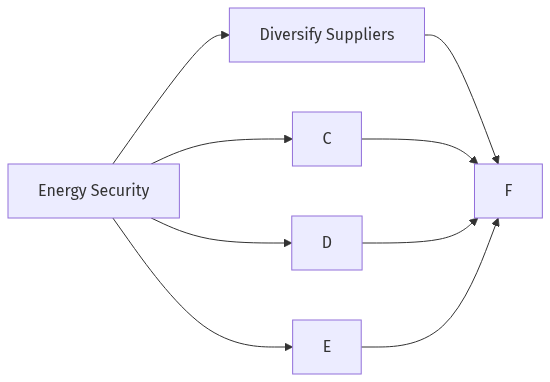
- 1. Diversify energy suppliers: India should reduce excessive dependence on any single supplier by expanding crude and LNG partnerships with Latin America, West Africa, the US and other resource-rich regions, while maintaining stable relations with Gulf producers.
- 2. Deepen strategic energy partnerships with the Gulf: India should move beyond a buyer–seller relationship with Saudi Arabia, UAE and Qatar towards long-term partnerships in LNG, refining, petrochemicals, renewables and green hydrogen. Initiatives such as CEPA with UAE and I2U2 can support this broader economic-energy relationship.
- 3. Protect energy routes: Energy security requires secure maritime connectivity. India should strengthen its naval and diplomatic engagement around critical routes such as the Strait of Hormuz and Red Sea, while developing alternative routes and infrastructure. Strategic Petroleum Reserves (SPR) should provide a buffer against temporary disruptions.
- 4. Maintain multi-alignment in West Asia: India should simultaneously engage Riyadh, Tehran, Tel Aviv and Washington rather than align exclusively with any one bloc. This allows India to protect energy interests despite Iran–Israel tensions, sanctions and regional conflicts.
- 5. Use Chabahar and IMEC for diversification: Chabahar Port provides strategic access to Afghanistan and Central Asia, reducing dependence on a single geographical route. IMEC can strengthen India's connectivity with the Gulf and Europe if regional security conditions permit.
- 6. Integrate energy transition with diplomacy: India's foreign policy should increasingly focus on green hydrogen, renewable energy, critical minerals and clean-energy technology. Partnerships with Gulf countries can combine their renewable-energy potential and capital with India's growing clean-energy demand and technological capabilities.
- 7. Strengthen overseas energy assets: Institutions such as ONGC Videsh can acquire overseas oil and gas assets and secure long-term offtake arrangements, converting foreign-policy relationships into direct energy-security instruments.
- 8. Use diaspora diplomacy: India's large diaspora in West Asia creates an additional strategic link between energy security and foreign policy. Protecting Indian workers and maintaining evacuation capabilities during crises should therefore remain part of India's West Asia strategy.
- 9. Gradually reduce the centrality of hydrocarbons: Energy security should ultimately move from simply securing more barrels to reducing vulnerability to the barrel itself through domestic renewables, biofuels, green hydrogen, electrification and other clean-energy sources.
Flow diagram
Conclusion
India's future energy diplomacy must evolve from securing hydrocarbons to securing the entire energy ecosystem—suppliers, routes, infrastructure, technology and critical minerals. A combination of diversified imports, deeper Gulf partnerships, protected sea lanes, multi-alignment and green-energy diplomacy can preserve India's strategic autonomy while gradually reducing the dominance of imported hydrocarbons in its foreign policy.
Quick related
Students also ask
-
'The West is fostering India as an alternative to reduce dependence on China's supply chain and as a strategic ally to counter China's political and economic dominance.' Explain this statement with examples.
Next question on this syllabus topic (2024 · Q9). View answer →
-
Has Russian oil ended the Gulf kingpin?
It added a supplier and a discount. Gulf grades, geography and LNG still structure the relationship.
-
Is Chabahar an energy port?
It is primarily an access route to Afghanistan and Central Asia. It is energy-relevant as diversification of geography, under sanctions risk.
Same topic · past papers
UPSC has asked this before
These previous-year questions sit on the same topic. Open one to practise the earlier ask.
More from this topic
Q20 · UPSC Mains 2026 · GS II · 15 marks · Solution
"China's Belt and Road Initiative (BRI) has transformed South Asia from a regional space into a theatre of great power competition." Analyse the strategic implications of the BRI for India's security and regional influence in South Asia.
India and its Neighbourhood
China's Belt and Road Initiative has turned South Asia into a zone of great-power rivalry, not just a regional neighbourhood. Ports like Gwadar and Hambantota raise fears of maritime encirclement and pressure on Indian Ocean trade routes. CPEC through Pakistan-Occupied Kashmir directly challenges India's sovereignty and adds a two-front security worry. Debt-heavy Chinese projects in Sri Lanka and Maldives have pushed smaller neighbours to hedge between Beijing and New Delhi. India must respond with trusted connectivity—Chabahar, BIMSTEC, Neighbourhood First aid, and Indo-Pacific partnerships—so development does not come with strategic dependence on China.
Q9 · UPSC Mains 2025 · GS II · 10 marks · Solution
India-Africa digital partnership is achieving mutual respect, co-development and long-term institutional partnerships. Elaborate.
India and its Neighbourhood
The partnership runs on Pan-African e-Network heritage, ITEC training, IAFS, and newer DPI (payments, identity, document rails). Co-development means African adaptation and AU working groups, not a vendor dump. Respect means data under African law, unlike a back-doored hardware grid. Limits: power and connectivity, summit-without-follow-through, and China’s larger cable footprint. Score the relationship by live hospital and payment links.
Q20 · UPSC Mains 2024 · GS II · 15 marks · Solution
Discuss the geopolitical and geostrategic importance of Maldives for India, with a focus on global trade and energy flows. Further, also discuss how this relationship affects India's maritime security and regional stability amidst international competition?
India and its Neighbourhood
Maldives sits on Indian Ocean channels that carry Gulf energy and East–West trade past India’s south-west. Bilateral trade is small; location, tourism, fuel and people-to-people ties are the substance. India’s security tools: SAGAR, radar, hydrography, Greater Male projects, Colombo Security Conclave. Electoral swings in Male, including India Out politics, show Chinese competition and sovereign sensitivity. Regional stability is a stable Male, not a client. Sea lanes remain; patrons change.