
Revision summary
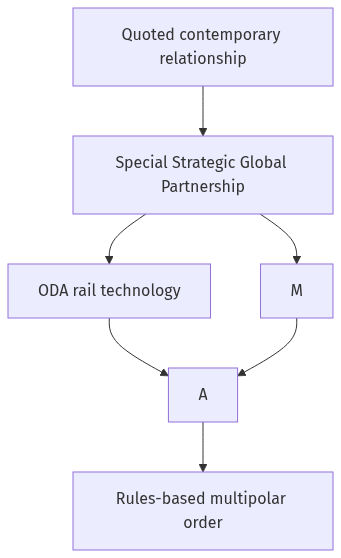
The quote matches the later Special Strategic and Global Partnership. Japan’s capital and technology meet India’s infrastructure and market scale. Maritime security and the Quad give the pair Asian and global weight. Quality infrastructure is an alternative connectivity offer for Africa and ASEAN. Delivery of rail and defence files is the test that joint statements still owe.
Model answer
Copper italics in this answer — like this — are the key facts. Each one is unpacked in the Facts & figures rail.
Introduction
The quoted line set the tone for a relationship that moved from aid and nostalgia to a Special Strategic and Global Partnership. India and Japan are two Asian democracies with complementary economies, a shared interest in a free Indo-Pacific, and no serious bilateral territorial dispute. A comment that is fair must show both the strategic logic and the slow delivery of projects.
Body
Why a strong contemporary relationship
- Japan’s official development assistance, technology, and quality infrastructure meet India’s need for capital in railways, metros, industrial corridors, and the Mumbai–Ahmedabad high-speed rail project.
- India offers Japan a large market, a young workforce, and a strategic partner that is not a US ally in treaty form but is willing to balance in Asia.
- Defence and security talks, including 2+2 dialogue, maritime exercises, and later logistics support, turn the relationship from commerce into strategy.
- People-to-people ties, Japanese language, and skill internships support a contemporary bond that older Colombo Plan images cannot carry.
Significance for Asia and world
- A stable India–Japan pair supports a multipolar Asia against any single-power maritime dominance in the Indian Ocean and the East China Sea, which is why both join the Quad with Australia and the United States.
- Quality infrastructure and the Asia–Africa Growth Corridor idea offer an alternative style of connectivity to debt-heavy models, which matters for ASEAN, Africa, and the Pacific islands.
- Cooperation on UN Security Council reform, climate technology, and resilient supply chains (including later semiconductor and critical-minerals talk) is a global public good, not only a bilateral file.
- Nuclear-energy cooperation after India’s civil nuclear understandings with Japan, and alignment on a rules-based trade order, widen the partnership beyond Asia’s shoreline.
Limits a comment must record
- Project delays, India’s procurement pace, and Japan’s caution on defence exports still cap the headline.
- Neither country will fight the other’s wars; the partnership is diplomatic, economic, and maritime, not a NATO-type alliance.
- China is the unspoken third party; the relationship is strongest when it is for something (connectivity, law of the sea) and not only against someone.
Short way forward
- Finish flagship rail and corridor projects on time, deepen maritime domain awareness, and keep Quad and ASEAN-centred forums in step so the 2006–14 vision becomes daily strategy.
Flow diagram
Conclusion
- The statement is sound: India and Japan need a contemporary strategic and global partnership, not a narrow aid tie. For Asia and the world that partnership supports a free Indo-Pacific, quality infrastructure, and democratic balancing — if projects and defence talk catch up with the joint statements.
Quick related
Students also ask
-
On what grounds a people's representative can be disqualified under the Representation of People Act, 1951? Also mention the remedies available to such person against his disqualification.(15).
Next question on this syllabus topic (2019 · Q11). View answer →
-
Is the India–Japan partnership a military alliance?
No. It is a strategic partnership with exercises, dialogue and logistics-type cooperation. It does not create an automatic war obligation.
-
Why does this bilateral matter beyond Asia?
Supply chains, UN reform, climate technology and Indo-Pacific sea lanes are global goods. Two large democracies coordinating on them affects more than their neighbourhood.
Same topic · past papers
UPSC has asked this before
These previous-year questions sit on the same topic. Open one to practise the earlier ask.
-
2024 · Q13 · GS II · 15 marks
What changes has the Union Government recently introduced in the domain of Centre-State relations? Suggest measures to be adopted to build the trust between the Centre and the States and for strengthening federalism. -
2023 · Q19 · GS II · 15 marks
'The expansion and strengthening of NATO and a stronger US-Europe strategic partnership works well in India.' What is your opinion about this statement? Give reasons and examples to support your answer.
More from this topic
Q15 · UPSC Mains 2026 · GS II · 15 marks · Solution
To what extent do pressure groups, social movements and corporate lobbies deepen pluralistic democracy in India by representing excluded interests? Analyse whether the growing convergence of corporate wealth and political power poses a threat to the autonomy of formal democratic institutions.
Governance and Policy
• Pluralism needs many competing groups so that no single interest dominates policy • Trade unions, farmer bodies and movements such as Chipko and Narmada Bachao Andolan have brought excluded voices into public debate • Movements delivered RTI, Forest Rights and Lokpal laws that give citizens lasting tools • Weak resources and FCRA and protest restrictions limit civil society reach • Corporate influence runs through party funding, lobbying, regulators and media ownership • The electoral bonds scheme was struck down in 2024 for violating citizens' right to information • Institutions such as the Supreme Court, CAG and the Election Commission still check capture, but risks remain • Reforms include funding transparency, a lobbying law, cooling-off periods and protection of dissent
Q12 · UPSC Mains 2026 · GS II · 15 marks · Solution
What is meant by judicial legislation? In this context, discuss the verdicts of the apex court allowing "passive euthanasia" and a "living will".
Governance and Policy
• Judicial legislation is court-made law that fills a legislative vacuum, using Articles 32, 141 and 142 • Vishaka, Prakash Singh and NALSA are common examples, and each invited later legislation • Gian Kaur (1996) denied a right to die but spoke of dying with dignity when death is imminent • Aruna Shanbaug (2011) permitted passive euthanasia with High Court supervision • Common Cause (2018) held the right to die with dignity to be part of Article 21 and recognised living wills • The 2023 modification simplified attestation, board composition and timelines • The tension is between dignity under Article 21 and the legislature's domain on a sensitive moral issue • A national statute on terminal illness would replace interim court guidelines
Q6 · UPSC Mains 2026 · GS II · 10 marks · Solution
Does India's tribal development policy reflect the aspirations for a socially grounded and equity-based governance? Justify your answer.
Governance and Policy
• Constitution: Fifth and Sixth Schedules create tribal self-rule, with Tribes Advisory Councils and autonomous district councils. • Law: PESA 1996 makes the Gram Sabha central and FRA 2006 recognises individual and community forest rights. • Welfare: DAPST, Article 275(1) grants, Eklavya schools, PM JANMAN and the sickle cell mission target the gap. • Weakness: mining, dams and forest clearance rules often override Gram Sabha consent. • Weakness: delayed PESA rules, FRA claim rejections and diverted funds blunt equity. • Security: LWE districts show the cost of land alienation and weak service delivery. • Verdict: strong legal design, uneven delivery, so equity is partial and conditional. • Way ahead: enforce consent, social audit, benefit-sharing through District Mineral Foundations.