
Revision summary
Targeted welfare classifies people; that is formal discrimination. Articles 14, 15(3)–(6), 16(4) and 46 authorise special measures for the disadvantaged. Indra Sawhney treated reservation as compatible with equality within limits. Exclusion and inclusion errors are implementation problems, not a reason to abandon targeting. The statement is acceptable as a description of method, not as a finding of unconstitutional bias.
Model answer
Copper italics in this answer — like this — are the key facts. Each one is unpacked in the Facts & figures rail.
Introduction
A scheme that names Scheduled Castes, women, persons with disability, or the income-poor treats unequals differently. That is discrimination in the dictionary sense, and it is the Constitution’s method of equality, not a breach of Article 14, when the classification is reasonable and aimed at disadvantage.
Body
The claim and the constitutional reply
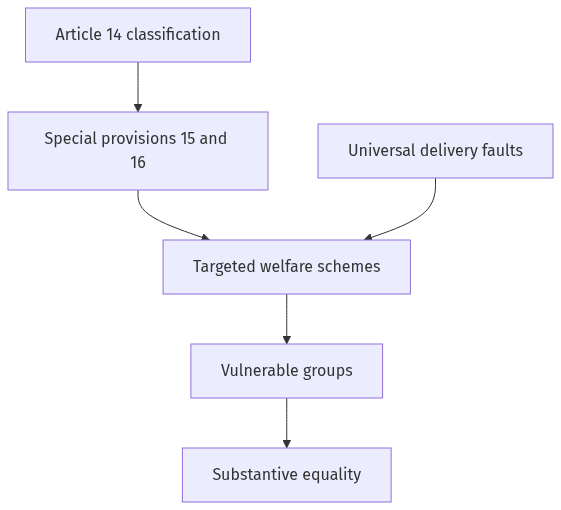
- Article 14 permits reasonable classification: intelligible differentia plus a rational nexus with the object of the law; it does not require identical treatment of unequals.
- Article 15(1) bars discrimination on listed grounds, while Article 15(3), 15(4), 15(5) and 15(6) allow special provisions for women, children, socially and educationally backward classes, Scheduled Castes and Scheduled Tribes, and economically weaker sections.
- Article 16(4) and 16(4A) allow reservation in public employment; Article 46 directs special care for SCs, STs and the weaker sections.
- Indra Sawhney v. Union of India (1992) accepted backward-class reservation as compatible with equality, with limits such as the exclusion of the creamy layer for OBCs.
- Substantive equality, as later benches have put it in gender and disability cases, is the name for this approach: the State may discriminate in favour of the vulnerable so that equality of outcome is not a fiction.
Why targeted schemes look “discriminatory” and why that is intended
- Universal schemes can miss those without documents, land, or a male household head; targeting is a response to that failure, not a taste for exclusion.
- The National Food Security Act, 2013, the Mahatma Gandhi National Rural Employment Guarantee Act, 2005, scholarships, hostels, and disability pensions name beneficiaries because scarcity and history are not evenly spread.
- Exclusion errors (leaving out the poor) and inclusion errors (covering the better-off) are design faults; they do not prove that targeting itself is unconstitutional.
- A purely universal cash transfer can still be financed by progressive taxation; the stem is about schemes for the vulnerable, which are targeted by definition.
Limits and the disagreement that remains
- Targeting can stigmatise, fragment citizenship, and create patronage lists if identification is political.
- Creamy-layer logic, Aadhaar-based lists, and social audits are tools to keep the classification tied to disadvantage.
- One should therefore agree with the statement only in this precise sense: such schemes are discriminatory in form because they classify. One should not agree if “discriminatory” means arbitrary or anti-equality.
Reasoned position
- I agree that welfare for the vulnerable is a classified, hence formally discriminatory, approach.
- I do not agree that this violates constitutional equality; it is how Articles 15(3)–(6), 16(4) and 46 operationalise equality for a society that is already unequal.
Flow diagram
Conclusion
Development and welfare schemes for the vulnerable do discriminate in the sense that they classify beneficiaries. That classification is constitutionally required special treatment, not forbidden caste or sex bias, so the statement is true as technique and false as a charge against equality.
Quick related
Students also ask
-
'The expansion and strengthening of NATO and a stronger US-Europe strategic partnership works well in India.' What is your opinion about this statement? Give reasons and examples to support your answer.
Next question on this syllabus topic (2023 · Q19). View answer →
-
Is any classification under a welfare scheme valid?
No. It must be reasonable under Article 14 and must fit the special-provision clauses. A communal or arbitrary list would fail.
-
Does targeting always work better than universal schemes?
Not always. Universal PDS in some States cut exclusion errors. The constitutional point is permission to target, not a ban on universal design.
Same topic · past papers
UPSC has asked this before
These previous-year questions sit on the same topic. Open one to practise the earlier ask.
-
2019 · Q5 · GS II · 10 marks
What can France learn from the Indian Constitution's approach to secularism?
More from this topic
Q20 · UPSC Mains 2026 · GS II · 15 marks · Solution
"China's Belt and Road Initiative (BRI) has transformed South Asia from a regional space into a theatre of great power competition." Analyse the strategic implications of the BRI for India's security and regional influence in South Asia.
India and its Neighbourhood
China's Belt and Road Initiative has turned South Asia into a zone of great-power rivalry, not just a regional neighbourhood. Ports like Gwadar and Hambantota raise fears of maritime encirclement and pressure on Indian Ocean trade routes. CPEC through Pakistan-Occupied Kashmir directly challenges India's sovereignty and adds a two-front security worry. Debt-heavy Chinese projects in Sri Lanka and Maldives have pushed smaller neighbours to hedge between Beijing and New Delhi. India must respond with trusted connectivity—Chabahar, BIMSTEC, Neighbourhood First aid, and Indo-Pacific partnerships—so development does not come with strategic dependence on China.
Q19 · UPSC Mains 2025 · GS II · 15 marks · Solution
"Energy security constitutes the dominant kingpin of India's foreign policy, and is linked with India's overarching influence in Middle Eastern countries." How would you integrate energy security with India's foreign policy trajectories in the coming years?
India and its Neighbourhood
Imported crude and LNG make energy the hard core of India’s Middle East policy, alongside diaspora and ports. UAE CEPA, I2U2, IMEC and Chabahar are the diplomatic frame around tankers. Risks: Hormuz, Red Sea, Iran sanctions, OPEC+ and over-reliance on any one discount supplier. Future integration: diversified barrels and routes, Gulf green-hydrogen partnerships, naval sea-lane policy, multi-alignment among regional rivals. The kingpin should shrink as the energy mix greener; it cannot be wished away this decade.
Q9 · UPSC Mains 2025 · GS II · 10 marks · Solution
India-Africa digital partnership is achieving mutual respect, co-development and long-term institutional partnerships. Elaborate.
India and its Neighbourhood
The partnership runs on Pan-African e-Network heritage, ITEC training, IAFS, and newer DPI (payments, identity, document rails). Co-development means African adaptation and AU working groups, not a vendor dump. Respect means data under African law, unlike a back-doored hardware grid. Limits: power and connectivity, summit-without-follow-through, and China’s larger cable footprint. Score the relationship by live hospital and payment links.