
Revision summary
The IMO is the UN specialised agency that drafts maritime conventions; States enforce them. MARPOL is the main anti-pollution treaty, including air emissions under Annex VI. Ballast water, anti-fouling, ship recycling and the Polar Code extend environmental protection. SOLAS and STCW are the core safety instruments. ISPS (under SOLAS) and the SUA Convention address terrorism and unlawful acts at sea. India’s role is membership plus Port State Control and merchant-shipping implementation.
Model answer
Copper italics in this answer — like this — are the key facts. Each one is unpacked in the Facts & figures rail.
Introduction
The sea carries trade, food, climate, and armed risk; it is a global commons, not a national pond. The International Maritime Organization, a United Nations specialised agency in London, writes the technical rules that make that commons cleaner, safer, and harder to use for terror or unsafe ships.
Body
IMO as the global maritime regulator
- The IMO sets conventions that flag States, port States, and coastal States then enforce; it does not police the ocean with its own navy.
- India is a member and a large flag, port, and coastal State, so IMO rules enter Indian law through merchant-shipping statutes and directorate circulars.
Protecting the marine environment
- The International Convention for the Prevention of Pollution from Ships, 1973, as modified by the Protocol of 1978 (MARPOL), is the core instrument on oil, chemicals, packaged goods, sewage, garbage, and air emissions from ships.
- MARPOL Annex VI addresses sulphur oxides and, with later IMO work, greenhouse-gas intensity of shipping, including the 2020 sulphur cap and carbon-intensity measures.
- The International Convention on the Control of Harmful Anti-fouling Systems, the Ballast Water Management Convention, and the Hong Kong International Convention for the Safe and Environmentally Sound Recycling of Ships extend the environmental mandate from the voyage to the scrap yard.
- The Polar Code adds environment and safety rules for Arctic and Antarctic waters, which climate change has opened to more traffic.
- These instruments treat the sea as a shared ecological system: a discharge in one exclusive economic zone becomes another coast’s tar ball.
Maritime safety
- The International Convention for the Safety of Life at Sea (SOLAS) is the basic safety treaty: construction, fire, life-saving appliances, radio, and the International Safety Management Code.
- The International Convention on Standards of Training, Certification and Watchkeeping for Seafarers (STCW) sets the human standard; most accidents are still crew and watch failures.
- The Load Lines Convention and search-and-rescue cooperation under the SAR Convention complete the safety net for cargo and persons in distress.
- Port State Control memoranda (Tokyo, Indian Ocean, and others) are how IMO standards are inspected on foreign ships in member ports.
Maritime security
- After 11 September 2001 the IMO adopted the International Ship and Port Facility Security Code (ISPS Code) as a SOLAS amendment, to harden ships and ports against terrorism.
- The Convention for the Suppression of Unlawful Acts against the Safety of Maritime Navigation (SUA), and its protocols, criminalise hijacking and certain violent acts at sea.
- IMO guidance on piracy (including off Somalia and in the Gulf of Guinea), on cyber risk, and on stowaways sits beside UN Security Council and naval-coalition action; the IMO’s part is standards and information, not warships.
- Safety and security meet in the same ship: a poorly maintained tanker is both an environmental bomb and a weak security target.
Recommendations
- Support IMO greenhouse-gas measures that do not simply displace old ships onto developing-country flags without finance for transition.
- Implement the Hong Kong recycling convention in Indian yards with real labour and toxin standards, not only accession on paper.
- Use Port State Control in Indian harbours as the daily enforcement arm of SOLAS, MARPOL and ISPS.
Flow diagram
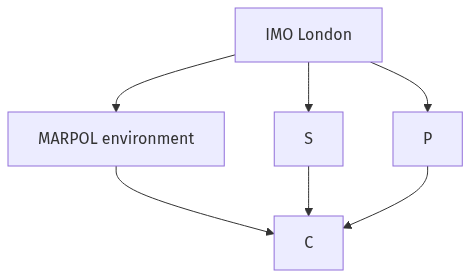
Conclusion
The IMO protects the marine environment through MARPOL and related conventions, and it enhances safety and security through SOLAS, STCW and the ISPS and SUA instruments. Because the sea is a shared component of the physical world, those global rules matter only when flag, port and coastal States, including India, actually enforce them.
Quick related
Students also ask
-
Clean energy is the order of the day.' Describe briefly India's changing policy towards climate change in various international fora in the context of geopolitics.
Next question on this syllabus topic (2022 · Q20). View answer →
-
Does the IMO have warships?
No. It sets conventions and guidance. Navies, coast guards and port States enforce safety, security and pollution rules.
-
Is climate change inside the IMO’s brief?
Yes, for emissions from international shipping, mainly through MARPOL Annex VI and later GHG strategy measures, not through a general climate treaty of its own.
Same topic · past papers
UPSC has asked this before
These previous-year questions sit on the same topic. Open one to practise the earlier ask.
More from this topic
Q20 · UPSC Mains 2026 · GS II · 15 marks · Solution
"China's Belt and Road Initiative (BRI) has transformed South Asia from a regional space into a theatre of great power competition." Analyse the strategic implications of the BRI for India's security and regional influence in South Asia.
India and its Neighbourhood
China's Belt and Road Initiative has turned South Asia into a zone of great-power rivalry, not just a regional neighbourhood. Ports like Gwadar and Hambantota raise fears of maritime encirclement and pressure on Indian Ocean trade routes. CPEC through Pakistan-Occupied Kashmir directly challenges India's sovereignty and adds a two-front security worry. Debt-heavy Chinese projects in Sri Lanka and Maldives have pushed smaller neighbours to hedge between Beijing and New Delhi. India must respond with trusted connectivity—Chabahar, BIMSTEC, Neighbourhood First aid, and Indo-Pacific partnerships—so development does not come with strategic dependence on China.
Q19 · UPSC Mains 2025 · GS II · 15 marks · Solution
"Energy security constitutes the dominant kingpin of India's foreign policy, and is linked with India's overarching influence in Middle Eastern countries." How would you integrate energy security with India's foreign policy trajectories in the coming years?
India and its Neighbourhood
Imported crude and LNG make energy the hard core of India’s Middle East policy, alongside diaspora and ports. UAE CEPA, I2U2, IMEC and Chabahar are the diplomatic frame around tankers. Risks: Hormuz, Red Sea, Iran sanctions, OPEC+ and over-reliance on any one discount supplier. Future integration: diversified barrels and routes, Gulf green-hydrogen partnerships, naval sea-lane policy, multi-alignment among regional rivals. The kingpin should shrink as the energy mix greener; it cannot be wished away this decade.
Q9 · UPSC Mains 2025 · GS II · 10 marks · Solution
India-Africa digital partnership is achieving mutual respect, co-development and long-term institutional partnerships. Elaborate.
India and its Neighbourhood
The partnership runs on Pan-African e-Network heritage, ITEC training, IAFS, and newer DPI (payments, identity, document rails). Co-development means African adaptation and AU working groups, not a vendor dump. Respect means data under African law, unlike a back-doored hardware grid. Limits: power and connectivity, summit-without-follow-through, and China’s larger cable footprint. Score the relationship by live hospital and payment links.