
Revision summary
Artisan tribes of Jharkhand include Asur and Agaria iron-smelters, Lohra smiths, Mahali bamboo workers, Chik Baraik weavers and Birhor rope-makers. They occupied a specialised niche in a tribe–caste village system described by Roy, Bailey and Vidyarthi. Jajmani-like exchange tied craft to cultivators. Colonial forest law and industrial iron collapsed furnaces and foraging. Several groups are now PVTGs; craft revival is thin beside wage labour and mining.
Model answer
Copper italics in this answer — like this — are the key facts. Each one is unpacked in the Facts & figures rail.
Introduction
Artisan tribes of Jharkhand are Scheduled Tribe and allied groups whose livelihood is specialised craft — iron, baskets, rope, weaving, or ritual objects — inside a multi-ethnic village system. They are not a single tribe and not simply “backward Hindus”.
Body
Who they are
Jharkhand’s plateau is a tribe–caste continuum (F. G. Bailey, N. K. Bose, Sachchidananda). Alongside Munda, Santal, Ho and Oraon cultivators sit artisan communities: Asur and Agaria (iron smelting), Lohra/Lohar (blacksmiths), Mahali (bamboo basketry), Chik Baraik (weaving), Karmali (ironwork among some Ho-Munda belts), Birhor (rope and hunting), and Turi or similar bamboo workers in some listings. Several are on the PVTG list (Asur, Birhor) because smelting and foraging collapsed.
S. C. Roy described Munda khuntkatti villages that needed the smith and the basket-maker. L. P. Vidyarthi’s sacred complex and nature–man–spirit frame placed craft next to forest and field, not outside culture.
Economy and rank
- Artisan tribes often held a jajmani-like relation with cultivators: grain and liquor for ploughshares, arrows, winnowing fans and marriage baskets. Rank was ambiguous. Hindu neighbours might treat them as low occupational castes; tribal kinship still classed them as adivasi. G. S. Ghurye would have absorbed them into Hindu society; Verrier Elwin would have stressed isolation and craft skill.
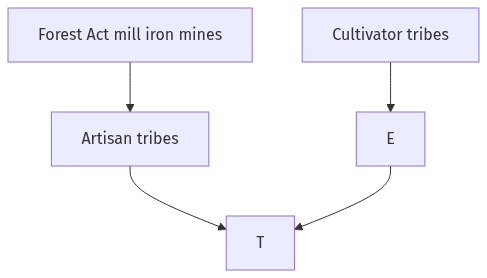
Colonial forest law (1878, 1927) and cheap mill iron killed Agaria and Asur furnaces. Mines and steel plants at Jamshedpur and Bokaro pulled labour but rarely preserved craft. Today many artisan households are wage-poor, with GI or TRIFED marketing as a thin overlay.
Why the category matters
Calling them artisan tribes records occupational specialisation inside tribal society, against the stereotype that tribes only hunt or slash-and-burn. It also explains why PVTG and OBC lists sometimes compete for the same groups.
Flow diagram
Conclusion
Jharkhand’s artisan tribes specialised in iron, bamboo, rope and cloth within a mixed tribal village. Forest reservation, mill iron and mining broke the old exchange. Policy that treats them only as labour or only as heritage craft misses that double history.
Quick related
Students also ask
-
Causes of stunting and wasting among tribal children.
Next question on this syllabus topic (2024 · Q1(e)). View answer →
-
Are artisan tribes Scheduled Castes?
Some occupational groups are listed as SC or OBC in neighbouring states. In Jharkhand several remain ST or PVTG; lists are political as well as ethnographic.
-
Did they only make tourist crafts?
No. Iron tools, arrows, baskets and rope were production goods for agriculture and forest life, not souvenirs.
More from this topic
Q6(a) · UPSC Mains 2026 · Anthropology GS 2 · 20 marks · Solution
Make a critical appraisal of the mesolithic culture of Ganga basin with reference to artifacts, faunal and human skeletal remains excavated from different sites
Evolution of the Indian Culture and Civilization
• Ganga basin Mesolithic sites like Sarai Nahar Rai, Mahadaha, and Damd
Q5(e) · UPSC Mains 2026 · Anthropology GS 2 · 10 marks · Solution
Contribution of L. K. Ananthakrishna Iyer in Anthropology.
Evolution of the Indian Culture and Civilization
L. K. Ananthakrishna Iyer is a pioneering figure in Indian anthropology, known for his monumental ethnographic surveys like The Cochin Tribes and Castes and The Mysore Tribes and Castes. Working during the colonial era, he bridged western anthropological methods with indigenous scholarship. His documentation of social stratification, material culture, and folklore laid the empirical foundation for Indian sociology and anthropology. Iyer also established the first department of anthropology in India at the University of Calcutta, shaping institutional teaching and research.
Q5(c) · UPSC Mains 2026 · Anthropology GS 2 · 10 marks · Solution
Article 371A of the Indian Constitution.
Evolution of the Indian Culture and Civilization
Article 371A of the Indian Constitution grants special autonomous status to Nagaland, protecting its traditional socio-religious practices, customary laws, and land ownership rights. Enacted via the 13th Constitutional Amendment Act, 1962, following the 16-point Agreement, it reflects the asymmetrical federal framework of India. The article places a special responsibility on the Governor regarding law and order and regional financial allocations. It balances tribal autonomy with national integration, though it faces implementation challenges in modern governance.