
Revision summary
Syro-Malabar Christians are Kerala’s East Syriac Catholic community, in communion with Rome. Origin memory is the Thomas tradition; the rite was Latinised after Diamper and later restored. They are socially distinct from Malankara, Orthodox, Latin and Protestant Christians. Endogamy, land and literacy produced a caste-like rank inside Kerala Christianity. They are an Indian social system using a West-Asian liturgical language, not a foreign enclave.
Model answer
Copper italics in this answer — like this — are the key facts. Each one is unpacked in the Facts & figures rail.
Introduction
Syro-Malabar Christians are an Eastern Catholic community of Kerala whose liturgy follows the East Syriac tradition while they remain in communion with Rome. They are an Indian social group with a long local history, not a recent missionary colony.
Body
Origin and rite
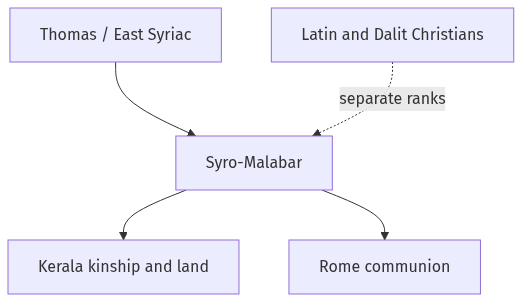
Community memory traces the church to Thomas the Apostle on the Malabar coast in the first century. Historians treat that as a founding legend whose kernel is early West-Asian Christian contact with Tamil-Malayalam ports. The rite used East Syriac, linked to the Church of the East, until Portuguese Latinisation after the Synod of Diamper (1599) and later restoration of the Syro-Malabar hierarchy (modern eparchies from the late nineteenth century, a major archiepiscopal church in 1992).
They are distinct from Syro-Malankara (West Syriac, also Catholic), Jacobite and Orthodox Syrian Christians, Latin Catholics, and Protestant groups. Anthropology must keep these churches separate; “Kerala Christian” is not one caste.
Social structure
Syrian Christians (Nasrani) historically ranked near upper-caste Hindus in land, oil-pressing and trade. Louis Dumont and Kerala ethnography noted a caste-like order inside Christianity: Syrian groups, Latin fisher Catholics, and Dalit converts did not intermarry freely. K. C. Alexander and later sociologists described endogamy, tharavad-like property, and high literacy.
Language is Malayalam in daily life; Syriac remains liturgical. Migration to the Gulf and to Indian cities has produced a translocal parish without dissolving endogamy. Political influence in central Kerala is real, but it is the influence of a landed, educated minority, not of a ghetto.
Anthropological point
Indian Christianity is indigenised. Syro-Malabar practice sits inside Kerala kinship, church associations and party competition. G. S. Ghurye’s civilisation frame and M. N. Srinivas’s Sanskritisation are incomplete here: status was maintained through church, land and English education as much as through Hindu ritual copying.
Flow diagram
Conclusion
Syro-Malabar Christians are an East Syriac Catholic community of Kerala with an apostolic origin story, a restored indigenous rite, and a caste-like internal ranking. They illustrate how a world religion becomes an Indian jati-like group without ceasing to be a church.
Quick related
Students also ask
-
Artisan tribes of Jharkhand
Next question on this syllabus topic (2024 · Q1(d)). View answer →
-
Are all Kerala Christians Syro-Malabar?
No. Kerala has Syro-Malabar, Syro-Malankara, Orthodox, Jacobite, Latin Catholic and Protestant communities with different rites and ranks.
-
Do they follow Hindu caste?
They are not a Hindu varna, but marriage, ranking and historic distance from Dalit Christians have been caste-like.
More from this topic
Q6(a) · UPSC Mains 2026 · Anthropology GS 2 · 20 marks · Solution
Make a critical appraisal of the mesolithic culture of Ganga basin with reference to artifacts, faunal and human skeletal remains excavated from different sites
Evolution of the Indian Culture and Civilization
• Ganga basin Mesolithic sites like Sarai Nahar Rai, Mahadaha, and Damd
Q5(e) · UPSC Mains 2026 · Anthropology GS 2 · 10 marks · Solution
Contribution of L. K. Ananthakrishna Iyer in Anthropology.
Evolution of the Indian Culture and Civilization
L. K. Ananthakrishna Iyer is a pioneering figure in Indian anthropology, known for his monumental ethnographic surveys like The Cochin Tribes and Castes and The Mysore Tribes and Castes. Working during the colonial era, he bridged western anthropological methods with indigenous scholarship. His documentation of social stratification, material culture, and folklore laid the empirical foundation for Indian sociology and anthropology. Iyer also established the first department of anthropology in India at the University of Calcutta, shaping institutional teaching and research.
Q5(c) · UPSC Mains 2026 · Anthropology GS 2 · 10 marks · Solution
Article 371A of the Indian Constitution.
Evolution of the Indian Culture and Civilization
Article 371A of the Indian Constitution grants special autonomous status to Nagaland, protecting its traditional socio-religious practices, customary laws, and land ownership rights. Enacted via the 13th Constitutional Amendment Act, 1962, following the 16-point Agreement, it reflects the asymmetrical federal framework of India. The article places a special responsibility on the Governor regarding law and order and regional financial allocations. It balances tribal autonomy with national integration, though it faces implementation challenges in modern governance.