
Revision summary
Stunting is chronic low height-for-age; wasting is acute low weight-for-height. Tribal children face both through thinner forest diets, infection, maternal undernutrition and distant services. Causes are biocultural: land and Forest Acts, water, gender, migration and some genetic disease burdens. POSHAN, ICDS and PM-JANMAN exist; Xaxa noted last-mile failure. Do not blame culture as such; blame the breaking of an older food and care system.
Model answer
Copper italics in this answer — like this — are the key facts. Each one is unpacked in the Facts & figures rail.
Introduction
Stunting is low height-for-age from chronic undernutrition and repeated infection. Wasting is low weight-for-height from acute food or disease shock. Among tribal children both remain higher than the Indian average because biology and the political economy of the forest village work together.
Body
Immediate causes
WHO and NFHS treat the immediate causes as inadequate diet, infection (diarrhoea, malaria, tuberculosis, measles) and poor maternal nutrition. Tribal diets that once used millets, forest greens, small game and mahua have thinned where Forest Acts, mining and PDS rice replaced diverse food. Exclusive breastfeeding may be short where mothers return to wage or forest work. Low birth weight starts the path to stunting.
Underlying biocultural causes
L. P. Vidyarthi’s nature–man–spirit complex is a food system: when jal, jungle, jameen shrink, child growth shrinks. Verrier Elwin already noted hunger in central Indian hills. Distance to anganwadi and PHC, language barriers, and distrust after coercive family-planning memories reduce uptake. Open defecation and unsafe water in hamlets raise enteric infection, which prevents nutrient absorption even when calories exist.
- Gender and birth order matter: girls and later children may eat last. Alcohol and distress migration leave children with grandparents. Sickle-cell and other haemoglobinopathies, more frequent in some ST groups, interact with malaria and anaemia. This is biocultural, not a racial defect.
Structural causes
Land alienation, PVTG isolation, and seasonal hunger before the harvest produce wasting spikes. NFHS-5 still showed very high stunting in parts of Jharkhand, Madhya Pradesh, Chhattisgarh and the central tribal belt. POSHAN Abhiyaan, ICDS, mid-day meals and PM-JANMAN for PVTGs address the gap; Xaxa Committee (2014) had already said delivery fails when the hamlet is off the road and the anganwadi worker is not local.
Do not reduce the problem to “tribal custom”. Custom includes complementary feeding knowledge that markets and displacement have broken.
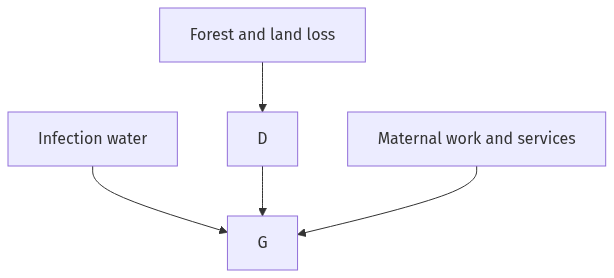
Flow diagram
Conclusion
Stunting records long deprivation; wasting records acute shock. Tribal children suffer both because forest food, infection, maternal work and thin public services coincide. Growth charts are a political document as well as a medical one.
Quick related
Students also ask
-
How is PESA Act empowering local self-governance and impacting women's political participation?
Next question on this syllabus topic (2024 · Q2(b)). View answer →
-
Is PDS rice enough to stop stunting?
Calories from rice do not replace protein, micronutrients, sanitation and care. Diversity of forest and millet diets mattered.
-
Are PVTG children a special case?
Yes in degree: smaller, more isolated populations with collapsed foraging have the worst wasting risks and need hamlet-level services.
Same topic · past papers
UPSC has asked this before
These previous-year questions sit on the same topic. Open one to practise the earlier ask.
-
2021 · Q8(c) · Anthropology GS 2 · 15 marks
Identify the causes of tribal unrest with special reference to North-East India
More from this topic
Q6(a) · UPSC Mains 2026 · Anthropology GS 2 · 20 marks · Solution
Make a critical appraisal of the mesolithic culture of Ganga basin with reference to artifacts, faunal and human skeletal remains excavated from different sites
Evolution of the Indian Culture and Civilization
• Ganga basin Mesolithic sites like Sarai Nahar Rai, Mahadaha, and Damd
Q5(e) · UPSC Mains 2026 · Anthropology GS 2 · 10 marks · Solution
Contribution of L. K. Ananthakrishna Iyer in Anthropology.
Evolution of the Indian Culture and Civilization
L. K. Ananthakrishna Iyer is a pioneering figure in Indian anthropology, known for his monumental ethnographic surveys like The Cochin Tribes and Castes and The Mysore Tribes and Castes. Working during the colonial era, he bridged western anthropological methods with indigenous scholarship. His documentation of social stratification, material culture, and folklore laid the empirical foundation for Indian sociology and anthropology. Iyer also established the first department of anthropology in India at the University of Calcutta, shaping institutional teaching and research.
Q5(c) · UPSC Mains 2026 · Anthropology GS 2 · 10 marks · Solution
Article 371A of the Indian Constitution.
Evolution of the Indian Culture and Civilization
Article 371A of the Indian Constitution grants special autonomous status to Nagaland, protecting its traditional socio-religious practices, customary laws, and land ownership rights. Enacted via the 13th Constitutional Amendment Act, 1962, following the 16-point Agreement, it reflects the asymmetrical federal framework of India. The article places a special responsibility on the Governor regarding law and order and regional financial allocations. It balances tribal autonomy with national integration, though it faces implementation challenges in modern governance.