
Revision summary
Rakhigarhi in Hisar is among the largest Harappan sites, with Early and Mature levels. Streets, drains, seals, weights, beads and burials match the Harappan urban package. It anchors the eastern Ghaggar province in the same civilisation as Harappa and Mohenjo-daro. aDNA from the cemetery is scientifically notable but too thin to write a people or a language. Do not treat the site as a separate civilisation or as a palace-state with a named king.
Model answer
Copper italics in this answer — like this — are the key facts. Each one is unpacked in the Facts & figures rail.
Introduction
Rakhigarhi (Rakhi Garhi) in Hisar district, Haryana, is among the largest Harappan cities on the now-seasonal Ghaggar–Hakra (often identified with Sarasvati in debate). Excavations by Amarendra Nath (ASI) and later Vasant Shinde (Deccan College) show a long sequence from Early to Mature Harappan. The site links the eastern Harappan province to the Indus system without making it a separate civilisation.
Body
Site and sequence
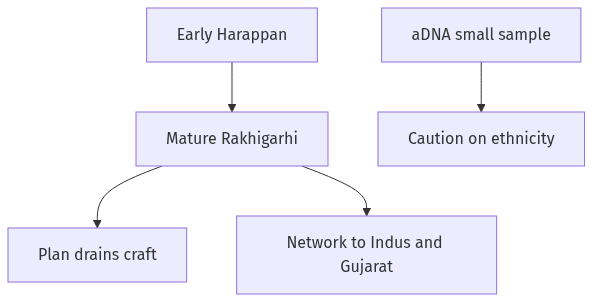
The mounds cover several hundred hectares (estimates vary with how outskirts are counted). Settlement begins in the Early Harappan (regional Hakra / Sothi–Siswal related levels) and thickens in the Mature Harappan (c. 2600–1900 BCE). Planning includes streets, burnt-brick drains, platforms and craft quarters, comparable to Harappa and Mohenjo-daro in urban grammar, though not in every monumental form. A possible reservoir and extensive mud-brick architecture sit in an alluvial setting, not on a perennial Indus main stem. That geography matters: the eastern Harappan belt used Ghaggar hydrology and overland routes to Gujarat and the Ganga–Yamuna doab edge.
Material linkages
Finds include typical Mature Harappan pottery, steatite seals and sealings, weights, faience and agate beads, copper objects, terracotta figurines, and evidence of craft specialisation (bead-making, possibly pyrotechnical crafts). Burials in a cemetery area show body orientation and grave goods in the Harappan range. These are the same civilisational package as at Kalibangan, Banawali, Farmana and, westward, Harappa: standardised measurement, script signs, and craft-trade.
Linkages are therefore stylistic, economic and urban, not a claim that Rakhigarhi ruled the Indus. It is a primate eastern city in a network that also included Dholavira, Lothal, Rakhigarhi, Mohenjo-daro and Harappa. Agricultural hinterland (barley, wheat, later evidence discussed for millets and animal husbandry) ties it to the Harappan agro-pastoral base.
Biological and critical evidence
Human remains from Rakhigarhi have been used in aDNA studies associated with Shinde and collaborators. Results have been publicly argued as showing Iranian-farmer-related ancestry without a Steppe component in a Mature Harappan individual, a finding used in debates on Indo-Aryan language spread. Anthropology must separate one cemetery’s genetics from a full population history. Sample size is small. Contamination and labelling debates exist. Genetic affinity is not a script, a language, or a caste origin story.
Skeletal biology also informs health, stature and stress — the ordinary bioarchaeology of an urban Harappan, comparable to Harappa cemetery analyses. Do not inflate Rakhigarhi into “the capital of all Harappans” or into a nationalist counter to Mehrgarh and the Indus west. Mehrgarh remains crucial for food production; Rakhigarhi remains crucial for the scale of the eastern Mature Harappan.
Critical description
Evidence of urbanism is strong; evidence of a palace-state is weak, as for Harappan sites generally. Flood, river shift and the Late Harappan transformation affect the Ghaggar belt as they affect Cholistan. Post-urban occupation should not be erased to keep a pure “Sarasvati” story. The correct linkage is: Rakhigarhi is Harappan in craft, plan, script-bearing objects and burial custom, and it shows that the civilisation’s centre of gravity included the Haryana–Ghaggar plains, not only Sindh and Punjab west.
Flow diagram
Conclusion
Rakhigarhi is a major Early-to-Mature Harappan city of the Ghaggar belt, linked to the wider civilisation by bricks, drains, seals, weights, craft and burials. Ancient DNA is a limited, important clue, not a complete ethnic history. The site expands the map of Harappan urbanism eastward; it does not replace Mohenjo-daro or invent a separate culture.
Quick related
Students also ask
-
B.K. Roy Burman's concept of 'Buffer Zone'
Next question on this syllabus topic (2024 · Q5(a)). View answer →
-
Is Rakhigarhi larger than Mohenjo-daro?
Some estimates of mound area place it among the largest; comparable ranking depends on how suburbs are measured. Size does not by itself prove political primacy.
-
Does Rakhigarhi DNA settle the Aryan debate?
No. A small Mature Harappan sample without Steppe ancestry is one data point in a long, multi-site history of movement and language.
Same topic · past papers
UPSC has asked this before
These previous-year questions sit on the same topic. Open one to practise the earlier ask.
-
2015 · Q6(c) · Anthropology GS 2 · 15 marks
Discuss the significance of Harappan Civilization sites from India -
2021 · Q1(c) · Anthropology GS 2 · 10 marks
Harappan seals
More from this topic
Q6(a) · UPSC Mains 2026 · Anthropology GS 2 · 20 marks · Solution
Make a critical appraisal of the mesolithic culture of Ganga basin with reference to artifacts, faunal and human skeletal remains excavated from different sites
Evolution of the Indian Culture and Civilization
• Ganga basin Mesolithic sites like Sarai Nahar Rai, Mahadaha, and Damd
Q5(e) · UPSC Mains 2026 · Anthropology GS 2 · 10 marks · Solution
Contribution of L. K. Ananthakrishna Iyer in Anthropology.
Evolution of the Indian Culture and Civilization
L. K. Ananthakrishna Iyer is a pioneering figure in Indian anthropology, known for his monumental ethnographic surveys like The Cochin Tribes and Castes and The Mysore Tribes and Castes. Working during the colonial era, he bridged western anthropological methods with indigenous scholarship. His documentation of social stratification, material culture, and folklore laid the empirical foundation for Indian sociology and anthropology. Iyer also established the first department of anthropology in India at the University of Calcutta, shaping institutional teaching and research.
Q5(c) · UPSC Mains 2026 · Anthropology GS 2 · 10 marks · Solution
Article 371A of the Indian Constitution.
Evolution of the Indian Culture and Civilization
Article 371A of the Indian Constitution grants special autonomous status to Nagaland, protecting its traditional socio-religious practices, customary laws, and land ownership rights. Enacted via the 13th Constitutional Amendment Act, 1962, following the 16-point Agreement, it reflects the asymmetrical federal framework of India. The article places a special responsibility on the Governor regarding law and order and regional financial allocations. It balances tribal autonomy with national integration, though it faces implementation challenges in modern governance.