
Revision summary
PESA 1996 extends panchayats to Fifth Schedule areas with Gram Sabha control over land consultation, MFP, markets and intoxicants. Bhuria supplied the idea; Xaxa recorded incomplete state rules. Women enter through 73rd Amendment reservation, including 50 percent in several states. Proxy mukhiyas and male customary councils limit the gain. Niyamgiri and Samata show how a real Sabha can affect mining; many Sabhas still do not sit.
Model answer
Copper italics in this answer — like this — are the key facts. Each one is unpacked in the Facts & figures rail.
Introduction
The Panchayats (Extension to Scheduled Areas) Act, 1996 extends Part IX of the Constitution to Fifth Schedule areas, with the Gram Sabha as the primary body. It is the statutory form of tribal self-rule recommended by the Bhuria Committee. Women’s political participation is both opened by reservation and constrained by custom and by weak implementation.
Body
What PESA empowers
PESA applies in Fifth Schedule areas of ten states (Andhra Pradesh, Telangana, Chhattisgarh, Gujarat, Himachal Pradesh, Jharkhand, Madhya Pradesh, Maharashtra, Odisha, Rajasthan). It is not the Sixth Schedule. The Gram Sabha is to approve plans, control minor water bodies, minor forest produce, village markets, money-lending, and intoxicants, and to be consulted on land acquisition and rehabilitation. Customary mode of dispute resolution is recognised so far as it is consistent with the Constitution and with women’s dignity — a clause that matters for this question.
Samata (1997) and later Niyamgiri (2013) used Scheduled Area and Gram Sabha logic against mining. Forest Rights Act, 2006 needs a Gram Sabha that PESA already tried to centre. Xaxa Committee (2014) found that several states had not fully aligned panchayat laws with PESA, and that departments still bypassed the Sabha.
Local self-governance in practice
Where a functioning Sabha exists, it can stop a liquor shop, set MFP rates, and question a mining hearing. L. P. Vidyarthi’s village as a cultural system and M. N. Srinivas’s dominant-caste panchayat are both altered: the statutory Sabha is territorial and adult-based, not only lineage-based. In practice, manjhi, munda, pahan or patel often capture the new office. Non-notification of villages, poorly translated rules, and parallel van samitis weaken the Act.
Women
The 73rd Amendment reserves not less than one-third of seats and chairpersons for women (many states now use 50 percent). PESA inherits that reservation in Scheduled Areas. This has produced mukhiya / sarpanch women among Oraon, Gond, Bhil and Santhal panchayats. Proxy rule by husbands (sarpanch-pati) is widely reported. Customary councils that exclude women sit beside the statutory Sabha.
PESA’s own text asks that custom be consistent with women’s dignity. That is a lever for claiming speaking rights in the Sabha on MFP (often women’s labour: tendu, sal seeds, mahua) and on land. Elwin had noted women’s forest work; Irawati Karve and later gender ethnography showed that public office does not automatically follow economic role.
- Impact is therefore uneven but real: reserved chairs increase presence; control of MFP and prohibition decisions can increase voice; mining and party machines still mute many women. Literacy, travel to the block, and safety at night meetings remain material conditions of participation.
Critical close
PESA is empowering where the Sabha is convened, informed, and backed by courts. It is a paper tiger where states delay rules, where men speak as custom, and where a woman chair signs files written at home. Anthropology should count both the new women office-holders and the silent Sabhas.
Flow diagram
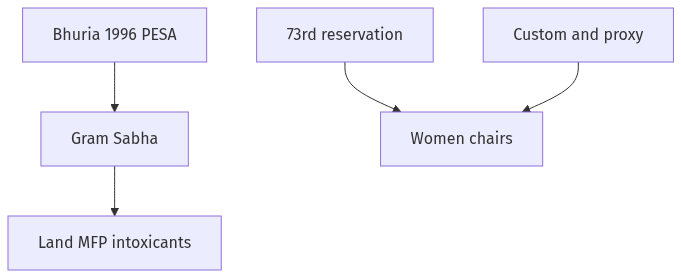
Conclusion
PESA places the Gram Sabha at the centre of Fifth Schedule local government and links land, forest produce and acquisition to that body. Reservation has brought women into chairs; custom, proxies and weak notification still limit voice. The Act is a necessary condition of tribal self-rule, not a completed one.
Quick related
Students also ask
-
Critically describe evidences from Rakhi Garhi and its linkages to Harappan civilization.
Next question on this syllabus topic (2024 · Q3(a)). View answer →
-
Does PESA apply in the North-East?
Not as a substitute for the Sixth Schedule. PESA is the Fifth Schedule instrument. Some North-Eastern areas use other special provisions.
-
Are women excluded by PESA custom clauses?
Custom is recognised only if consistent with the Constitution and women’s dignity. That clause is meant to block male-only custom from voiding reservation.
Same topic · past papers
UPSC has asked this before
These previous-year questions sit on the same topic. Open one to practise the earlier ask.
-
2021 · Q7(c) · Anthropology GS 2 · 15 marks
Discuss the interventions made by the Non-Governmental Organizations for empowering tribal women
More from this topic
Q6(a) · UPSC Mains 2026 · Anthropology GS 2 · 20 marks · Solution
Make a critical appraisal of the mesolithic culture of Ganga basin with reference to artifacts, faunal and human skeletal remains excavated from different sites
Evolution of the Indian Culture and Civilization
• Ganga basin Mesolithic sites like Sarai Nahar Rai, Mahadaha, and Damd
Q5(e) · UPSC Mains 2026 · Anthropology GS 2 · 10 marks · Solution
Contribution of L. K. Ananthakrishna Iyer in Anthropology.
Evolution of the Indian Culture and Civilization
L. K. Ananthakrishna Iyer is a pioneering figure in Indian anthropology, known for his monumental ethnographic surveys like The Cochin Tribes and Castes and The Mysore Tribes and Castes. Working during the colonial era, he bridged western anthropological methods with indigenous scholarship. His documentation of social stratification, material culture, and folklore laid the empirical foundation for Indian sociology and anthropology. Iyer also established the first department of anthropology in India at the University of Calcutta, shaping institutional teaching and research.
Q5(c) · UPSC Mains 2026 · Anthropology GS 2 · 10 marks · Solution
Article 371A of the Indian Constitution.
Evolution of the Indian Culture and Civilization
Article 371A of the Indian Constitution grants special autonomous status to Nagaland, protecting its traditional socio-religious practices, customary laws, and land ownership rights. Enacted via the 13th Constitutional Amendment Act, 1962, following the 16-point Agreement, it reflects the asymmetrical federal framework of India. The article places a special responsibility on the Governor regarding law and order and regional financial allocations. It balances tribal autonomy with national integration, though it faces implementation challenges in modern governance.