
Revision summary
Apatani of Ziro practise bunded wet-rice with fish, millet on bunds, and bamboo-pine agroforestry. Irrigation and water-sharing are community institutions. Haimendorf contrasted this intensification with neighbouring shifting cultivation. Ziro is often cited as agricultural heritage; roads and migration now press the labour system. It is skilled tribal farming, not a primitive leftover.
Model answer
Copper italics in this answer — like this — are the key facts. Each one is unpacked in the Facts & figures rail.
Introduction
The Apatani of the Ziro valley in Lower Subansiri, Arunachal Pradesh, practise a famous wet-rice agriculture on terraces without large draught animals. The system joins water, millet, fish, bamboo and pine in a tightly worked valley, which is why anthropologists treat it as a classic Himalayan intensive ecology.
Body
The agricultural system
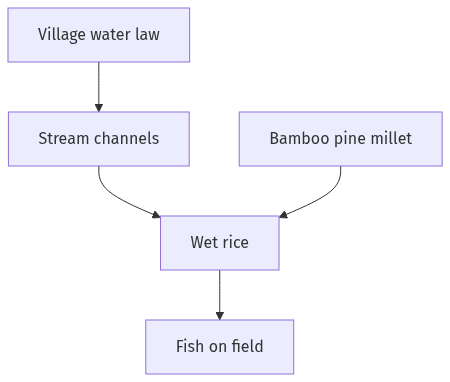
Apatani fields are bunded wet paddies fed by channels from streams. Households transplant rice and often raise fish in the same water. Finger millet and other dry crops occupy bunds and kitchen gardens. Bamboo groves and pine (Pinus wallichiana plantations in community woods) supply fuel, timber and leaf litter that returns to fields. Irrigation is a community duty: channels and weirs are repaired together, and water-sharing is a village political fact.
Haimendorf’s ethnography of the Apatani described this intensification next to neighbouring Nyishi and Hill Miri shifting cultivation. The contrast is the point: one plateau valley supports dense settlement through water control; surrounding hills used jhum. Ritual (myoko and other cycles), clan land, and bulyang or village authority historically regulated labour and conflict over water.
Significance and change
The FAO has discussed Ziro as Globally Important Agricultural Heritage. That praise can freeze a living system. Roads, wet-rice commercialisation, tourism, and youth out-migration alter labour. Wetland conversion and climate irregularity stress channels. The Apatani remain a Scheduled Tribe of Arunachal; Inner Line and land custom still restrict outsider purchase, which has protected the valley more than many plains tribal tracts.
Agriculture here is not primitive. It is skilled intensification, the opposite of the old PTG stereotype.
Flow diagram
Conclusion
Apatani agriculture is wet-rice with fish, millet, bamboo and pine, organised by village water law in Ziro. It shows tribal intensification, not backwardness. Tourism and labour change are the present tests of the system.
Quick related
Students also ask
-
Status of Sixth Schedule Areas
Next question on this syllabus topic (2024 · Q5(d)). View answer →
-
Do the Apatani only practise jhum?
No. Their reputation rests on permanent wet-rice terraces. Neighbours on steeper hills used more shifting cultivation.
-
Is Ziro isolated from markets?
Less than before. Roads, rice sale and tourism have entered; custom still structures land.
More from this topic
Q6(a) · UPSC Mains 2026 · Anthropology GS 2 · 20 marks · Solution
Make a critical appraisal of the mesolithic culture of Ganga basin with reference to artifacts, faunal and human skeletal remains excavated from different sites
Evolution of the Indian Culture and Civilization
• Ganga basin Mesolithic sites like Sarai Nahar Rai, Mahadaha, and Damd
Q5(e) · UPSC Mains 2026 · Anthropology GS 2 · 10 marks · Solution
Contribution of L. K. Ananthakrishna Iyer in Anthropology.
Evolution of the Indian Culture and Civilization
L. K. Ananthakrishna Iyer is a pioneering figure in Indian anthropology, known for his monumental ethnographic surveys like The Cochin Tribes and Castes and The Mysore Tribes and Castes. Working during the colonial era, he bridged western anthropological methods with indigenous scholarship. His documentation of social stratification, material culture, and folklore laid the empirical foundation for Indian sociology and anthropology. Iyer also established the first department of anthropology in India at the University of Calcutta, shaping institutional teaching and research.
Q5(c) · UPSC Mains 2026 · Anthropology GS 2 · 10 marks · Solution
Article 371A of the Indian Constitution.
Evolution of the Indian Culture and Civilization
Article 371A of the Indian Constitution grants special autonomous status to Nagaland, protecting its traditional socio-religious practices, customary laws, and land ownership rights. Enacted via the 13th Constitutional Amendment Act, 1962, following the 16-point Agreement, it reflects the asymmetrical federal framework of India. The article places a special responsibility on the Governor regarding law and order and regional financial allocations. It balances tribal autonomy with national integration, though it faces implementation challenges in modern governance.