
Revision summary
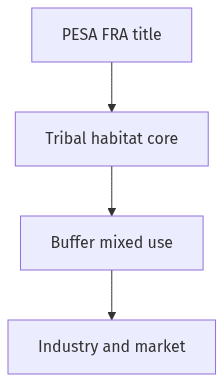
Roy Burman proposed a buffer between tribal habitat and full industrial or fortress-forest pressure. The core should keep customary land and livelihood; the margin should regulate contact. Wildlife core–buffer maps are a cousin, but must not evict the village from the core. Without FRA and PESA rights the buffer is only delay. The idea continues Elwin’s caution against sudden assimilation.
Model answer
Copper italics in this answer — like this — are the key facts. Each one is unpacked in the Facts & figures rail.
Introduction
B. K. Roy Burman used buffer zone for a belt of land and livelihood that should stand between a tribal habitat and the full force of mines, plantations, highways and reserved-forest fortress conservation. It is a development-anthropology idea, not only a wildlife map.
Body
The idea
Roy Burman, a leading applied anthropologist of tribal India, argued that isolated or PVTG-like communities need a protected ecological and social margin. Inside the core, customary land, shifting cultivation or foraging, and ritual geography should continue. Around it, a buffer of mixed use — regulated minor forest produce, limited roads, no heavy industry — would absorb contact. Outside, the ordinary market and state could operate.
The concept sits with Elwin’s protective philosophy and against a sudden Ghurye-style assimilation. It also sits with later national park language (core–buffer–transition), which Roy Burman did not want to become an excuse to evict people from the core. For him the tribal village is the core to be buffered, not a trespasser in a tiger reserve.
Use and criticism
Planners used buffer talk for North-Eastern and Andaman contact policy and for industrial belts in Jharkhand and Odisha. In practice, buffers were often drawn on paper after a lease was granted, or they became a police line. Xaxa and mining ethnography show that a buffer without PESA, FRA and Samata title is only a delay of alienation. Wildlife buffers can criminalise tendu and grazing. Roy Burman’s point remains: contact must be paced and spatially organised, or vulnerability becomes dispossession.
Flow diagram
Conclusion
- Roy Burman’s buffer zone is a spatial ethic of tribal development: a living core, a regulated margin, and a delayed industrial front. Without rights in the core, the buffer is only a map.
Quick related
Students also ask
-
Agricultural practices of the Apatani
Next question on this syllabus topic (2024 · Q5(c)). View answer →
-
Is a buffer zone a national park?
Not necessarily. Roy Burman meant a development buffer around a community. Parks later used similar rings, sometimes against the same community.
-
Does a buffer replace land rights?
No. Title and Gram Sabha consent are the legal core; the buffer is a spatial policy around them.
Same topic · past papers
UPSC has asked this before
These previous-year questions sit on the same topic. Open one to practise the earlier ask.
-
2021 · Q5(d) · Anthropology GS 2 · 10 marks
Concept of tribe and Indian census -
2025 · Q4(c) · Anthropology GS 2 · 15 marks
Critically examine the concept of Scheduled Tribe (ST) and mention the limitations of administrator's criteria -
2026 · Q2(a) · Anthropology GS 2 · 20 marks
What are the major debates related to the concept of jajmani system? -
2025 · Q7(c) · Anthropology GS 2 · 15 marks
Critically evaluate the concept of Nation-State and describe its impact on indigenous societies -
2023 · Q3(a) · Anthropology GS 2 · 20 marks
"Sanskritization is a culture-bound concept." Critically comment to assess the strength and limitation of this concept in developing a theoretical framework to study social change.
More from this topic
Q6(a) · UPSC Mains 2026 · Anthropology GS 2 · 20 marks · Solution
Make a critical appraisal of the mesolithic culture of Ganga basin with reference to artifacts, faunal and human skeletal remains excavated from different sites
Evolution of the Indian Culture and Civilization
• Ganga basin Mesolithic sites like Sarai Nahar Rai, Mahadaha, and Damd
Q5(e) · UPSC Mains 2026 · Anthropology GS 2 · 10 marks · Solution
Contribution of L. K. Ananthakrishna Iyer in Anthropology.
Evolution of the Indian Culture and Civilization
L. K. Ananthakrishna Iyer is a pioneering figure in Indian anthropology, known for his monumental ethnographic surveys like The Cochin Tribes and Castes and The Mysore Tribes and Castes. Working during the colonial era, he bridged western anthropological methods with indigenous scholarship. His documentation of social stratification, material culture, and folklore laid the empirical foundation for Indian sociology and anthropology. Iyer also established the first department of anthropology in India at the University of Calcutta, shaping institutional teaching and research.
Q5(c) · UPSC Mains 2026 · Anthropology GS 2 · 10 marks · Solution
Article 371A of the Indian Constitution.
Evolution of the Indian Culture and Civilization
Article 371A of the Indian Constitution grants special autonomous status to Nagaland, protecting its traditional socio-religious practices, customary laws, and land ownership rights. Enacted via the 13th Constitutional Amendment Act, 1962, following the 16-point Agreement, it reflects the asymmetrical federal framework of India. The article places a special responsibility on the Governor regarding law and order and regional financial allocations. It balances tribal autonomy with national integration, though it faces implementation challenges in modern governance.