
Revision summary
Social influence works through norms and peers; persuasion is a direct appeal. Public campaigns need both for immunisation, sanitation, and warnings. Ethics requires truth, a chance to refuse voluntary schemes without shame, and no communal targeting. Authority and social proof are fair if they are real, not staged. Party publicity dressed as a civic campaign fails the test.
Model answer
Introduction
A public campaign must move people without treating them as objects. Social influence and persuasion are ethical when they tell the truth, respect autonomy, and serve a lawful public good.
Body
What the tools are
- Social influence is change that comes from peers, leaders, and norms, such as a village seeing others use a toilet.
- Persuasion is reasoned or emotional appeal by the State, a doctor, or a local body to adopt a practice.
- Both are ordinary in immunisation, voting, water use, and disaster warnings.
Ethical use
- The message must be true and checkable; a scare story that inflates numbers is propaganda, not public health.
- Autonomy requires that people can refuse a voluntary scheme without humiliation in a public shaming ritual.
- Vulnerable groups must not be targeted with fear or superstition that the campaigner would not accept for their own family.
- Credit and blame should not communalise a disease or a sanitation gap.
- The officer’s own office must not be used to trend a party line under the label of a civic campaign.
Guardrails
- Disclosure of sponsorship, a grievance channel, and correction of error keep persuasion inside trust.
- Cialdini’s tools of authority and social proof are usable if the authority is real and the proof is not staged.
- Compulsory law, when it exists, should be named as law, not dressed only as a friendly nudge.
Flow diagram
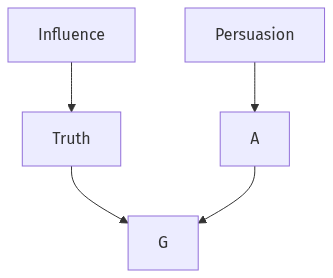
Conclusion
Ethical campaigns use influence and persuasion to serve a public good with truth and respect. The line is crossed when fear, shame, or falsehood does the work that evidence and dignity should do.
Quick related
Students also ask
-
Analyse the role of social skills in the context of increasing use and role of social media in cyber crimes.
Next question in the 2025 paper (Q9). View answer →
-
Is a nudge unethical because people do not notice it?
A transparent default that people can change can be ethical. A hidden trick that blocks refusal is not.
-
May the State use fear in a disaster warning?
Proportionate warning of real harm is a duty. Invented panic to force a scheme is not.
Same topic · past papers
UPPSC has asked this before
These previous-year questions sit on the same topic. Open one to practise the earlier ask.
-
2025 · Q17 · UPGS4 · 12 marks
How can social influence and persuasion contribute to the success of "Swachh Bharat Abhiyan"? Give your objective suggestions. -
2022 · Q13 · UPGS4 · 12 marks
What do you understand by social influence? How can social influence and persuasion bring out behavioural change? -
2020 · Q19 · UPGS4 · 12 marks
Social influence and persuasion contributed in controlling the spread of the Corona Virus in India. Discuss. -
2023 · Q10 · UPGS4 · 8 marks
What is the role of social influence in public administration? Elucidate with examples. -
2022 · Q2 · UPGS4 · 8 marks
Explain the role of persuasion in relation to public protest with proper argument.
More from this paper
Q1 · UPSC Mains 2025 · UPGS4 · 8 marks · Solution
Defining value; explain the distinctive features of human values and the role of the family in inculcating these values.
Civil Service aptitude and values
A value is a stable standard that guides worthy choice, not a passing mood. Human values are taught, claim universal worth, join conscience to conduct, and can be justified in public. The family is the first school of trust, empathy, and honour through daily example. A closed home can also plant prejudice, so the family’s power is not automatically ethical. Later schools and offices confirm or correct that first map.
Q2 · UPSC Mains 2025 · UPGS4 · 8 marks · Solution
Evaluate the contemporary relevance of Chanakya's life and thoughts in the context of ethical and people-centric governance.
Emotional Intelligence
Kautilya judges the ruler by the happiness and security of subjects. Yogakshema, a tested service, and honest accounts remain usable tests of ethical administration. Danda is lawful restraint of the strong, not personal cruelty. A democracy cannot import palace deceit; rights and publicity now bind the officer. The living lesson is welfare plus fiscal integrity under the Constitution.
Q3 · UPSC Mains 2025 · UPGS4 · 8 marks · Solution
Discuss the Aristotelian view of virtues and its application in administrative affairs.
Emotional Intelligence
Aristotle’s moral virtue is a stable habit of the mean, learned by practice. Courage, temperance, and justice are civic virtues an officer must show in files, not only in speech. Phronesis is practical wisdom that finds the right mean in a live case. Administration applies this as honest noting, fiscal restraint, and equal treatment. Office culture can train vice; example and rules can still rebuild the mean.