
Revision summary
Emotional intelligence uses feeling as information and energy, not as a flood. The quote is right when fear becomes preparation and anger becomes a lawful, measured reply. Empathy can turn irritation into a better public counter. The caution is that prejudiced feeling must not be made efficient. For a civil servant, “for you” means for the constitutional role, not for private ego.
Model answer
Introduction
The statement treats emotional intelligence as skill in using feeling as a tool, not as a flood. The claim is largely right for public service, with one caution that feelings must still answer to rights.
Body
Why the statement holds
- Emotions carry information: fear can mark a real risk, and anger can mark an injustice, so ignoring them is not professionalism.
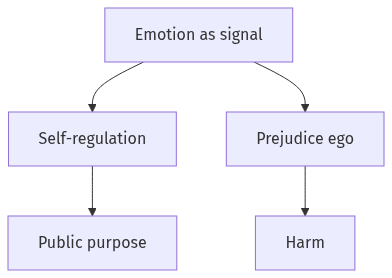
- Emotional intelligence is the trained use of that information so that fear becomes preparation and anger becomes a lawful, measured reply.
- Self-awareness and self-regulation stop an officer from shouting in a hearing or freezing in a riot, which is emotion working against the role.
- Empathy and social skill turn irritation at a queue into a redesigned counter, which is emotion working for the citizen.
- Goleman’s workplace model matches the quote: feeling is steered toward a goal rather than denied.
Limits of the quote
- Emotions can be prejudiced; making a communal dislike “work for you” would be efficient vice, not intelligence.
- The Constitution, not the officer’s comfort, decides whose feelings count in a minority’s file.
- Manipulation of others’ fear in a campaign can look like skill and still be unethical persuasion.
- Therefore agreement is yes, if “work for you” means work for the lawful public role, not for private ego.
Discussion for the civil servant
- Training, sleep, and peer debrief after a disaster are practical ways to keep emotion as a resource.
- A stone-faced officer who never names feeling often leaks it as delay or sarcasm, which is emotion against the office.
Flow diagram
Conclusion
The statement is acceptable when emotional intelligence means steering feeling toward a lawful public purpose. It is not a licence to weaponise prejudice or to treat citizens as material for one’s own mood.
Quick related
Students also ask
-
How can social influence and persuasion be ethically employed in a public information campaign by public servants? Explain.
Next question in the 2025 paper (Q8). View answer →
-
Should an officer suppress all emotion?
No. Suppression often leaks as delay or sarcasm. The task is to name and steer feeling, not to pretend it is absent.
-
Is emotional intelligence manipulation?
It becomes manipulation when others’ fear is used for a private or unlawful end. Ethical EI serves a public, lawful end.
Same topic · past papers
UPPSC has asked this before
These previous-year questions sit on the same topic. Open one to practise the earlier ask.
-
2024 · Q6 · UPGS4 · 8 marks
What is the role of emotional intelligence in establishing harmony in disaster management and workplace? -
2023 · Q9 · UPGS4 · 8 marks
Explain the role of emotional intelligence for good governance and administration. -
2023 · Q12 · UPGS4 · 12 marks
While formulating public policies, a civil servant must solely focus on public welfare, and while implementing those policies, he must have foresight to infer possible unexpected consequences. Do you agree with this statement? Give arguments and justifications for your answer. -
2022 · Q4 · UPGS4 · 8 marks
What do you understand by emotional intelligence? Discuss its dimensions. -
2021 · Q8 · UPGS4 · 8 marks
‘Emotional Intelligence is very important in effective administrative practices.’ Throw light on this statement.
More from this paper
Q1 · UPSC Mains 2025 · UPGS4 · 8 marks · Solution
Defining value; explain the distinctive features of human values and the role of the family in inculcating these values.
Civil Service aptitude and values
A value is a stable standard that guides worthy choice, not a passing mood. Human values are taught, claim universal worth, join conscience to conduct, and can be justified in public. The family is the first school of trust, empathy, and honour through daily example. A closed home can also plant prejudice, so the family’s power is not automatically ethical. Later schools and offices confirm or correct that first map.
Q2 · UPSC Mains 2025 · UPGS4 · 8 marks · Solution
Evaluate the contemporary relevance of Chanakya's life and thoughts in the context of ethical and people-centric governance.
Emotional Intelligence
Kautilya judges the ruler by the happiness and security of subjects. Yogakshema, a tested service, and honest accounts remain usable tests of ethical administration. Danda is lawful restraint of the strong, not personal cruelty. A democracy cannot import palace deceit; rights and publicity now bind the officer. The living lesson is welfare plus fiscal integrity under the Constitution.
Q3 · UPSC Mains 2025 · UPGS4 · 8 marks · Solution
Discuss the Aristotelian view of virtues and its application in administrative affairs.
Emotional Intelligence
Aristotle’s moral virtue is a stable habit of the mean, learned by practice. Courage, temperance, and justice are civic virtues an officer must show in files, not only in speech. Phronesis is practical wisdom that finds the right mean in a live case. Administration applies this as honest noting, fiscal restraint, and equal treatment. Office culture can train vice; example and rules can still rebuild the mean.