
Revision summary
A value is a stable standard that guides worthy choice, not a passing mood. Human values are taught, claim universal worth, join conscience to conduct, and can be justified in public. The family is the first school of trust, empathy, and honour through daily example. A closed home can also plant prejudice, so the family’s power is not automatically ethical. Later schools and offices confirm or correct that first map.
Model answer
Introduction
A value is a lasting standard of what a person holds as worth choosing. Human values have a public face, and the family is the first school that plants them.
Body
Definition
- A value is a relatively stable preference that guides choice between right and wrong, and between what is merely useful and what is worthy.
- It is not a passing mood; it is a criterion a person uses when interest, fear, or fashion pull in another direction.
Distinctive features of human values
- Human values are chosen and taught; they are not only instinct, which is why they can be examined and improved.
- They claim universal worth, such as truth, dignity, and compassion, even when a group’s custom is narrower.
- They bind inner conscience to outer conduct, so a value that never appears in action is only a slogan.
- They are social: they live in language, story, and example, not only in a private feeling.
- They remain open to reason; a human value can be justified to a stranger, unlike a mere taste.
Role of the family
- The family is the first site of trust, so a child learns fairness, care, and truth-telling by watching parents more than by hearing lectures.
- Daily sharing of food, work, and apology trains empathy and self-restraint before any school syllabus begins.
- Family stories of elders and of the neighbourhood give a child a first map of honour and shame.
- A closed or violent home can also plant prejudice, which is why the family’s role is powerful and not always good.
- Later institutions correct or confirm that first map, but they rarely replace it entirely.
Flow diagram
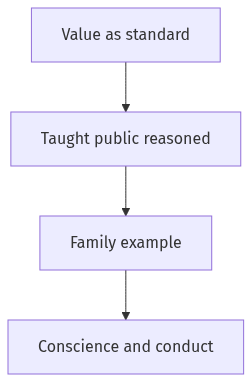
Conclusion
A value is a lasting standard of worthy choice. Human values are taught, public, and open to reason. The family plants them through example, care, and story, for good or for harm.
Quick related
Students also ask
-
Evaluate the contemporary relevance of Chanakya's life and thoughts in the context of ethical and people-centric governance.
Next question in the 2025 paper (Q2). View answer →
-
Are values the same as customs?
No. A custom is a group habit. A human value claims a worth that can be examined even against custom.
-
Can school replace the family in value education?
School can correct prejudice and add civic values. It rarely erases the first map of trust or fear learned at home.
Same topic · past papers
UPPSC has asked this before
These previous-year questions sit on the same topic. Open one to practise the earlier ask.
-
2020 · Q1 · UPGS4 · 8 marks
Discuss the role of family, society and educational institutions in inculcating values.
More from this paper
Q2 · UPSC Mains 2025 · UPGS4 · 8 marks · Solution
Evaluate the contemporary relevance of Chanakya's life and thoughts in the context of ethical and people-centric governance.
Emotional Intelligence
Kautilya judges the ruler by the happiness and security of subjects. Yogakshema, a tested service, and honest accounts remain usable tests of ethical administration. Danda is lawful restraint of the strong, not personal cruelty. A democracy cannot import palace deceit; rights and publicity now bind the officer. The living lesson is welfare plus fiscal integrity under the Constitution.
Q3 · UPSC Mains 2025 · UPGS4 · 8 marks · Solution
Discuss the Aristotelian view of virtues and its application in administrative affairs.
Emotional Intelligence
Aristotle’s moral virtue is a stable habit of the mean, learned by practice. Courage, temperance, and justice are civic virtues an officer must show in files, not only in speech. Phronesis is practical wisdom that finds the right mean in a live case. Administration applies this as honest noting, fiscal restraint, and equal treatment. Office culture can train vice; example and rules can still rebuild the mean.
Q4 · UPSC Mains 2025 · UPGS4 · 8 marks · Solution
Distinguish between moral responsibility and role (ex-officio) responsibility in the life of a public servant.
Moral thinkers and philosophers
Role responsibility is what the post owes by law, rules, and warrant, and it moves with the chair. Moral responsibility is personal answerability for harm, including silence and a cruel but technically correct act. Ex-officio duty is inspectable and transferable; moral ownership of a signature is not fully transferable. A healthy service designs the role so that care of the weak has a lawful channel. When an order is unlawful or grossly unjust, recorded dissent and refusal are both role and moral duties.