
Revision summary
Political elites are regular decision-makers in parties and the state. Kothari’s Congress system centred a professional and upper-caste mediating elite. Mandal and regional parties diversified caste and linguistic composition. Post-1991 capital and media reshaped recruitment and funding. Women and informal labour remain weakly present inside the elite.
Model answer
Copper italics in this answer — like this — are the key facts. Each one is unpacked in the Facts & figures rail.
Introduction
Political elites are the relatively small set of people who regularly shape binding decisions—in parties, ministries, state capitals and now in business-media nexuses. Independent India’s elite was never a closed European aristocracy. It has still changed in social composition and in how power is organised.
Body
The older pattern
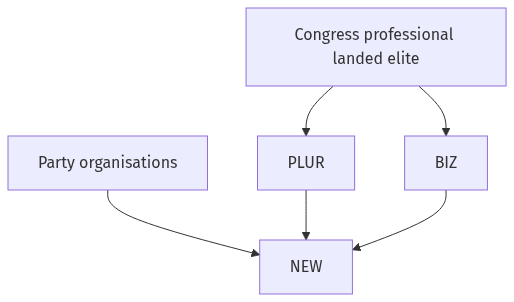
Rajni Kothari’s Congress system described a centrist, English-educated, often upper-caste professional and landed elite that mediated factions. André Béteille and others noted the overlap of caste status, land and office. The Rudolphs showed tradition modernising as caste federations entered this elite as brokers rather than as revolution.
What has changed
Mandal and state-level OBC parties brought backward-caste elites into chief ministerships and cabinets. Regional parties produced linguistic and state elites. Business wealth after 1991 entered politics more openly through funding, media and candidate selection. Dynastic succession sits beside self-made contractors. Hindu nationalist organisation created a parallel elite of swayamsevaks and communication managers. Women remain under-represented except where dynasty or reservation operates. Dalit and Adivasi elites exist (BSP’s rise and plateau, ST leaders in the Northeast and central India) but rarely command the core of capital.
The elite is more plural in caste and region, more capital-intensive, and more media-facing. It is not a simple replacement of Brahmin-Kayastha lawyers by farmers. Corporate and professional layers still matter in the Union. Local elites in panchayats are a different storey of the same building after the 73rd Amendment.
- Changing nature, then: from a relatively coherent Congress-era professional-landed centre to a federal bazaar of caste blocs, regional bosses, business and organisational cadres, still male-dominated and still distant from informal labour.
Flow diagram
Conclusion
Political elites in India have widened by caste and region since Mandal and the rise of state parties, and they have grown closer to business and media after 1991. The older professional-landed Congress type has not vanished; it has been crowded. Labouring classes still enter mainly as voters, not as the elite itself.
Quick related
Students also ask
-
Critique the victory narratives of Green Revolution in the context of Indian society
Next question on this syllabus topic (2023 · Q4(c)). View answer →
-
Has the old upper-caste elite disappeared?
No. It remains strong in higher judiciary, diplomacy, business and parts of the Union, while state politics diversified more.
-
Are businessmen a new political elite?
They are a more visible fraction. Funding and media make capital a direct political resource.
Same topic · past papers
UPSC has asked this before
These previous-year questions sit on the same topic. Open one to practise the earlier ask.
-
2022 · Q6(c) · Sociology GS 2 · 15 marks
Discuss the changing nature of structure of political elites. -
2022 · Q2(b) · Sociology GS 2 · 15 marks
Elaborate on changing nature of caste system with suitable illustrations. -
2022 · Q8(c) · Sociology GS 2 · 15 marks
Discuss the changing nature of industrial working class. -
2016 · Q6(b) · Sociology GS 2 · 15 marks
Discuss the changing nature of the problems of working class in the informal sector of the economy.
More from this topic
Q6(b) · UPSC Mains 2026 · Sociology GS 2 · 20 marks · Solution
Synchronise the developmental programmes and social change in India, and describe them through visible and lived experiences
Rural and Agrarian transformation in India
• State-led developmental plans in India act as tools for social engineering to break traditional inequalities. • Land reforms altered agrarian structures, but uneven implementation created varied local realities. • The 1952 Community Development Programme aimed for rural uplift but often strengthened dominant caste power. • The Green Revolution drove agricultural modernization while widening regional and class gaps. • The 73rd Amendment transformed grassroots politics by empowering women and marginalized castes through reservations. • MGNREGA and welfare schemes improved rural bargaining power, reduced distress migration, and redefined state-citizen ties. • True progress requires pairing economic growth with substantive social equality to overcome persistent structural exclusions.
Q8(c) · UPSC Mains 2025 · Sociology GS 2 · 10 marks · Solution
What are the Indian government's schemes launched for poverty alleviation after the United Nation's Declaration of 'Sustainable Development Goals - 2015' ? Briefly describe
Rural and Agrarian transformation in India
SDG 2015 became a frame for Indian poverty policy rather than a single new statute. PM-KISAN, Ayushman Bharat, Jal Jeevan and PMAY are major post-2015 launches. NFSA, MGNREGA and NRLM pre-date 2015 but were continued and digitised in the SDG era. POSHAN, PMGKAY and Ujjwala sit in the same toolkit. The package is broad; landless and informal workers still fall through title-based and insurance-based designs.
Q5(d) · UPSC Mains 2025 · Sociology GS 2 · 10 marks · Solution
What are the major problems faced by the labour migrants while working in informal sectors of Indian States? Discuss.
Rural and Agrarian transformation in India
Interstate migrants in informal work are hired through contractors, not stable contracts. Wage theft, unsafe housing, and missing social security are the core problems. Women and children carry extra risks of harassment and lost schooling. COVID reverse migration exposed their civic invisibility. Portability laws and e-SHRAM are incomplete answers to a structural informality.