
Revision summary
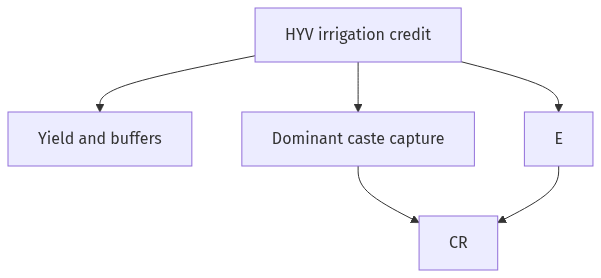
High-yield wheat and rice plus procurement did raise output in irrigated north-west India. Victory narratives treat that as a national social success. Class and caste capture, mechanisation of labour, and regional bias contradict that story. Groundwater and chemical costs are part of the same package. A sociological critique keeps the grain and drops the miracle.
Model answer
Copper italics in this answer — like this — are the key facts. Each one is unpacked in the Facts & figures rail.
Introduction
Victory narratives say the Green Revolution ended food shortage through high-yield seed, fertiliser, irrigation, and procurement. Sociologically the same package also ranked regions, castes, and ecologies. A critique does not deny grain. It denies that grain was a social victory for all.
Body
What the victory story gets right
- Wheat and rice yields rose in Punjab, Haryana, and parts of western Uttar Pradesh from the late 1960s, and public procurement built a buffer.
- Famine as a national calendar risk receded for several decades.
Social critique
- Gains followed irrigation and owned land, so dominant-caste rich peasants captured machines, credit, and support prices, which Desai’s class lens predicted.
- Landless labourers sometimes gained days of work and then lost them to mechanisation; real wages did not automatically become just.
- Rainfed eastern and central India were labelled ‘backward’ against a Punjabi model, which is regional inequality, not national victory.
- Beteille’s overlap of caste and land explains why a ‘farmer’ in official talk was often a particular jati.
Ecological and later political costs
- Groundwater collapse, pesticide harm, and crop diversity loss sit inside the same package.
- Debt and distress in some Green Revolution belts later contradicted the forever-victory story.
- Victory talk also hid women and migrant labour as the unseen workforce of the miracle.
Flow diagram
Conclusion
The Green Revolution was a production success for selected crops and regions. As a social narrative of national victory it erases class capture, regional bias, labour, and ecology.
Quick related
Students also ask
-
What is 'reverse migration' ? Discuss its features, causes and consequences in India
Next question on this syllabus topic (2023 · Q7(b)). View answer →
-
Does critique mean India should not have raised yields?
No. It means yield is not the same as just agrarian structure or sustainable ecology.
-
Was the Green Revolution only Punjab?
The classic wave was north-west wheat-rice. Later pockets elsewhere copied parts of the package with mixed results.
Same topic · past papers
UPSC has asked this before
These previous-year questions sit on the same topic. Open one to practise the earlier ask.
-
2017 · Q1(a) · Sociology GS 2 · 10 marks
Write a critique of the structural and functional perspective used by M.N. Srinivas in the understanding of Indian society
More from this topic
Q6(b) · UPSC Mains 2026 · Sociology GS 2 · 20 marks · Solution
Synchronise the developmental programmes and social change in India, and describe them through visible and lived experiences
Rural and Agrarian transformation in India
• State-led developmental plans in India act as tools for social engineering to break traditional inequalities. • Land reforms altered agrarian structures, but uneven implementation created varied local realities. • The 1952 Community Development Programme aimed for rural uplift but often strengthened dominant caste power. • The Green Revolution drove agricultural modernization while widening regional and class gaps. • The 73rd Amendment transformed grassroots politics by empowering women and marginalized castes through reservations. • MGNREGA and welfare schemes improved rural bargaining power, reduced distress migration, and redefined state-citizen ties. • True progress requires pairing economic growth with substantive social equality to overcome persistent structural exclusions.
Q8(c) · UPSC Mains 2025 · Sociology GS 2 · 10 marks · Solution
What are the Indian government's schemes launched for poverty alleviation after the United Nation's Declaration of 'Sustainable Development Goals - 2015' ? Briefly describe
Rural and Agrarian transformation in India
SDG 2015 became a frame for Indian poverty policy rather than a single new statute. PM-KISAN, Ayushman Bharat, Jal Jeevan and PMAY are major post-2015 launches. NFSA, MGNREGA and NRLM pre-date 2015 but were continued and digitised in the SDG era. POSHAN, PMGKAY and Ujjwala sit in the same toolkit. The package is broad; landless and informal workers still fall through title-based and insurance-based designs.
Q5(d) · UPSC Mains 2025 · Sociology GS 2 · 10 marks · Solution
What are the major problems faced by the labour migrants while working in informal sectors of Indian States? Discuss.
Rural and Agrarian transformation in India
Interstate migrants in informal work are hired through contractors, not stable contracts. Wage theft, unsafe housing, and missing social security are the core problems. Women and children carry extra risks of harassment and lost schooling. COVID reverse migration exposed their civic invisibility. Portability laws and e-SHRAM are incomplete answers to a structural informality.