
Revision summary
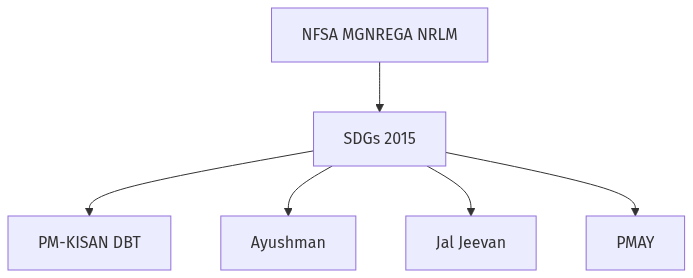
SDG 2015 became a frame for Indian poverty policy rather than a single new statute. PM-KISAN, Ayushman Bharat, Jal Jeevan and PMAY are major post-2015 launches. NFSA, MGNREGA and NRLM pre-date 2015 but were continued and digitised in the SDG era. POSHAN, PMGKAY and Ujjwala sit in the same toolkit. The package is broad; landless and informal workers still fall through title-based and insurance-based designs.
Model answer
Copper italics in this answer — like this — are the key facts. Each one is unpacked in the Facts & figures rail.
Introduction
The UN Sustainable Development Goals (2015), especially SDG 1 (no poverty) and related goals on food, health, water and work, became a frame for Indian welfare. Some schemes were new after 2015; others were older rights continued and digitally recast. A brief sociological catalogue should keep that distinction.
Body
Post-2015 launches and recasts
PM-KISAN (2019) pays an income support to landholder farmer families—poverty alleviation as a cash transfer, skewed toward those with title. Ayushman Bharat (2018)—PM-JAY insurance plus health and wellness centres—attacks medical impoverishment (SDG 3). Jal Jeevan Mission (2019) targets household tap water (SDG 6). PMAY (Gramin 2016, Urban 2015) is housing as asset and dignity (SDG 11). National Nutrition Mission / POSHAN (2018) and the continued NFSA, 2013 (implemented through the SDG years with One Nation One Ration portability) address hunger. NRLM / DAY-NRLM (pre-2015 architecture, expanded with SHGs and lakhpati didi targets) is women’s livelihood poverty work (SDG 5 and 1). MGNREGA (2005) continued as a rural employment floor through the SDG period, including a COVID spike in demand.
- Other aligned instruments: e-SHRAM, PMGKAY food extra during COVID, Ujjwala, Saubhagya, and Direct Benefit Transfer plumbing. Together they form a welfare architecture mapped onto SDGs, not a single anti-poverty law.
- Limits belong in a brief note: landless labour gains less from PM-KISAN; insurance is not a health system; MGNREGA wages and delays remain political. PMAY can become a pucca house without a livelihood. Jal Jeevan can deliver a tap and still fail on quality. The schemes still matter as the state’s post-2015 poverty toolkit, especially when read as SDG 1 plus 2, 3, 5, 6, 8 and 11 rather than as rival ministries.
Sociologically they also recast the poor as Aadhaar-verified beneficiaries, which is inclusion and surveillance together. That is the post-2015 signature as much as any new acronym.
Flow diagram
Conclusion
After 2015 India combined new transfers (PM-KISAN, Ayushman, Jal Jeevan, PMAY) with continued rights (NFSA, MGNREGA, NRLM). That is the government’s SDG-era poverty package: wide, digital, and still uneven for the landless informal poor.
Quick related
Students also ask
-
Is there a connection between labour migration and informal sector? Justify your answer with reference to Indian context.
Next question on this syllabus topic (2024 · Q5(b)). View answer →
-
Did MGNREGA start after the SDGs?
No. It is a 2005 Act. After 2015 it continued as the main rural employment guarantee, which India reports against SDG 1 and 8.
-
Is NFSA a post-2015 scheme?
The Act is 2013. Its nationwide implementation, portability and COVID top-ups fall in the SDG years.
Same topic · past papers
UPSC has asked this before
These previous-year questions sit on the same topic. Open one to practise the earlier ask.
-
2022 · Q5(e) · Sociology GS 2 · 10 marks
What role do co-operatives plays in poverty alleviation in rural India ? -
2021 · Q8(c) · Sociology GS 2 · 10 marks
Does "economic empowerment" automatically bring about "substantive empowerment" for women ? Briefly describe the main issues in women empowerment in India
More from this topic
Q6(b) · UPSC Mains 2026 · Sociology GS 2 · 20 marks · Solution
Synchronise the developmental programmes and social change in India, and describe them through visible and lived experiences
Rural and Agrarian transformation in India
• State-led developmental plans in India act as tools for social engineering to break traditional inequalities. • Land reforms altered agrarian structures, but uneven implementation created varied local realities. • The 1952 Community Development Programme aimed for rural uplift but often strengthened dominant caste power. • The Green Revolution drove agricultural modernization while widening regional and class gaps. • The 73rd Amendment transformed grassroots politics by empowering women and marginalized castes through reservations. • MGNREGA and welfare schemes improved rural bargaining power, reduced distress migration, and redefined state-citizen ties. • True progress requires pairing economic growth with substantive social equality to overcome persistent structural exclusions.
Q5(d) · UPSC Mains 2025 · Sociology GS 2 · 10 marks · Solution
What are the major problems faced by the labour migrants while working in informal sectors of Indian States? Discuss.
Rural and Agrarian transformation in India
Interstate migrants in informal work are hired through contractors, not stable contracts. Wage theft, unsafe housing, and missing social security are the core problems. Women and children carry extra risks of harassment and lost schooling. COVID reverse migration exposed their civic invisibility. Portability laws and e-SHRAM are incomplete answers to a structural informality.
Q5(d) · UPSC Mains 2024 · Sociology GS 2 · 10 marks · Solution
Discuss the changing nature of political elites in India.
Rural and Agrarian transformation in India
Political elites are regular decision-makers in parties and the state. Kothari’s Congress system centred a professional and upper-caste mediating elite. Mandal and regional parties diversified caste and linguistic composition. Post-1991 capital and media reshaped recruitment and funding. Women and informal labour remain weakly present inside the elite.