
Revision summary
Interstate migrants in informal work are hired through contractors, not stable contracts. Wage theft, unsafe housing, and missing social security are the core problems. Women and children carry extra risks of harassment and lost schooling. COVID reverse migration exposed their civic invisibility. Portability laws and e-SHRAM are incomplete answers to a structural informality.
Model answer
Copper italics in this answer — like this — are the key facts. Each one is unpacked in the Facts & figures rail.
Introduction
Most Indian migrants who cross state lines to work do not enter a factory with a standing order. They enter informal sectors: construction, brick kilns, garments, domestic work, street vending, and now platforms. Their problems are legal invisibility plus social distance in the host state.
Body
The usual injuries
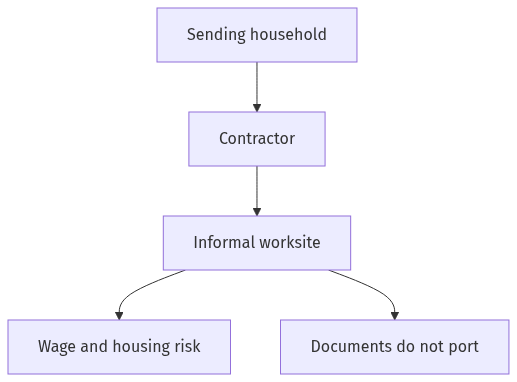
Contractors mediate hiring; the principal employer denies the relation. Wage theft, delayed payment, and piece-rates below minimum wage are routine. Housing is a jhuggi, a night shelter, or a site shed—no tenancy right. Health is out-of-pocket; accidents in construction are frequent; ESI rarely follows the worker. Documents—ration card, voter ID, e-SHRAM, One Nation One Ration—do not travel smoothly, so PDS and school admission break. Women face sexual harassment and unpaid care; children miss school or work. Language and caste isolation block unions. During COVID-19, reverse migration showed that the city would use their labour and not keep their bodies.
The Interstate Migrant Workmen Act, 1979 was weakly enforced. BOCW cess boards are state-bound. Labour codes promise portability; practice is still the munshi’s notebook. Jan Breman’s footloose labour remains the right phrase: circular, indebted, and replaceable.
Host states want labour, not citizens. Sending states want remittances, not political anger. Migrants fall between. Occupational safety is a sociological fact: heat, dust, falling from slabs, and pesticide exposure in destination farms. Unionisation is hard because the worksite dissolves when the building is finished. During elections they are a vote in the village and a non-person in the city. Platform workers add a new informal layer without solving housing or PDS.
A just response would be portable social security, landlord-employer liability, and the right to stay. Until then, “problems of labour migrants” are the normal operating system of Indian informal capitalism.
Flow diagram
Conclusion
Informal migrant labour faces wage theft, bad housing, broken social security, gendered risk, and civic non-recognition. Law exists on paper; the contractor and the disaster reveal the social fact.
Quick related
Students also ask
-
What are the Indian government's schemes launched for poverty alleviation after the United Nation's Declaration of 'Sustainable Development Goals - 2015' ? Briefly describe
Next question on this syllabus topic (2025 · Q8(c)). View answer →
-
Are all migrants informal?
No. IT and formal transfers exist. The majority of manual interstate movers are informal.
-
Does e-SHRAM solve this?
It is a registry. Without enforceable wages, housing and portable rations, a number is not a right.
Same topic · past papers
UPSC has asked this before
These previous-year questions sit on the same topic. Open one to practise the earlier ask.
-
2026 · Q1(d) · Sociology GS 2 · 10 marks
Discuss the debates on the concepts 'duty' and 'worship' while understanding religion in India. -
2023 · Q8(c) · Sociology GS 2 · 10 marks
What is 'Ageing'? Discuss the major problems of aged people in India -
2021 · Q6(b) · Sociology GS 2 · 20 marks
Is 'ageing an emerging issue in Indian society ? Discuss the major problems of the old age people in India
More from this topic
Q6(b) · UPSC Mains 2026 · Sociology GS 2 · 20 marks · Solution
Synchronise the developmental programmes and social change in India, and describe them through visible and lived experiences
Rural and Agrarian transformation in India
• State-led developmental plans in India act as tools for social engineering to break traditional inequalities. • Land reforms altered agrarian structures, but uneven implementation created varied local realities. • The 1952 Community Development Programme aimed for rural uplift but often strengthened dominant caste power. • The Green Revolution drove agricultural modernization while widening regional and class gaps. • The 73rd Amendment transformed grassroots politics by empowering women and marginalized castes through reservations. • MGNREGA and welfare schemes improved rural bargaining power, reduced distress migration, and redefined state-citizen ties. • True progress requires pairing economic growth with substantive social equality to overcome persistent structural exclusions.
Q8(c) · UPSC Mains 2025 · Sociology GS 2 · 10 marks · Solution
What are the Indian government's schemes launched for poverty alleviation after the United Nation's Declaration of 'Sustainable Development Goals - 2015' ? Briefly describe
Rural and Agrarian transformation in India
SDG 2015 became a frame for Indian poverty policy rather than a single new statute. PM-KISAN, Ayushman Bharat, Jal Jeevan and PMAY are major post-2015 launches. NFSA, MGNREGA and NRLM pre-date 2015 but were continued and digitised in the SDG era. POSHAN, PMGKAY and Ujjwala sit in the same toolkit. The package is broad; landless and informal workers still fall through title-based and insurance-based designs.
Q5(d) · UPSC Mains 2024 · Sociology GS 2 · 10 marks · Solution
Discuss the changing nature of political elites in India.
Rural and Agrarian transformation in India
Political elites are regular decision-makers in parties and the state. Kothari’s Congress system centred a professional and upper-caste mediating elite. Mandal and regional parties diversified caste and linguistic composition. Post-1991 capital and media reshaped recruitment and funding. Women and informal labour remain weakly present inside the elite.