
Revision summary
Most Indian labour migrants enter informal work, not a formal citadel. Contractors, advances and caste-kin networks organise the move. Construction, garments, domestic work and platforms illustrate the link. COVID return walks showed the city does not socially incorporate this labour. Informality and migration reproduce each other.
Model answer
Copper italics in this answer — like this — are the key facts. Each one is unpacked in the Facts & figures rail.
Introduction
Yes, there is a tight connection. Most internal migrants in India do not enter a formal factory with a provident fund. They enter construction, workshops, domestic service, vending, kilns and now platforms—the informal sector. Migration supplies flexible labour; informality is how that labour is used without social security.
Body
How the link works
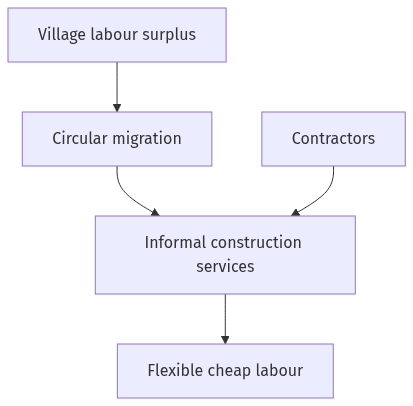
Jan Breman’s circular migrants move between village and work site without becoming a stable urban proletariat. Labour contractors recruit by kin and caste, pay advances, and keep people outside the regular roll. That is the same dualism Holmström described inside industry. The informal sector is not a traditional leftover; it is how Indian capitalism uses migrant flexibility.
Construction in Mumbai, Delhi and Gulf-oriented Kerala streams; garments in Tiruppur and NCR; domestic work in every metro; and seasonal agriculture in Punjab all rest on this link. The COVID-19 lockdown made the connection visible when informal migrants walked home because the city had no claim on them.
Justification in the Indian context
If migration went mainly into organised public-sector jobs, informality would be a side issue. The employment structure is the opposite. Even registered firms subcontract. e-SHRAM and One Nation One Ration are attempts to follow the migrant inside informality, which admits the link. Caste and region organise niches: eastern India to western construction, Adivasi streams to brick kilns.
The connection is two-way. Informal demand pulls migrants. Migrant oversupply keeps work informal by weakening unions. Village land, however small, subsidises urban cheap labour—A. R. Desai’s political economy still holds.
- So the justification is structural: India’s informal sector is a migrant labour regime, not a separate traditional economy.
Flow diagram
Conclusion
Labour migration and the informal sector are connected because migrants are recruited into unsecured work through contractors, and because firms stay informal by using that circulating labour. Indian cities and harvests run on that link.
Quick related
Students also ask
-
Discuss the changing nature of political elites in India.
Next question on this syllabus topic (2024 · Q5(d)). View answer →
-
Do all informal workers migrate?
No. Local own-account workers are many. The dynamic growth sectors of urban informality lean heavily on migrants.
-
Is the gig economy a break from this link?
It is a digital version of informal wage work, often using the same migrant and young-urban labour pool.
Same topic · past papers
UPSC has asked this before
These previous-year questions sit on the same topic. Open one to practise the earlier ask.
More from this topic
Q6(b) · UPSC Mains 2026 · Sociology GS 2 · 20 marks · Solution
Synchronise the developmental programmes and social change in India, and describe them through visible and lived experiences
Rural and Agrarian transformation in India
• State-led developmental plans in India act as tools for social engineering to break traditional inequalities. • Land reforms altered agrarian structures, but uneven implementation created varied local realities. • The 1952 Community Development Programme aimed for rural uplift but often strengthened dominant caste power. • The Green Revolution drove agricultural modernization while widening regional and class gaps. • The 73rd Amendment transformed grassroots politics by empowering women and marginalized castes through reservations. • MGNREGA and welfare schemes improved rural bargaining power, reduced distress migration, and redefined state-citizen ties. • True progress requires pairing economic growth with substantive social equality to overcome persistent structural exclusions.
Q8(c) · UPSC Mains 2025 · Sociology GS 2 · 10 marks · Solution
What are the Indian government's schemes launched for poverty alleviation after the United Nation's Declaration of 'Sustainable Development Goals - 2015' ? Briefly describe
Rural and Agrarian transformation in India
SDG 2015 became a frame for Indian poverty policy rather than a single new statute. PM-KISAN, Ayushman Bharat, Jal Jeevan and PMAY are major post-2015 launches. NFSA, MGNREGA and NRLM pre-date 2015 but were continued and digitised in the SDG era. POSHAN, PMGKAY and Ujjwala sit in the same toolkit. The package is broad; landless and informal workers still fall through title-based and insurance-based designs.
Q5(d) · UPSC Mains 2025 · Sociology GS 2 · 10 marks · Solution
What are the major problems faced by the labour migrants while working in informal sectors of Indian States? Discuss.
Rural and Agrarian transformation in India
Interstate migrants in informal work are hired through contractors, not stable contracts. Wage theft, unsafe housing, and missing social security are the core problems. Women and children carry extra risks of harassment and lost schooling. COVID reverse migration exposed their civic invisibility. Portability laws and e-SHRAM are incomplete answers to a structural informality.