
Revision summary
Reverse migration is return from destination work sites to native places. In India it is the visible face of circular, footloose labour. COVID-19 2020 made the corridors public; seasonal return was already normal. Causes are urban insecurity and rural household ties. Consequences are distress, temporary rural labour surplus and later re-migration.
Model answer
Copper italics in this answer — like this — are the key facts. Each one is unpacked in the Facts & figures rail.
Introduction
Reverse migration is the return of workers from destination cities, industrial belts, or other countries back to their native villages and towns. In India it is usually the other side of circular labour, made visible when the destination economy shuts or the household is needed at origin.
Body
Features
- It is often sudden in crisis, as in the 2020 lockdown walks and special trains, and slower when a construction season ends.
- Households, not only single men, may move; women and children appear on the road when the city job vanishes.
- It follows existing corridors: Bihar–Punjab, Odisha–Gujarat, Uttar Pradesh–Mumbai, and Gulf return to Kerala and elsewhere.
- Jan Breman’s footloose labour is the structural type: the worker was never fully urban, so reverse movement is built into the class.
Causes
- Immediate: lockdowns, factory closure, unpaid wages, collapsed housing, and fear of epidemic without urban welfare.
- Structural: no portable rations then, weak rental rights, and contractor systems that dump labour when demand falls.
- Positive pulls also exist: harvest, marriage, local elections, new rural schemes, or a small plot that still needs hands.
- A. R. Desai’s agrarian structure explains why origin villages can still absorb bodies even when they cannot absorb decent work.
Consequences
- Short run: distress on highways, overcrowded villages, health risk, and a shock to urban sectors that ran on migrants.
- Rural labour supply rose in some districts; wages and farm tasks shifted, then many re-migrated when cities reopened.
- Households remitted less, which hit local consumption and debt cycles.
- Policy learning: portable ration experiments, some state transport, and talk of local livelihoods; implementation remained uneven.
- Yogendra Singh’s modernizing village met a pre-modern welfare hole: phones could call home, the state could not feed the worker in the city.
What it teaches about class
- India’s urban growth still rests on a rural safety net that is unpaid care and a small plot.
- Reverse migration is not urbanisation reversed forever; it is a pulse in a circular system.
- Caste and region still decide who can wait in the city and who must walk.
Flow diagram
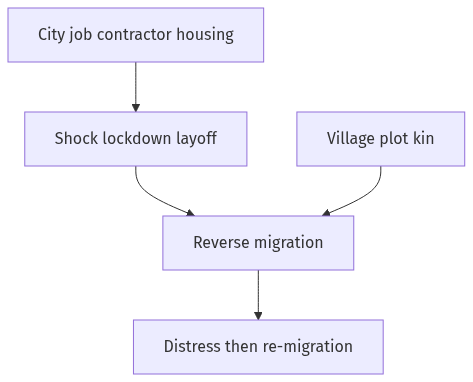
Conclusion
Reverse migration in India is the return pulse of circular labour, spectacular in 2020 and ordinary every lean season. Its features are corridor movement and household distress; its causes are urban insecurity plus rural ties; its consequences are shared pain and a still-weak portable welfare state.
Quick related
Students also ask
-
What role do co-operatives plays in poverty alleviation in rural India ?
Next question on this syllabus topic (2022 · Q5(e)). View answer →
-
Is reverse migration the same as de-urbanisation?
No. Most workers remain tied to urban labour markets and often go back.
-
Did villages gain from the return?
They gained hands and also mouths. Decent local work did not automatically appear.
Same topic · past papers
UPSC has asked this before
These previous-year questions sit on the same topic. Open one to practise the earlier ask.
-
2021 · Q4(a) · Sociology GS 2 · 20 marks
What are the sociological reasons and implication of "reverse migration" during the recent pandemic in India ?
More from this topic
Q6(b) · UPSC Mains 2026 · Sociology GS 2 · 20 marks · Solution
Synchronise the developmental programmes and social change in India, and describe them through visible and lived experiences
Rural and Agrarian transformation in India
• State-led developmental plans in India act as tools for social engineering to break traditional inequalities. • Land reforms altered agrarian structures, but uneven implementation created varied local realities. • The 1952 Community Development Programme aimed for rural uplift but often strengthened dominant caste power. • The Green Revolution drove agricultural modernization while widening regional and class gaps. • The 73rd Amendment transformed grassroots politics by empowering women and marginalized castes through reservations. • MGNREGA and welfare schemes improved rural bargaining power, reduced distress migration, and redefined state-citizen ties. • True progress requires pairing economic growth with substantive social equality to overcome persistent structural exclusions.
Q8(c) · UPSC Mains 2025 · Sociology GS 2 · 10 marks · Solution
What are the Indian government's schemes launched for poverty alleviation after the United Nation's Declaration of 'Sustainable Development Goals - 2015' ? Briefly describe
Rural and Agrarian transformation in India
SDG 2015 became a frame for Indian poverty policy rather than a single new statute. PM-KISAN, Ayushman Bharat, Jal Jeevan and PMAY are major post-2015 launches. NFSA, MGNREGA and NRLM pre-date 2015 but were continued and digitised in the SDG era. POSHAN, PMGKAY and Ujjwala sit in the same toolkit. The package is broad; landless and informal workers still fall through title-based and insurance-based designs.
Q5(d) · UPSC Mains 2025 · Sociology GS 2 · 10 marks · Solution
What are the major problems faced by the labour migrants while working in informal sectors of Indian States? Discuss.
Rural and Agrarian transformation in India
Interstate migrants in informal work are hired through contractors, not stable contracts. Wage theft, unsafe housing, and missing social security are the core problems. Women and children carry extra risks of harassment and lost schooling. COVID reverse migration exposed their civic invisibility. Portability laws and e-SHRAM are incomplete answers to a structural informality.