
Revision summary
Gender-based domestic division assigns unpaid household and care work mainly to women. Oakley, Hartmann and Hochschild made that work theoretically central. Women’s formal employment has produced dual burdens more often than equal sharing. Outsourcing to paid domestic workers relocates rather than ends gendered care. India’s Time Use Survey shows a large unpaid-work gap by sex. Change is lagged and class-specific, not automatic with a salary slip.
Model answer
Copper italics in this answer — like this — are the key facts. Each one is unpacked in the Facts & figures rail.
Introduction
A gender-based domestic division of labour is the patterned assignment of unpaid household and care tasks according to sex, not according to taste alone. Cooking, cleaning, childcare, eldercare and the management of kin relations are still, in most societies, women’s work in the last instance. The question is whether women’s rising presence in formal employment is rewriting that script or merely adding a second shift to the first.
Body
The pattern and its theory
Ann Oakley made housework visible as work. Heidi Hartmann treated the domestic division as a pillar of patriarchy allied to capitalism: men as a group benefit from unpaid services that reproduce labour power. Arlie Hochschild’s The Second Shift showed dual-earner couples in which the woman’s paid job did not equalise the evening. Sylvia Walby listed household production among the structures of patriarchy. The arrangement is moralised as love and nature, which is why it is so sticky.
Is it changing with formal employment?
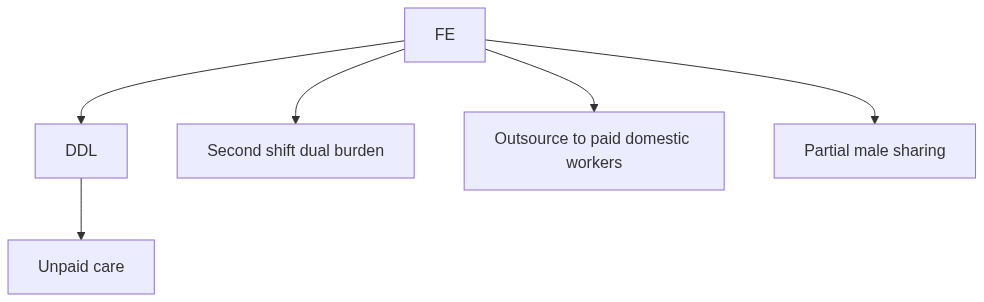
It is changing unevenly. In urban dual-earner professional households some men cook, some couples hire a cook or a nanny, and some delay fertility. Outsourcing transfers the gendered burden onto poorer women, often migrant and informal, rather than abolishing it. “Help” from husbands is still framed as favour, not duty. Time Use Survey 2019 in India found women spending several more hours a day on unpaid domestic work than men, a gap that employment status narrows only partly. Rural and small-town formal jobs for women, where they exist, often sit beside unchanged kin surveillance and the honour of a “good wife”. Maternity, unsafe transport and the motherhood penalty push some women out of formal jobs, which then restores the old division.
- Comparative research speaks of lagged adaptation: fertility and women’s employment move faster than men’s unpaid hours. Nordic policy shows that public childcare and paternal leave can shift the pattern; their absence in much of India keeps the domestic gender contract intact. So formal employment is a necessary pressure for change, not a sufficient cause. Illustrations should include both the new urban kitchen and the continuing dawn routine of unpaid work that makes the office possible.
Flow diagram
Conclusion
The domestic division of labour remains gendered even when women hold formal jobs. Change is real in some dual-earner settings and largely a dual burden or a shift onto poorer women in others. Employment without a reorganisation of care and male time will not complete the revolution at home.
Quick related
Students also ask
-
How do theories of Marx, Weber and Durkheim differ in understanding religion? Explain
Next question on this syllabus topic (2025 · Q7(b)). View answer →
-
If a couple hires a maid, is the gender division gone?
It may be reduced between spouses and reproduced as classed, caste-inflected paid care work by other women.
-
Do all cultures share the same domestic map?
The content of tasks varies; the assignment of last-instance responsibility to women is widely documented, including in India.
Same topic · past papers
UPSC has asked this before
These previous-year questions sit on the same topic. Open one to practise the earlier ask.
-
2020 · Q2(c) · Sociology GS 1 · 15 marks
Explain democracy as an order of society. What are the factors preventing people's participation in politics?
More from this topic
Q7(c) · UPSC Mains 2026 · Sociology GS 1 · 10 marks · Solution
Compare the social organisation of work in industrial capitalism and platform capitalism
Sociological Thinkers: Karl Marx
• **Setting:** Industrial capitalism centres work in physical factories; platform capitalism disperses it via digital apps. • **Control:** Factories use direct managerial supervision and time-discipline; platforms use invisible algorithms and automated ratings. • **Contracts:** Industrial work relies on standard, secure employment with welfare benefits; platform work relies on gig contracts and independent contractors. • **Risk:** Factories shoulder capital costs; platform capitalism shifts risks and equipment costs onto individual workers. • **Solidarity:** Shared factory spaces foster collective class consciousness; digital isolation creates an atomised "precariat." • **Surplus Value:** Both systems extract surplus value, but platforms obscure exploitation behind the illusion of entrepreneurial freedom.
Q5(d) · UPSC Mains 2026 · Sociology GS 1 · 10 marks · Solution
How does Max Weber's 'theory of authority' shape bureaucracy? Analyse.
Sociological Thinkers: Karl Marx
Max Weber's sociological framework links different forms of legitimate domination directly to the rise of modern rational-legal bureaucracy. Traditional and charismatic authority provide historical context, but rational-legal authority creates the impersonal rules, hierarchy, and technical expertise defining bureaucratic structures. While ensuring efficiency, this iron cage of rationalisation also poses risks of alienation and goal displacement, which later thinkers critiqued.
Q3(c) · UPSC Mains 2026 · Sociology GS 1 · 10 marks · Solution
How does Emile Durkheim conceptualize religion as a 'social fact'? Explain
Sociological Thinkers: Karl Marx
Emile Durkheim treats religion as a quintessential social fact in 'The Elementary Forms of the Religious Life' (1912). Moving away from supernatural or animistic definitions, he argues that religion is fundamentally a collective product. Society objectifies its own moral authority and solidarity through sacred symbols and rituals. By separating the sacred from the profane, religious practices reinforce social integration and collective consciousness. Thus, religion is society worshipping itself, operating as an external and coercive constraint upon individual thought and action.