
Revision summary
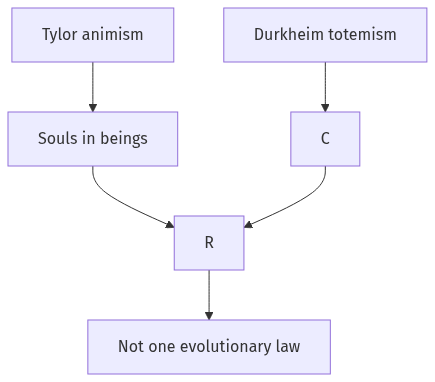
Animism, for Tylor, is belief in souls in persons and things. Totemism, for Durkheim, is the clan’s sacred emblem and the rite that gathers the group. They share a sacred link to non-human beings and an old evolutionary placement that is no longer law. They differ as intellectualist soul-theory versus sociological emblem-theory. Village spirits and clan names in India may resemble either without copying Australian totemism.
Model answer
Copper italics in this answer — like this — are the key facts. Each one is unpacked in the Facts & figures rail.
Introduction
Animism and totemism are two classical names for early religion. Edward Tylor used animism for belief in souls and spirits. Emile Durkheim used totemism, especially Australian clan religion, as the elementary form of the sacred. They overlap as theories of non-theistic religion. They differ in what they take as the object of worship.
Body
Animism
- Tylor, in Primitive Culture, defined animism as the belief that persons, animals, plants, and things have souls.
- Dreams, death, and trance were his evidence for how the soul idea arose.
- Animism is a philosophy of nature as peopled by wills. It need not organise a clan.
Totemism
- A totem is a plant, animal, or object that stands for a clan and is treated as sacred kin.
- Durkheim, in The Elementary Forms of Religious Life, argued that the totem is the clan’s emblem, and that worship of the totem is society worshipping itself.
- Taboos of killing and eating, and rites that gather the clan, are the social machinery.
- Radcliffe-Brown and later writers debated whether totemism is one institution or a bundle of practices.
Similarities
- Both were used to describe religions without a single high god of the Abrahamic type.
- Both link the sacred to non-human beings.
- Both were placed by nineteenth-century anthropology at the start of a religious evolution, a ladder that later anthropology rejected as a law.
- Both can appear in the same society: spirits of place beside clan emblems.
Differences
- Animism centres souls in things. Totemism centres a social emblem and a group.
- Tylor’s path is intellectualist: people infer souls. Durkheim’s path is sociological: rites make the sacred.
- Totemism is a system of classification of groups. Animism is a theory of life in nature.
- Indian illustrations include village spirit cults that look animistic, and clan or gotra animal names that look totemic without being Australian totemism.
Flow diagram
Conclusion
Animism and totemism are similar as classical labels for sacred relations with non-human beings. They differ because animism is a doctrine of souls and totemism is a clan emblem and rite. Tylor explains belief. Durkheim explains society. Neither is a universal first stage of all religion.
Quick related
Students also ask
-
Examine the relevance of corporate social responsibility in a world marked by increasing environmental crises
Next question on this syllabus topic (2023 · Q5(a)). View answer →
-
Is every animal-named clan totemic?
No. A name may survive without taboo, rite, and emblem worship in Durkheim’s sense.
-
Did Durkheim deny spirits?
He shifted the explanation from souls in things to the social production of the sacred.
Same topic · past papers
UPSC has asked this before
These previous-year questions sit on the same topic. Open one to practise the earlier ask.
-
2024 · Q6(c) · Sociology GS 1 · 10 marks
Discuss the concept of animism and differentiate it from naturism
More from this topic
Q8(c) · UPSC Mains 2026 · Sociology GS 1 · 10 marks · Solution
Discuss the significance and limitations of 'intersectionality' in social research
Sociology
Intersectionality, coined by Kimberlé Crenshaw, examines how overlapping identities like race, class, and gender shape systemic oppression. Its significance in social research lies in capturing lived realities beyond single-axis frameworks and preventing reductive generalisations. However, limitations include methodological complexity, risks of infinite regress, and difficulties in operationalising fluid categories. Effective application requires balancing structural macro-analysis with micro-level lived experiences.
Q6(b) · UPSC Mains 2026 · Sociology GS 1 · 20 marks · Solution
Critically analyse the nature-nurture debate from different perspectives
Sociology
1. The nature-nurture debate explores whether biology or society primarily shapes human behavior
Q6(a) · UPSC Mains 2026 · Sociology GS 1 · 20 marks · Solution
Discuss the intellectual origins of sociology and its evolution as a distinct field of study
Sociology
Sociology arose in 19th-century Western Europe to make sense of massive upheavals caused by the Industrial and French Revolutions. Enlightenment thinkers laid the groundwork by championing reason, empirical observation, and human agency over traditional dogma. Auguste Comte gave the discipline its name, pushing for a positivist "physics of society" based on scientific laws. Émile Durkheim secured its academic legitimacy by defining "social facts" and using empirical methods to study human behavior. Max Weber introduced interpretive sociology, while Karl Marx focused on material conditions and class struggle. In the 20th century, Talcott Parsons advanced structural-functionalism to study systemic equilibrium. Later, conflict theories, the Frankfurt School, and postmodern critiques broadened the field to address power and marginalisation. Today, sociology continues to evolve by analyzing globalisation, digital shifts, and modern identity politics.