
Revision summary
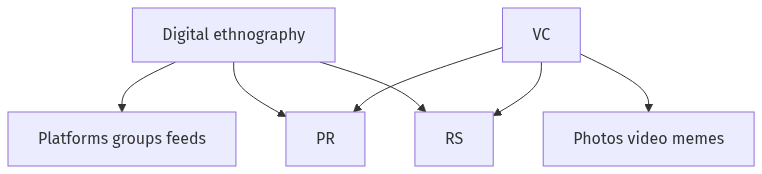
Digital ethnography follows social life on platforms with ethnographic patience. Visual culture treats images and video as data and as a mode of presentation. The trend matches a world where kinship, politics and markets are already mediated. Promises include access to networks, movements and everyday visual politics. Problems include consent, platform sampling, stereotype and loss of co-presence. The methods are necessary if they stay disciplined, and weak if they become screenshot dumps.
Model answer
Copper italics in this answer — like this — are the key facts. Each one is unpacked in the Facts & figures rail.
Introduction
Digital ethnography studies social life as it is lived on platforms, messaging groups and online worlds, using the same patience that older ethnography used in a village or a factory. Visual culture in research means treating photographs, video, memes and screens as data, and sometimes as a way of showing results. Both trends have grown quickly. A sociological assessment must weigh what they add to knowledge and what they risk.
Body
What the trend is
Classic ethnography, after Malinowski, asked the researcher to live among people and to learn their point of view. Digital ethnography, in the work of scholars such as Daniel Miller and later internet ethnographers, follows people into WhatsApp families, gaming worlds, caste groups and political feeds. It may be purely online, or it may mix online and offline, which many Indian researchers now do because kinship and politics already mix the two. Visual sociology, from earlier uses of the camera in fieldwork to today’s study of selfies and political video, treats the image as a social fact, not as a decoration. John Berger’s writing on seeing, and later work on media events, sit in the background. The trend is increasing because so much interaction is now mediated.
Promises
- The methods open fields that a village stay cannot reach: diaspora networks, hidden fandoms, troll farms, and the everyday visual politics of rumour. They can record interaction that would vanish in a notebook. They suit the study of social movements that organise on Telegram or Instagram. They can democratise who is seen, if local people hold the camera. For Indian sociology, digital caste publics, online marriage markets and campaign videos are now ordinary objects. Mixed with older fieldwork, they give a fuller map of how honour, class and the state are performed.
Problems and a view
Ethics are sharp. A public tweet is not always meant for a thesis. Consent, lurking, and the use of images of minors or of the dead raise duties that survey ethics codes only partly cover. Platforms already watch the watcher. Algorithms sample the world for the researcher. Visual material can aestheticise poverty or freeze a stereotype. Clifford Geertz’s warning about interpretation still applies: a meme is not self-explanatory. Co-presence, smell, fear and the long wait of fieldwork can be lost if the researcher never leaves the screen. Digital methods can also over-represent the connected urban user and miss those who live at the edge of the network.
My assessment is that digital ethnography and visual culture are now necessary tools, not toys. They should remain ethnographic in discipline: long engagement, contrary cases, and an account of how the data were produced. They should not replace face-to-face work where bodies, land and offices still organise power. Used with those limits, they strengthen sociological research. Used as a dump of screenshots, they weaken it.
How I would use them in a study
Suppose the object is a caste association’s marriage campaign, or a farmers’ protest. The visual record of posters, live streams and forwarded clips is part of how honour and grievance are made. A researcher should log how those images circulate, who edits them, and which audiences they never reach. Then the same researcher should sit in the office, the langar or the court queue. Digital ethnography without that second step will overstate the loudest users. Visual culture without theory will treat a photograph as proof rather than as a social performance. The increasing trend is welcome as an expansion of the field. It is unwelcome as a fashion that forgets ethics, time and the offline organisation of power.
Flow diagram
Conclusion
Digital ethnography and visual culture extend fieldwork into mediated life and treat images as social data. They add access and new objects. They bring ethical, algorithmic and representational risks. The sound view is to use them with the old ethnographic duties of consent, context and time.
Quick related
Students also ask
-
Critically assess the impact of technological advancement and automation on the nature of work and employment
Next question on this syllabus topic (2024 · Q4(c)). View answer →
-
Is lurking in a Facebook group ethnography?
Only if it is part of a designed, ethically considered study. Silent scraping without context is not ethnography.
-
Must digital work drop older fieldwork?
No. Many of the best studies mix online traces with interviews and offline observation.
Same topic · past papers
UPSC has asked this before
These previous-year questions sit on the same topic. Open one to practise the earlier ask.
-
2019 · Q2(b) · Sociology GS 1 · 20 marks
Bring out the significance of Ethnography in social research -
2024 · Q5(e) · Sociology GS 1 · 10 marks
Critically examine the roles of science and technology in social change. What is your opinion on their increasing trend in 'online' education and teaching?
More from this topic
Q8(c) · UPSC Mains 2026 · Sociology GS 1 · 10 marks · Solution
Discuss the significance and limitations of 'intersectionality' in social research
Sociology
Intersectionality, coined by Kimberlé Crenshaw, examines how overlapping identities like race, class, and gender shape systemic oppression. Its significance in social research lies in capturing lived realities beyond single-axis frameworks and preventing reductive generalisations. However, limitations include methodological complexity, risks of infinite regress, and difficulties in operationalising fluid categories. Effective application requires balancing structural macro-analysis with micro-level lived experiences.
Q6(b) · UPSC Mains 2026 · Sociology GS 1 · 20 marks · Solution
Critically analyse the nature-nurture debate from different perspectives
Sociology
1. The nature-nurture debate explores whether biology or society primarily shapes human behavior
Q6(a) · UPSC Mains 2026 · Sociology GS 1 · 20 marks · Solution
Discuss the intellectual origins of sociology and its evolution as a distinct field of study
Sociology
Sociology arose in 19th-century Western Europe to make sense of massive upheavals caused by the Industrial and French Revolutions. Enlightenment thinkers laid the groundwork by championing reason, empirical observation, and human agency over traditional dogma. Auguste Comte gave the discipline its name, pushing for a positivist "physics of society" based on scientific laws. Émile Durkheim secured its academic legitimacy by defining "social facts" and using empirical methods to study human behavior. Max Weber introduced interpretive sociology, while Karl Marx focused on material conditions and class struggle. In the 20th century, Talcott Parsons advanced structural-functionalism to study systemic equilibrium. Later, conflict theories, the Frankfurt School, and postmodern critiques broadened the field to address power and marginalisation. Today, sociology continues to evolve by analyzing globalisation, digital shifts, and modern identity politics.