
Revision summary
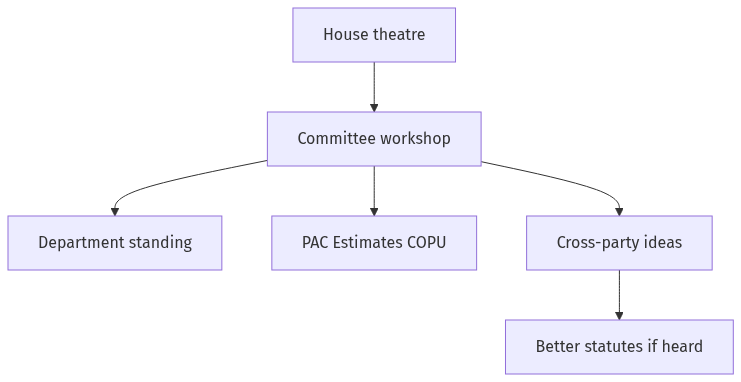
Parliamentary committees are the efficient working form of Indian parliamentary democracy, where bills, grants, and CAG reports can be examined in detail. Department-related Standing Committees mix Lok Sabha and Rajya Sabha members across ministries; PAC, Estimates, and COPU are the financial core. Cross-pollination happens because the whip is weaker, witnesses bring expertise, and members may agree on technical text they would never concede in the well of the House. The tool fails when bills are not referred, demands are guillotined, or ordinances replace debate. Committees strengthen democracy only if the House and the executive treat their reports as more than annual ritual.
Model answer
Copper italics in this answer — like this — are the key facts. Each one is unpacked in the Facts & figures rail.
Introduction
Parliament in full House is a theatre of majority and opposition. Parliament in committee is a workshop. Walter Bagehot already distinguished the dignified and efficient parts of the constitution. In India, the committee system is the efficient part of parliamentary democracy: smaller rooms, papers, witnesses, and the chance for members to think across the aisle. The question is right to link that chance with cross-pollination of ideas.
Body
Why committees are a strong tool
A sitting of 700-odd members cannot vet a finance bill line by line, nor sit with the Defence Secretary on preparedness. Department-related Standing Committees, created in two waves (1993 and 2004) after the Rules Committee and the experience of other Westminster systems, cover ministries. They examine demands for grants, bills, and long-term policy. The Public Accounts Committee, guided by CAG reports and traditionally chaired by an opposition member, and the Estimates and Public Undertakings Committees, are the older financial trinity from the G. V. Mavalankar and Asok Chanda years of parliamentary culture.
Select and joint committees on bills — GST in its long gestation, or more recently high-salience social bills when they are actually referred — force the executive to answer clause by clause. Ivor Jennings called committees the House in miniature. Indian practice adds a federal flavour when Rajya Sabha members sit with Lok Sabha members on DRSCs, mixing states’ voices with the majority’s mandate.
Cross-pollination
In committee, the whip is weaker, cameras are fewer, and expertise can outrank the day’s slogan. A backbencher from a regional party may persuade a ruling-party specialist on a technical amendment. Retired secretaries, scholars, and industry appear as witnesses; members borrow language from one another’s notes. This is Mill’s representative government as discussion, not only as counting. It is also a mild version of Arendt’s space of appearance: speech that is recorded in a report even if the vote in the House later follows the whip.
The 2002–2010s education and defence reports often show bipartisan paragraphs that Question Hour would not produce.
Limits
Money bills, ordinances, and guillotined grants empty the workshop. Leaderships punish dissent. Referral of bills has declined in some sessions. Cross-pollination is real only if the House reads the reports and the majority does not treat committee as a waiting room for the whip.
Flow diagram
Conclusion
Committees make parliamentary democracy workable by specialising scrutiny and by letting ideas move across party and House lines. They are strong when bills and budgets go there and when reports matter. They fail when the executive legislates by surprise. The cross-pollination the question names is the civic justification of the system, not a guaranteed harvest.
Quick related
Students also ask
-
Enunciate the impediments to women's participation in local governance in the process of political decentralisation
Next question on this syllabus topic (2025 · Q7(a)). View answer →
-
Are committee reports binding?
No. They recommend. Their force is publicity, expertise, and the political cost of ignoring a unanimous all-party text.
-
Why include Rajya Sabha members on DRSCs?
To let the Council of States work on ministries that the federal bargain cares about, and to mix longer tenures with the Lok Sabha’s majority.
Same topic · past papers
UPSC has asked this before
These previous-year questions sit on the same topic. Open one to practise the earlier ask.
-
2023 · Q3(a) · PSIR GS 1 · 20 marks
Fascism displays an ambivalent stance towards parliamentary democracy. Explain
More from this topic
Q8(b) · UPSC Mains 2026 · PSIR GS 1 · 15 marks · Solution
Critically comment on the shifts in the functioning of the Indian Parliament in the last two decades
Indian Nationalism
This 15-mark answer analyses the transformation of the Indian Parliament over the past two decades, moving from a deliberative forum to an arena of executive assertion. It highlights declining debate hours, bypassing of Department-Related Standing Committees (DRSCs), and the rise of ordinance-making and bypassing of bicameral consensus through Money Bills. The critique incorporates Morris-Jones and Pratap Bhanu Mehta's insights on the hollowing out of institutions. The conclusion argues for systemic institutional reforms to restore Parliament's core constitutional role as a deliberative check on executive power.
Q7(a) · UPSC Mains 2025 · PSIR GS 1 · 20 marks · Solution
Enunciate the impediments to women's participation in local governance in the process of political decentralisation
Indian Nationalism
The 73rd and 74th Amendments reserved local seats for women, which is a structural opening, not yet equal participation. Sarpanch-pati proxy rule, unpaid care, and a male bureaucracy remain the everyday patriarchal impediments. Caste and class decide which women can act; Dalit women office-holders face additional violence and veto. Thin devolution of money and staff makes many local offices ceremonial, so participation has no policy content. Parties and seat rotation often transfer the reserved ticket to a household rather than building a woman’s public career.
Q7(b) · UPSC Mains 2025 · PSIR GS 1 · 20 marks · Solution
Caste remains a vital axis for political mobilisation in India. How would the caste census address the aspirations of people? Discuss
Indian Nationalism
Caste remains a mobilisation axis because it still structures dignity, land, and access to the state, as Kothari, Mandal, and bahujan politics show. Parties already count jatis; the demand is that the official Census should too, beyond SC and ST. Aspirations include fairer reservation design, targeting of welfare, and recognition after the unpublished 2011 SECC caste data. Risks include reification of identity and a pure percentage war that forgets class, gender, and Ambedkar’s horizon of annihilation. A democratic census would publish usable aggregates while protecting persons and keeping constitutional individual rights at the centre.