
Revision summary
August 2019 ended J&K’s special constitutional status and reorganised the state into two Union Territories. A Lieutenant Governor-centred executive, new domicile and land rules, and the 2023 Supreme Court judgment now frame politics. Security policy, targeted violence, and development claims compete as rival legitimacies. Delimitation and the 2024 assembly election restored party competition, with NC, BJP, and a weakened PDP as principal markers. Statehood remains the central unfinished institutional demand of the new landscape.
Model answer
Copper italics in this answer — like this — are the key facts. Each one is unpacked in the Facts & figures rail.
Introduction
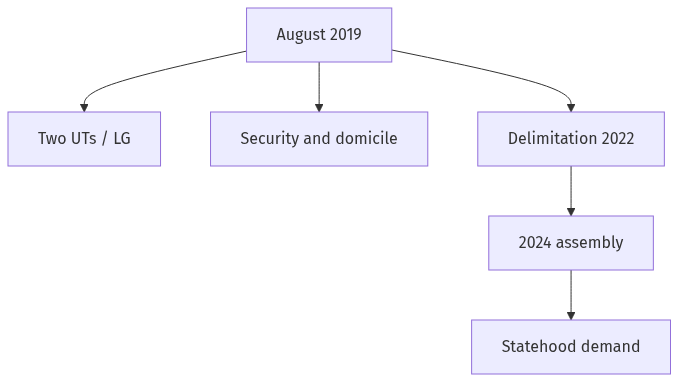
On 5–6 August 2019 the Union ended the special constitutional position of Jammu and Kashmir under Article 370, and Parliament passed the Jammu and Kashmir Reorganisation Act. The political landscape since then has been shaped by that legal break, by security policy, by new electoral arithmetic, and by the unmet demand for restoration of statehood. These are the key factors, not a single story of peace or of rupture alone.
Body
Constitutional and institutional change
- Presidential orders and the Reorganisation Act created two Union Territories: J&K with a legislature, and Ladakh without one. The old state constitution and constituent assembly logic of Article 370 were declared spent. Land, jobs, and domicile rules were recast under Union-territory administration, with a Lieutenant Governor as the hinge of executive power. This shifted politics from a bargained special autonomy to a more direct Union frame, closer to Delhi’s other territories than to the 1950s Delhi Agreement.
The Supreme Court’s 2023 judgment upheld the Union’s route and noted the promise of statehood. Statute plus court now structure what parties may say.
Security, society, and economy
Official narratives stress reduced street violence and investment. Counter-narratives stress detentions in 2019, targeted killings, and domicile anxiety. Institutions without consent, as conflict scholars have long argued, do not end a disputed politics.
Delimitation, elections, and parties
The 2022 delimitation reopened the Jammu–Kashmir seat balance. The 2024 assembly vote returned competition: National Conference in office, BJP strong in Jammu, PDP weakened. The Lieutenant Governor versus elected ministry split over police and land is the daily federal story. Until statehood returns, the landscape is electoral yet thinner than a full state.
Flow diagram
Conclusion
Post-2019 J&K is defined by the end of Article 370, Union-territory government, security-led administration, delimitation, and a revived but constrained electoral arena. The key factors are legal centralisation, the LG–ministry split, regional party adaptation, and the unfinished promise of statehood.
Quick related
Students also ask
-
Parliamentary Committees are a strong tool of Parliamentary Democracy. It provides for the opportunity for cross-pollination of ideas among members of the Parliament. Discuss
Next question on this syllabus topic (2025 · Q6(a)). View answer →
-
Is J&K now an ordinary Indian state politically?
It has an elected assembly again, but as a Union Territory the LG and Union retain powers that full states do not, which is why statehood is still the hinge.
-
Did 2019 end regional parties?
No. It interrupted them. The 2024 vote showed the National Conference could still win a mandate inside the new rules.
Same topic · past papers
UPSC has asked this before
These previous-year questions sit on the same topic. Open one to practise the earlier ask.
-
2022 · Q2(a) · PSIR GS 1 · 20 marks
Factors like community, culture and nation weaken the hegemony of neo-liberalism today. Discuss -
2022 · Q6(a) · PSIR GS 1 · 20 marks
Electoral behaviour of voters is governed more by the social and economic factors than the political factors. Explain
More from this topic
Q8(b) · UPSC Mains 2026 · PSIR GS 1 · 15 marks · Solution
Critically comment on the shifts in the functioning of the Indian Parliament in the last two decades
Indian Nationalism
This 15-mark answer analyses the transformation of the Indian Parliament over the past two decades, moving from a deliberative forum to an arena of executive assertion. It highlights declining debate hours, bypassing of Department-Related Standing Committees (DRSCs), and the rise of ordinance-making and bypassing of bicameral consensus through Money Bills. The critique incorporates Morris-Jones and Pratap Bhanu Mehta's insights on the hollowing out of institutions. The conclusion argues for systemic institutional reforms to restore Parliament's core constitutional role as a deliberative check on executive power.
Q7(a) · UPSC Mains 2025 · PSIR GS 1 · 20 marks · Solution
Enunciate the impediments to women's participation in local governance in the process of political decentralisation
Indian Nationalism
The 73rd and 74th Amendments reserved local seats for women, which is a structural opening, not yet equal participation. Sarpanch-pati proxy rule, unpaid care, and a male bureaucracy remain the everyday patriarchal impediments. Caste and class decide which women can act; Dalit women office-holders face additional violence and veto. Thin devolution of money and staff makes many local offices ceremonial, so participation has no policy content. Parties and seat rotation often transfer the reserved ticket to a household rather than building a woman’s public career.
Q7(b) · UPSC Mains 2025 · PSIR GS 1 · 20 marks · Solution
Caste remains a vital axis for political mobilisation in India. How would the caste census address the aspirations of people? Discuss
Indian Nationalism
Caste remains a mobilisation axis because it still structures dignity, land, and access to the state, as Kothari, Mandal, and bahujan politics show. Parties already count jatis; the demand is that the official Census should too, beyond SC and ST. Aspirations include fairer reservation design, targeting of welfare, and recognition after the unpublished 2011 SECC caste data. Risks include reification of identity and a pure percentage war that forgets class, gender, and Ambedkar’s horizon of annihilation. A democratic census would publish usable aggregates while protecting persons and keeping constitutional individual rights at the centre.