
Revision summary
The Northeast’s security problems mix leftover insurgency, ethnic conflict, drugs, migration and Myanmar-China borders. The 2020 Bodo Accord and 2021 Karbi Accord were the big Assam settlements of the decade. The 2015 Naga framework agreement is still not a final peace. The 2020 Bru-Reang deal and 2023 UNLF pact sit beside Manipur’s 2023 ethnic violence. Assam’s border agreements with Meghalaya and Arunachal tried to quiet inter-State maps.
Model answer
Copper italics in this answer — like this — are the key facts. Each one is unpacked in the Facts & figures rail.
Introduction
The North-East is strategically vital due to its international borders, ethnic diversity and connectivity with mainland India through the Siliguri Corridor. Although insurgency has declined significantly, internal security remains shaped by ethnic tensions, porous borders, organised crime and unresolved political demands, making peace a continuing process rather than a one-time settlement.
Body
Major challenges to internal security and peace process
- Insurgency and unfinished political settlements: Several insurgent groups continue to operate or retain unresolved political demands despite the decline in violence.
- Example: The NSCN-IM continues to seek resolution of issues such as a separate Naga flag and constitution, leaving the 2015 Framework Agreement unfinished.
- Ethnic conflict and identity politics: Competition over land, political representation, resources and ethnic identity can transform local disputes into prolonged violence.
- Example: The Meitei–Kuki-Zo conflict in Manipur since 2023 demonstrated how unresolved identity and land-related tensions can overwhelm existing peace mechanisms.
- Porous international borders and difficult terrain: Mountainous terrain and difficult-to-monitor borders facilitate infiltration, arms trafficking and movement of insurgent groups.
- Example: The India–Myanmar border provides difficult terrain and cross-border spaces that can be exploited by armed groups.
- Drug and arms trafficking: Proximity to the Golden Triangle creates a strong narcotics–arms–insurgency nexus.
- Migration and demographic anxieties: Migration and refugee flows can intensify competition over land, employment, political representation and cultural identity.
- Example: The post-2021 Myanmar conflict has generated refugee inflows into states such as Mizoram and Manipur.
- Inter-State boundary disputes: Colonial-era boundaries and competing territorial claims continue to create local tensions.
- Example: Long-standing disputes between Assam–Mizoram, Assam–Nagaland and Assam–Meghalaya have periodically produced confrontation.
- External and geopolitical pressures: The region's proximity to China, Myanmar and Bangladesh gives local conflicts a wider strategic dimension.
- Example: China's territorial claims over Arunachal Pradesh add a strategic layer to the region's internal-security concerns.
- Governance and development deficit: Limited employment opportunities, connectivity gaps and perceived political exclusion can sustain alienation even after armed violence declines.
- Information and technological threats: Social media can accelerate misinformation, communal polarisation and mobilisation, while drones and modern communication technologies can aid illicit activities.
Peace accords and agreements: 2015–2025
- 2015 — Naga Framework Agreement | Nagaland: Agreement between the Government of India and NSCN-IM, recognising the unique history and identity of the Nagas and establishing a framework for further negotiations.
- Current challenge: Differences over a separate Naga flag, constitution and Greater Nagalim continue to delay a final settlement.
- 2020 — Bodo Peace Accord | Assam: Tripartite agreement with NDFB factions aimed at ending the armed Bodo movement and strengthening the Bodoland Territorial Region.
- Outcome: Former militants were brought into the political mainstream through rehabilitation and democratic participation.
- 2020 — Bru-Reang Agreement | Tripura/Mizoram: Agreement for the permanent settlement and rehabilitation of Bru-Reang displaced families.
- Outcome: It addressed a long-standing displacement and rehabilitation issue through permanent resettlement.
- 2021 — Karbi Anglong Agreement | Assam: Agreement with Karbi groups to end armed insurgency and strengthen autonomous governance and development in Karbi Anglong.
- Outcome: Armed groups were brought into the mainstream through surrender, rehabilitation and political arrangements.
- 2022 — Assam–Meghalaya Border Agreement: Partial settlement of the long-standing inter-State boundary dispute.
- Outcome: Disputes in 6 of the 12 identified areas were resolved through negotiated settlement.
- 2023 — Assam–Arunachal Pradesh Border Agreement: Agreement aimed at resolving the decades-old boundary dispute between the two States.
- Outcome: It addressed more than 1,200 disputed points along the inter-State boundary.
- 2023 — UNLF Peace Agreement | Manipur: Peace agreement with the United National Liberation Front (UNLF), bringing the group into the mainstream.
- Outcome: The agreement involved renunciation of violence, surrender of arms and participation in the democratic process.
- 2024 — Tripura Peace Agreement: Agreement involving the Government of India, Tripura government and NLFT/ATTF factions to end armed insurgency and facilitate rehabilitation.
- Outcome: Surrender of cadres and their rehabilitation formed key elements of the settlement.
- Continuous — Suspension of Operations (SoO): Ceasefire arrangements with armed groups provide space for dialogue and prevent immediate escalation.
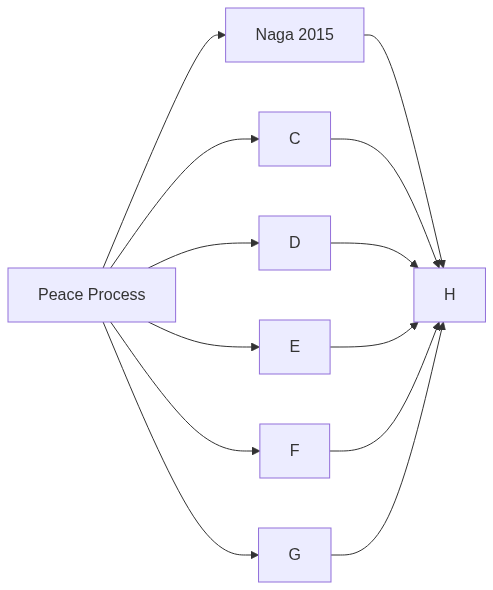
Flow diagram
Conclusion
The North-East requires a shift from conflict management to durable conflict resolution. Peace accords have reduced organised insurgency, but inclusive dialogue, effective implementation, border management, development and reconciliation between communities are essential to ensure that political settlements translate into sustainable peace.
Quick related
Students also ask
-
What are the internal security challenges being faced by India? Give out the role of Central Intelligence and Investigative Agencies tasked to counter such threats.
Next question on this syllabus topic (2023 · Q19). View answer →
-
Did AFSPA end in the Northeast?
It has been lifted or reduced in several districts over the 2020s. It remains in some still-notified areas.
-
Is a border fence the peace process?
A fence is a tool against some crossings. Peace is who sits in a council and who has a job.
Same topic · past papers
UPSC has asked this before
These previous-year questions sit on the same topic. Open one to practise the earlier ask.
-
2017 · Q10 · GS III · 10 marks
The north-eastern region of India has been infested with insurgency for a very long time. Analyze the major reasons for the survival of armed insurgency in this region. -
2024 · Q13 · GS III · 15 marks
What are the major challenges faced by Indian irrigation system in recent times? State the measures taken by the government for efficient irrigation management. -
2022 · Q3 · GS III · 10 marks
What are the major challenges of Public Distribution System (PDS) in India ? How can it be made effective and transparent ?
More from this topic
Q19 · UPSC Mains 2026 · GS III · 15 marks · Solution
Separatist movements have been one of the major factors contributing to militancy and instability in Jammu & Kashmir (J&K). Bring out actions taken by the Government to bring J&K into national mainstream. Discuss pre and post abrogation status of Articles 370 and 35A. Also bring out positive impacts of abrogation of both articles in mainstreaming the state.
Internal Security and Extremism
• J&K's historical instability stemmed from separatist radicalization and cross-
Q10 · UPSC Mains 2025 · GS III · 10 marks · Solution
The Government of India recently stated that Left Wing Extremism (LWE) will be eliminated by 2026. What do you understand by LWE and how are the people affected by it? What measures have been taken by the government to eliminate LWE?
Internal Security and Extremism
Left Wing Extremism in India means the Maoist insurgency centred on central Indian forest-tribal belts. Villagers suffer killings, extortion, closed schools and the crossfire of operations. Official figures show fewer severely affected districts and fewer deaths than at the peak. SAMADHAN combines intelligence, camps, surrenders and connectivity. A 2026 ‘end’ is credible as a shrinking map, not as the death of every idea; development and forest rights decide whether the map stays quiet.
Q20 · UPSC Mains 2023 · GS III · 15 marks · Solution
Give out the major sources of terror funding in India and efforts being made to curtail these sources. In the light of this, also discuss the aim and objective of the ' No Money for Terror [NMFT]' Conference recently held at New Delhi in November 2022.
Internal Security and Extremism
Major sources are overseas patronage, hawala, narcotics, counterfeit notes, extortion, misuse of non-profits, and emerging crypto rails. India uses UAPA, PMLA, NIA, FIU-IND, FCRA, narcotics and fake-currency drives, and FATF standards. The No Money for Terror conference in New Delhi in November 2022 was the third ministerial on terror finance. Its aim was joint investigation, freezing, and no safe haven for financiers, including new payment tech. International cooperation is required because the money chain is rarely inside one country.