
Revision summary
PDS under NFSA 2013 is a legal grain entitlement, not a discretionary dole. Main challenges are wrong lists, diversion, poor quality, weak last-mile shops, and a rice-wheat nutrition gap. Migrants lose access when the card is locked to one State. Effectiveness needs computerised supply chains, e-PoS, One Nation One Ration Card, social audits, and exception rules when biometrics fail. DBT can complement urban PDS; it is a poor substitute where food markets are thin.
Model answer
Copper italics in this answer — like this — are the key facts. Each one is unpacked in the Facts & figures rail.
Introduction
The Public Distribution System (PDS) is the State’s grain pipeline from the Food Corporation of India and State agencies to the ration shop. Under the National Food Security Act, 2013 it is a legal entitlement for a large share of households. Leakage, exclusion and poor quality have dogged it for decades. Reforms now run through Aadhaar, digitised records and, in some States, One Nation One Ration Card.
Body
Major challenges
- Inclusion and exclusion errors: deserving households missing from the list; better-off names remaining. Migration breaks the old State-bound ration card.
- Leakage and diversion: grain siphoned between the godown and the shop; ghost cards; under-weighing at the counter.
- Quality and nutrition: wheat and rice dominate; coarse grains, pulses and oil are uneven; storage pests and moisture spoil stocks.
- Last-mile shop: irregular hours, poor weighing, and a dealer who is also a local power-holder.
- Fiscal and logistics load: high economic cost of procurement, carrying and storage; yet the poor still face out-of-pocket if the shop is shut.
- Intra-household and gender: the card is often in a male name; women and the aged may not actually receive the grain.
Making PDS effective and transparent
- End-to-end computerisation: digitised beneficiary lists, electronic weighing, and GPS or e-PoS at the fair-price shop so off-take matches Aadhaar authentication.
- One Nation One Ration Card so a migrant can lift grain in the destination State against the same entitlement.
- Grievance and social audit: recorded complaints, display of stock, and panchayat or urban ward audits; the NFSA already requires transparency machinery.
- Cover the genuinely poor: use Socio-Economic Caste Census-type lists with periodic revision; do not punish a failed biometric with a starved month—keep an exception protocol.
- Diversify the basket where fiscally possible (millets, pulses) and improve scientific storage to cut wastage.
- Direct Benefit Transfer of the food subsidy is an option in some urban settings; it should not replace physical grain where markets are thin or prices spike.
Balance
- Technology cuts ghost cards. It does not by itself put grain in a remote hamlet. Effectiveness is stock plus shop plus list, not a portal alone.
Flow diagram
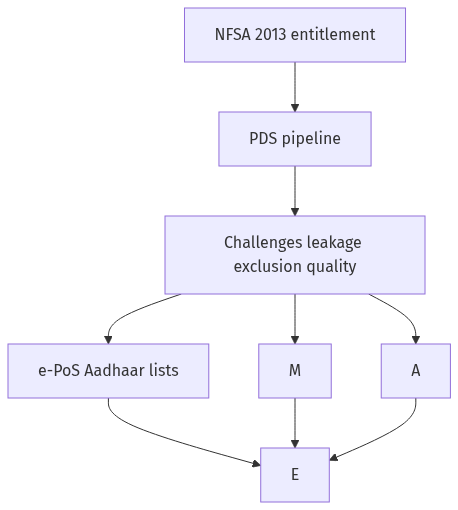
Conclusion
PDS fails when lists are wrong, grain is diverted, and shops are unaccountable. NFSA 2013 made food a right; digitisation, One Nation One Ration Card, social audit and a nutrition-wider basket are how that right becomes a transparent monthly lift. Biometrics must aid the entitled, not lock them out.
Quick related
Students also ask
-
Do you think India will meet 50 percent of its energy needs from renewable energy by 2030 ? Justify your answer. How will the shift of subsidies from fossil fuels to renewables help achieve the above objective ? Explain.
Next question on this syllabus topic (2022 · Q12). View answer →
-
Does Aadhaar authentication end leakage?
It cuts ghost cards. Diversion can still occur before the shop, and a failed fingerprint can wrongly deny a genuine household.
-
Is DBT always better than grain?
Not where local food prices are volatile or shops are the only reliable supply. Cash helps when markets work.
Same topic · past papers
UPSC has asked this before
These previous-year questions sit on the same topic. Open one to practise the earlier ask.
-
2019 · Q13 · GS III · 15 marks
What are the reformative steps taken by the Government to make food grain distribution system more effective? -
2018 · Q2 · GS III · 10 marks
Comment on the important changes introduced in respect of the Long term Capital Gains Tax (LCGT) and Dividend Distribution Tax (DDT) in the Union Budget for 2018-2019. (150 Words, 10 Marks). -
2025 · Q19 · GS III · 15 marks
What are the major challenges to internal security and peace process in the North-Eastern States? Map the various peace accords and agreements initiated by the government in the past decade. -
2024 · Q13 · GS III · 15 marks
What are the major challenges faced by Indian irrigation system in recent times? State the measures taken by the government for efficient irrigation management.
More from this topic
Q14 · UPSC Mains 2024 · GS III · 15 marks · Solution
Elucidate the importance of buffer stocks for stabilizing agricultural prices in India. What are the challenges associated with the storage of buffer stock? Discuss.
Farm Subsidies and PDS
Buffer stocks buy rice and wheat at MSP so harvest prices do not crash, and release them through PDS and open sale so retail prices do not spike. FCI and State agencies hold the central cereal pool; a Price Stabilisation Fund is used for some pulses and perishables. Storage challenges: CAP exposure, rodents and fungus, high carrying cost, and stocks piled in a few surplus States. A rice-wheat mountain does not automatically cool onion or tur inflation. Silos, WDRA warehouses and a wider commodity set are the storage reforms that match the price-stability claim.
Q14 · UPSC Mains 2023 · GS III · 15 marks · Solution
What are the direct and indirect subsidies provided to farm sector in India? Discuss the issues raised by the World Trade Organization(WTP) in relation to agricultural subsidies.
Farm Subsidies and PDS
Direct subsidies include fertiliser, power, irrigation, crop-loan subvention, PM-KISAN and insurance premium support. Indirect subsidies include MSP, public procurement, food subsidy, and cheap public research and seed. WTO Amber Box covers trade-distorting price and input support, with 10 per cent de minimis for developing countries. Green Box is uncapped if genuinely non-distorting; Blue Box is production-limiting payments. The peace clause protects public stockholding from disputes pending a permanent solution.
Q12 · UPSC Mains 2022 · GS III · 15 marks · Solution
Do you think India will meet 50 percent of its energy needs from renewable energy by 2030 ? Justify your answer. How will the shift of subsidies from fossil fuels to renewables help achieve the above objective ? Explain.
Farm Subsidies and PDS
Panchamrit targets 50 per cent of installed electric capacity from non-fossil sources by 2030, including hydro and nuclear. That is not 50 per cent of energy needs, and not even 50 per cent of electricity generation, because solar and wind have lower capacity factors. Half of all energy from renewables by 2030 is unlikely given oil and industrial coal. The capacity target is more plausible if transmission, storage and discom health improve. Shifting subsidies from fossils to renewables and storage helps relative prices and manufacturing; social fuels need targeted DBT, not a blunt cut.