
Revision summary
India grows a lot of food and still processes a thin share of fruit and vegetables. Dairy is the mature processing success; marine, spices and grains have export clusters. PMKSY, mega food parks, food PLI, Operation Greens and 100 per cent FDI are the main Union levers. Jobs come in packing, cold chain and MSME units if raw material and power are real. Ultra-processed snacks are a health caveat inside the same industry.
Model answer
Copper italics in this answer — like this — are the key facts. Each one is unpacked in the Facts & figures rail.
Introduction
India has a large and diversified agricultural base, but a relatively low level of value addition through processing. The Food Processing Industry (FPI) can bridge agriculture and industry by converting farm produce into higher-value, safer and longer-lasting products while creating employment, reducing post-harvest losses and expanding exports.
Body
Scope of Food Processing Industry in India
1. Large raw-material base
- India is a major producer of milk, fruits, vegetables, cereals, sugar, spices, marine products and livestock, providing a strong raw-material base for processing.
- This creates scope for developing farm-to-factory value chains and strengthening India's position in global food markets.
2. Low level of processing = large untapped potential
- A significant share of agricultural produce is still sold in relatively unprocessed form.
- Example: Low processing of fruits and vegetables indicates substantial potential for pulp, juice, frozen food, dehydration and ready-to-eat products.
- Expansion of processing can therefore increase value addition and farmer realisation.
3. Reduction in post-harvest losses
- Processing, cold chains and better storage can extend the shelf life of perishables and reduce wastage.
- This can also moderate seasonal price volatility and improve supply-chain efficiency.
4. Employment generation
- FPI is relatively labour-intensive, creating employment in processing, packaging, logistics, cold chains, quality control and marketing.
- It can generate rural non-farm employment, particularly for women and surplus agricultural labour.
5. Exports and economic growth
- Processed foods such as marine products, spices, basmati rice and other value-added agricultural products can expand India's export basket.
- The sector can strengthen agriculture–industry linkages, attract investment and increase manufacturing value addition.
6. Scope for MSMEs and local value chains
- Food processing provides opportunities for MSMEs, SHGs, FPOs and local enterprises to convert region-specific agricultural products into branded products.
- Example: The One District One Product (ODOP) approach can develop local processing and marketing ecosystems.
Government Measures for Generating Employment
1. Pradhan Mantri Kisan SAMPADA Yojana (PMKSY)
- Supports food-processing infrastructure, Mega Food Parks, cold chains and agro-processing clusters.
- Better infrastructure creates employment across processing, storage, transportation and logistics.
2. PM Formalisation of Micro Food Processing Enterprises (PM-FME)
- Supports micro food-processing enterprises, particularly in the unorganised sector.
- Provides credit-linked support and seed capital to SHGs, helping create local enterprises and self-employment.
- Example: ODOP under PM-FME promotes district-level products and strengthens local value chains.
3. Production Linked Incentive Scheme for Food Processing Industry (PLISFPI)
- Provides incentives linked to incremental sales of domestically manufactured food products.
- Encourages investment, expansion of processing capacity and creation of direct and indirect employment.
4. Operation Greens
- Initially focused on Tomato, Onion and Potato (TOP) and subsequently expanded to other perishables.
- Supports transportation and storage, thereby strengthening supply chains and employment in logistics and cold storage.
5. Foreign Direct Investment
- 100% FDI through the automatic route in food processing facilitates capital and technology inflows.
- This can expand processing capacity and generate employment across the value chain.
6. Skill development
- Food-processing-specific training under government skill-development initiatives helps create a skilled workforce for processing, packaging, quality control and allied activities.
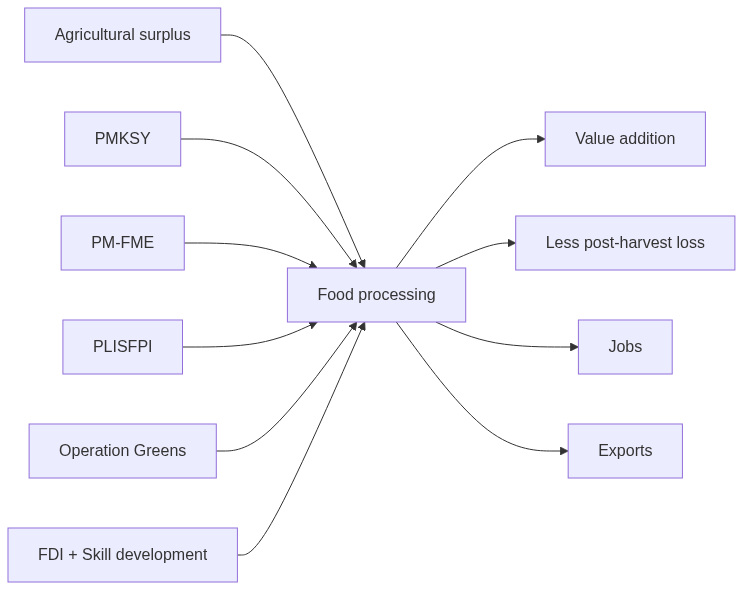
Flow diagram
Conclusion
The Food Processing Industry can transform India's agricultural surplus into value, employment and exports. Government interventions through PMKSY, PM-FME, PLISFPI, Operation Greens, FDI and skill development can strengthen processing capacity and rural employment. The key is to integrate farmers, infrastructure, enterprises and markets into efficient value chains.
Quick related
Students also ask
-
Elaborate the scope and significance of the food processing industry in India.
Next question on this syllabus topic (2022 · Q4). View answer →
-
Does a mega food park always mean jobs?
Only if farmers, power and a buyer exist. Several parks have lagged as real estate more than as factories.
-
Is street food processing?
It is a large informal food economy. Formal processing is the regulated, scalable cousin.
Same topic · past papers
UPSC has asked this before
These previous-year questions sit on the same topic. Open one to practise the earlier ask.
-
2020 · Q4 · GS III · 10 marks
What are the challenges and opportunities of food processing sector in the country? How can income of the farmers be substantially increased by encouraging food processing? -
2024 · Q13 · GS III · 15 marks
What are the major challenges faced by Indian irrigation system in recent times? State the measures taken by the government for efficient irrigation management. -
2018 · Q18 · GS III · 15 marks
Describe various measures taken in India for Disaster Risk Reduction (DRR) before and after signing 'Sendai Framework for DRR (2015-2030)'. How is this framework different from 'Hyogo Framework for Action, 2005'? (250 Words, 15 Marks).
More from this topic
Q4 · UPSC Mains 2022 · GS III · 10 marks · Solution
Elaborate the scope and significance of the food processing industry in India.
Food Processing
Food processing converts perishable farm output into milled, dairy, frozen and packaged products. India’s production base is large; organised processing still covers only a modest share, so scope is wide. SAMPADA, food-processing PLI, ODOP and FSSAI standards are the main Union tools. Significance is higher farmer realisation, less post-harvest loss, consumer safety, exports and jobs. Micro units still face power, cold-chain and compliance costs.
Q14 · UPSC Mains 2019 · GS III · 15 marks · Solution
Elaborate the policy taken by the Government of India to meet the challenges of the food processing sector.
Food Processing
Food processing must cut perishable wastage, formalise units, and raise farm prices in a glut. Mega Food Parks and integrated cold chain are the cluster and logistics tools. SAMPADA / PM Kisan SAMPADA Yojana is the umbrella; Operation Greens began with tomato, onion, and potato. 100 per cent FDI and FSSAI standards bring capital and safety. Success needs FPO contracts, a full reefer network, and power and GST that let units stay formal.
Q6 · UPSC Mains 2015 · GS III · 12 marks · Solution
What are the impediments in marketing and supply chain management in developing the food processing industry in India? Can e-commerce help in overcoming this bottleneck?
Food Processing
Food processing needs a reliable farm-to-plant chain, which India still lacks at scale. APMC rules, many intermediaries, 25–30 per cent horticulture wastage and thin cold chain are the main impediments. Standards, roads, working capital and Mega Food Park last-mile links also lag. E-commerce helps price discovery, orders and payments, and branded retail reach. Physical cold logistics and market-law reform remain necessary; an app is not a pack-house.