
Revision summary
Food processing converts perishable farm output into milled, dairy, frozen and packaged products. India’s production base is large; organised processing still covers only a modest share, so scope is wide. SAMPADA, food-processing PLI, ODOP and FSSAI standards are the main Union tools. Significance is higher farmer realisation, less post-harvest loss, consumer safety, exports and jobs. Micro units still face power, cold-chain and compliance costs.
Model answer
Copper italics in this answer — like this — are the key facts. Each one is unpacked in the Facts & figures rail.
Introduction
India grows a vast primary surplus—grain, milk, fruit, vegetables, spices, fish and meat—yet much of it is sold raw, seasonal and perishable. The food processing industry turns that produce into flour, oil, dairy, frozen, ready-to-eat and packaged food. Scope is the whole chain from farm gate to retail; significance is less waste, more farm income, and formal jobs.
Body
Scope
- Processing covers primary (cleaning, milling, ginning) and secondary/tertiary (branded snacks, dairy products, beverages, meat and marine, nutraceuticals).
- India is among the world’s large producers of milk, spices, fruit and vegetables; organised processing is still a modest share of that output, so the headroom is large.
- Segments with clear room include cold-chain horticulture, millet-based foods, marine exports, buffalo meat, and traditional foods brought to FSSAI standards.
- Policy tools: Ministry of Food Processing Industries, Pradhan Mantri Kisan SAMPADA Yojana (mega food parks, cold chains, value-addition), Production Linked Incentive for food processing, and One District One Product branding.
- FSSAI sets safety standards; without them processed food cannot enter organised retail or export.
Significance
- Farmers: a processor is a bulk buyer who can offer a contract, a tomato paste line, or a milk route; that cuts distress sale at harvest and raises realisation.
- Waste: horticulture and milk spoil; processing and cold chain convert a glut into stock, which is the practical answer to post-harvest loss.
- Consumers: safer, labelled, longer-shelf food; urban demand for convenience is already there.
- Exports: spices, marine products, rice, buffalo meat and processed snacks earn foreign exchange if traceability and residue standards are met.
- Jobs: plants, cold stores, packaging and logistics hire more people per tonne than raw mandi trade, including women in sorting and packing.
- Nutrition and millets: processing can put coarse grains into biscuits and mixes, which matches the International Year of Millets push and PDS diversification.
Constraints to name, not to hide
- Small farm lots, weak backward links, expensive power and cold chain, and compliance cost for micro units. Scope is real; it is not automatic.
Flow diagram
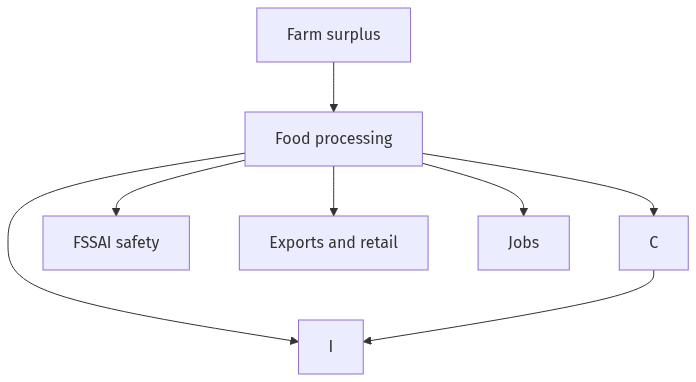
Conclusion
Food processing is the industrial use of India’s farm surplus. Its scope runs from mill to branded export. Its significance is farm income, less wastage, safer food, jobs and foreign exchange. SAMPADA, PLI and FSSAI are the present rails; they work when the plant is tied to a cluster of actual growers.
Quick related
Students also ask
-
Elaborate the policy taken by the Government of India to meet the challenges of the food processing sector.
Next question on this syllabus topic (2019 · Q14). View answer →
-
Does processing only help large brands?
Brands scale fastest, but farmer income rises only if procurement is linked to the growing region, including FPOs and clusters.
-
Why is FSSAI in a processing answer?
Because unsafe or unlabelled food cannot enter organised retail or export; standards are part of industrial scope.
Same topic · past papers
UPSC has asked this before
These previous-year questions sit on the same topic. Open one to practise the earlier ask.
-
2025 · Q14 · GS III · 15 marks
Examine the scope of the food processing industries in India. Elaborate the measures taken by the government in the food processing industries for generating employment opportunities. -
2025 · Q4 · GS III · 10 marks
Elaborate the scope and significance of supply chain management of agricultural commodities in India. -
2019 · Q19 · GS III · 15 marks
Indian Government has recently strengthened the anti-terrorism laws by amending the unlawful Activities (Prevention) Act (UAPA), 1967 and the NIA act. Analyze the changes in the context of prevailing security environment while discussing the scope and reasons for opposing the UAPA by human rights organizations. -
2016 · Q13 · GS III · 12 marks
Why is nanotechnology one of the key technologies of the 21st century? Describe the salient features of Indian Government's Mission on Nanoscience and Technology and the scope of its application in the development process of the country.
More from this topic
Q14 · UPSC Mains 2025 · GS III · 15 marks · Solution
Examine the scope of the food processing industries in India. Elaborate the measures taken by the government in the food processing industries for generating employment opportunities.
Food Processing
India grows a lot of food and still processes a thin share of fruit and vegetables. Dairy is the mature processing success; marine, spices and grains have export clusters. PMKSY, mega food parks, food PLI, Operation Greens and 100 per cent FDI are the main Union levers. Jobs come in packing, cold chain and MSME units if raw material and power are real. Ultra-processed snacks are a health caveat inside the same industry.
Q14 · UPSC Mains 2019 · GS III · 15 marks · Solution
Elaborate the policy taken by the Government of India to meet the challenges of the food processing sector.
Food Processing
Food processing must cut perishable wastage, formalise units, and raise farm prices in a glut. Mega Food Parks and integrated cold chain are the cluster and logistics tools. SAMPADA / PM Kisan SAMPADA Yojana is the umbrella; Operation Greens began with tomato, onion, and potato. 100 per cent FDI and FSSAI standards bring capital and safety. Success needs FPO contracts, a full reefer network, and power and GST that let units stay formal.
Q6 · UPSC Mains 2015 · GS III · 12 marks · Solution
What are the impediments in marketing and supply chain management in developing the food processing industry in India? Can e-commerce help in overcoming this bottleneck?
Food Processing
Food processing needs a reliable farm-to-plant chain, which India still lacks at scale. APMC rules, many intermediaries, 25–30 per cent horticulture wastage and thin cold chain are the main impediments. Standards, roads, working capital and Mega Food Park last-mile links also lag. E-commerce helps price discovery, orders and payments, and branded retail reach. Physical cold logistics and market-law reform remain necessary; an app is not a pack-house.