
Revision summary
Indian irrigation is stressed by falling groundwater, leaky canals, climate swings, fragmented plots and cheap farm power. Tube-wells now dominate many States; north-western paddy-wheat is a leading depletion case. PMKSY bundles access, per-drop-more-crop micro-irrigation and watersheds. Atal Bhujal supports community groundwater budgets in stressed blocks; command-area lining and water-user associations target the canal tail. Solar pumps help energy but can increase extraction unless paired with a water limit and crop shift.
Model answer
Copper italics in this answer — like this — are the key facts. Each one is unpacked in the Facts & figures rail.
Introduction
Indian irrigation is still the difference between a stable grain bowl and a rain gamble. The system is under stress that is recent as well as old: aquifers falling, canals leaking, climate swinging, and a power-water nexus that pays farmers to pump the future dry. Efficiency is therefore not a sprinkler catalogue. It is governance of a shared, shrinking litre.
Body
Challenges in recent times
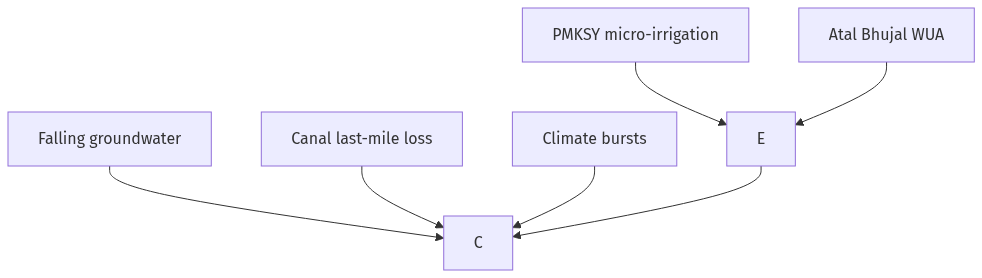
Groundwater now waters more Indian plots than canals in many States, and the water table in Punjab, Haryana, western UP, Rajasthan and parts of the peninsula has been in long decline. Canal irrigation still loses a large share to seepage and theft before the tail-ender sees a wetting. Climate makes the monsoon burstier: a flood week, then a dry spell, which wrecks both reservoir scheduling and a rainfed sowing. Fragmented holdings make field channels expensive. Energy subsidies for pump-sets turn groundwater into a free common. Waterlogging and salinity persist in some command areas. Inter-State river disputes delay projects. Urban and industrial demand now competes with the field. Maintenance of minor irrigation tanks in the south and east has lagged, even though those tanks were climate buffers. The challenge is therefore too much pumping, too little last-mile, and a climate that no longer matches the old reservoir rule-curve.
- Peg: Tube-well India and canal India are two systems; both are stressed, for different reasons.
- Peg: The paddy–wheat MSP couple in the north-west is a groundwater story as much as a food story.
Measures for efficient management
PMKSY (Pradhan Mantri Krishi Sinchayee Yojana) is the umbrella: Har Khet Ko Pani for access, Per Drop More Crop for micro-irrigation, and watershed work. Atal Bhujal Yojana pays for community groundwater management in notified water-stressed blocks. Command Area Development and lining try to finish the last mile of old dams. Drip and sprinkler subsidies, often through State missions, cut flood irrigation on horticulture and sugarcane. Participatory Irrigation Management and Water User Associations are meant to take the outlet out of a purely departmental hand. Solar pumps (including KUSUM) cut diesel but can worsen extraction unless they are paired with feeder separation or a water budget. River-linking is a larger, contested structural bet; efficiency first is the cheaper claim. Crop diversification out of paddy in depleted blocks is the agricultural measure that irrigation engineering cannot skip.
- Peg: PMKSY plus Atal Bhujal is the Union’s efficiency pair: more crop per drop, and less reckless pumping.
- Peg: A solar pump without a water budget is a cleaner way to empty the aquifer.
Crop, power and federal water
Engineering fails if the crop and the tariff still reward waste. A paddy-wheat MSP couple on a falling water table cannot be cured only by a lined canal. Feeder separation, a water budget, and diversification are irrigation policy by other names. Inter-State river machinery (tribunals, the Inter-State River Water Disputes Act) still decides whether a dam’s water ever becomes a field’s water. Efficiency is therefore agronomy plus electricity plus federal bargaining, not only a drip-pipe tender.
- Peg: Cheap night power for pumps is an irrigation subsidy that can erase a micro-irrigation gain.
- Peg: A tribunal award without last-mile canals is a legal litre, not a wet field.
Flow diagram
Conclusion
Recent irrigation stress is falling groundwater, leaky canals, climate swings and cheap power to pump. Government measures — PMKSY, micro-irrigation, Atal Bhujal, command-area work — aim at efficiency. They work only if the crop and the tariff stop rewarding waste.
Quick related
Students also ask
-
How does e-Technology help farmers in production and marketing of agricultural produce? Explain it.
Next question on this syllabus topic (2023 · Q3). View answer →
-
Is building more dams the main answer now?
New storage can help in some basins. The binding recent problem is often groundwater and last-mile loss, not only missing concrete.
-
Why does drip adoption stay patchy?
Cost, clogging, power and a crop mix that still rewards flood-irrigated paddy and cane.
Same topic · past papers
UPSC has asked this before
These previous-year questions sit on the same topic. Open one to practise the earlier ask.
-
2025 · Q14 · GS III · 15 marks
Examine the scope of the food processing industries in India. Elaborate the measures taken by the government in the food processing industries for generating employment opportunities. -
2025 · Q19 · GS III · 15 marks
What are the major challenges to internal security and peace process in the North-Eastern States? Map the various peace accords and agreements initiated by the government in the past decade. -
2022 · Q3 · GS III · 10 marks
What are the major challenges of Public Distribution System (PDS) in India ? How can it be made effective and transparent ? -
2018 · Q18 · GS III · 15 marks
Describe various measures taken in India for Disaster Risk Reduction (DRR) before and after signing 'Sendai Framework for DRR (2015-2030)'. How is this framework different from 'Hyogo Framework for Action, 2005'? (250 Words, 15 Marks).
More from this topic
Q14 · UPSC Mains 2026 · GS III · 15 marks · Solution
Discuss the different types of subsidies and supports provided by the Government of India to agricultural sector. Examine the related issues pertaining to Agreement on Agriculture of World Trade Organisation (WTO).
Crops, Irrigation and Marketing
• India supports farmers through MSP procurement, subsidized inputs like fertilizers and power, and cheap
Q13 · UPSC Mains 2026 · GS III · 15 marks · Solution
In which manner has Indian agriculture been transformed from food scarcity to food-surplus level? Describe the various government policies implemented for diversification of Indian agriculture.
Crops, Irrigation and Marketing
• India shifted from chronic post-independence food scarcity to a surplus nation through systemic technological
Q5 · UPSC Mains 2026 · GS III · 10 marks · Solution
Explain by giving two examples, how biotechnology has helped the Indian farmers in processing their perishable crops.
Crops, Irrigation and Marketing
• Biotechnology extends the post-harvest shelf life and processing capabilities of perishable crops, protecting farmers from distress sales. • Silencing ripening enzymes (like polygalacturonase) in transgenic varieties prevents premature softening and reduces transit losses. • Example 1: Genetically modified tomatoes engineered to resist rapid rotting during storage without complete cold-chain dependency. • Microbial fermentation and bio-processing convert surplus perishable harvests into stable, high-value industrial and food products. • Enzymatic maceration using pectinases and cellulases allows efficient fruit pulp breakdown and juice extraction. • Example 2: Biotech-driven conversion of surplus horticulture crops into stable concentrates, purees, and fermented beverages. • Scaling these interventions requires strengthening public-private research partnerships and biosafety frameworks.