
Revision summary
Nanotechnology in farming includes nano-fertilisers, lower-dose pesticides, sensors and smarter packaging. India’s public debate has centred on nano urea and nano DAP, with still-contested yield evidence. Gains for farmers would be lower bulk input cost, less residue and better export quality. Ecotoxicity and weak regulation are the downside. Uplift needs ICAR-grade proof, fair price and extension, not only a brand.
Model answer
Copper italics in this answer — like this — are the key facts. Each one is unpacked in the Facts & figures rail.
Introduction
Nanotechnology operates at the 1–100 nanometre scale and enables precise manipulation of agricultural inputs and processes. In agriculture, it can improve nutrient-use efficiency, crop protection, disease detection, soil monitoring and post-harvest management, thereby reducing costs and risks for farmers.
Body
Significant advancements in agriculture
1. Nano-fertilisers
- Nano Urea and Nano DAP enable more targeted and efficient nutrient delivery.
- Foliar application can improve nutrient-use efficiency and reduce losses associated with conventional fertilisers.
2. Nano-pesticides and herbicides
- Nano-formulations enable target-specific delivery of active ingredients.
- This can reduce the quantity of chemicals required and minimise chemical residues and environmental losses.
3. Nano-sensors and nano-biosensors
- Nano-sensors can monitor soil moisture, soil health and crop conditions in real time.
- Nano-biosensors can facilitate early detection of plant pathogens, allowing timely intervention.
4. Controlled delivery systems
- Nanocapsules can deliver nutrients, growth regulators, herbicides and other inputs to specific plant tissues.
- This improves the effectiveness of inputs by reducing premature degradation.
5. Post-harvest management
- Nanocoatings can delay ripening and spoilage of fruits and vegetables.
- Nano-enabled packaging can improve shelf life and preservation during storage and transportation.
6. Agricultural infrastructure
- Antimicrobial nanoparticle coatings can help control microbial growth on agricultural infrastructure and improve its durability.
Uplifting the socio-economic status of farmers
1. Lower input costs
- Higher efficiency of nano-fertilisers and nano-pesticides can reduce the quantity and cost of agricultural inputs.
- Lower bulk requirements can also reduce transport and handling costs.
2. Higher productivity and farm income
- More precise nutrient and crop-protection management can improve crop productivity and resource-use efficiency.
- Higher output per unit of land can contribute to improved farm incomes.
3. Reduced crop-loss risk
- Early detection of pests and pathogens allows timely intervention and protects farmers from sudden crop losses.
- This reduces income volatility and production risk.
4. Reduced post-harvest losses
- Nanocoatings and nano-enabled packaging can extend shelf life and reduce spoilage.
- This can reduce distress sales and allow farmers greater flexibility in choosing when to sell.
5. Sustainable agricultural productivity
- More efficient use of fertilisers and pesticides can reduce soil and groundwater contamination.
- Maintaining soil quality supports the long-term productivity and livelihood security of farmers.
6. Better market opportunities
- Lower chemical residues and improved preservation can help farmers meet quality and export requirements, particularly for high-value agricultural products.
Flow diagram
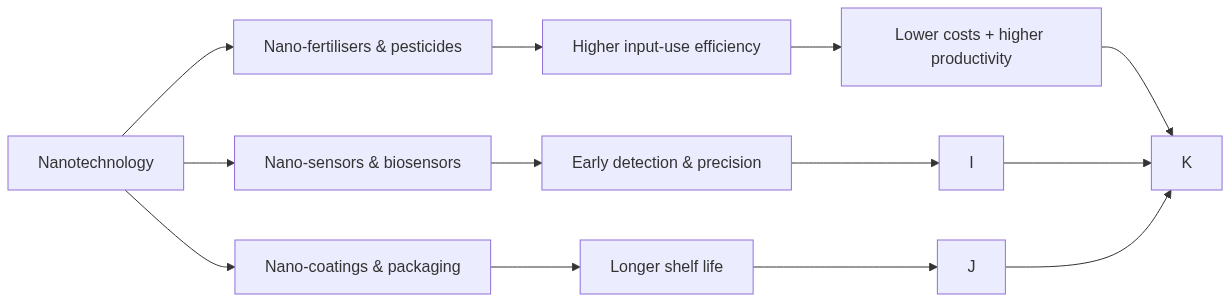
Conclusion
Nanotechnology can make agriculture more precise, resource-efficient and resilient through nano-fertilisers, targeted crop protection, sensors and improved post-harvest management. By reducing input costs, crop losses and wastage while improving productivity and marketability, it can contribute to higher and more sustainable farmer incomes.
Quick related
Students also ask
-
What are the major challenges faced by Indian irrigation system in recent times? State the measures taken by the government for efficient irrigation management.
Next question on this syllabus topic (2024 · Q13). View answer →
-
Is nano urea proven everywhere?
No. Official promotion is ahead of a full independent consensus. A civil servant should watch trial data, not only advertisements.
-
Can nanotech end farmer suicide?
No. Distress is debt, climate and prices. A better input is one piece.
Same topic · past papers
UPSC has asked this before
These previous-year questions sit on the same topic. Open one to practise the earlier ask.
More from this topic
Q14 · UPSC Mains 2026 · GS III · 15 marks · Solution
Discuss the different types of subsidies and supports provided by the Government of India to agricultural sector. Examine the related issues pertaining to Agreement on Agriculture of World Trade Organisation (WTO).
Crops, Irrigation and Marketing
• India supports farmers through MSP procurement, subsidized inputs like fertilizers and power, and cheap
Q13 · UPSC Mains 2026 · GS III · 15 marks · Solution
In which manner has Indian agriculture been transformed from food scarcity to food-surplus level? Describe the various government policies implemented for diversification of Indian agriculture.
Crops, Irrigation and Marketing
• India shifted from chronic post-independence food scarcity to a surplus nation through systemic technological
Q5 · UPSC Mains 2026 · GS III · 10 marks · Solution
Explain by giving two examples, how biotechnology has helped the Indian farmers in processing their perishable crops.
Crops, Irrigation and Marketing
• Biotechnology extends the post-harvest shelf life and processing capabilities of perishable crops, protecting farmers from distress sales. • Silencing ripening enzymes (like polygalacturonase) in transgenic varieties prevents premature softening and reduces transit losses. • Example 1: Genetically modified tomatoes engineered to resist rapid rotting during storage without complete cold-chain dependency. • Microbial fermentation and bio-processing convert surplus perishable harvests into stable, high-value industrial and food products. • Enzymatic maceration using pectinases and cellulases allows efficient fruit pulp breakdown and juice extraction. • Example 2: Biotech-driven conversion of surplus horticulture crops into stable concentrates, purees, and fermented beverages. • Scaling these interventions requires strengthening public-private research partnerships and biosafety frameworks.