
Revision summary
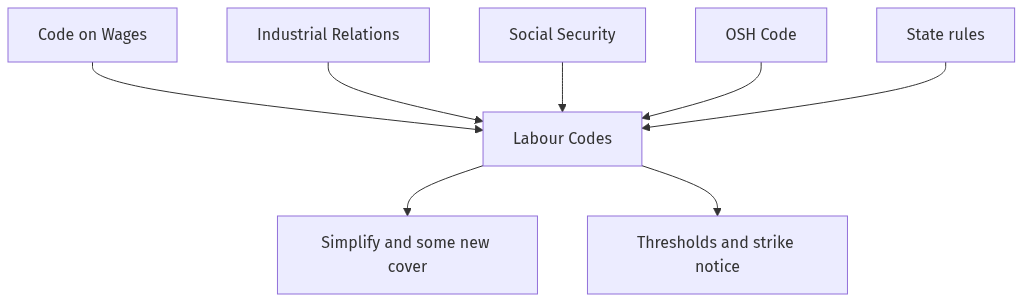
The four Labour Codes (Wages 2019; IR, Social Security and OSH 2020) consolidate a stack of Central Acts. Merits: simpler compliance, a national floor-wage idea, fixed-term with benefits, and gig workers named for social security. Demerits: higher thresholds for standing orders and retrenchment permission, strike notice, and a risk of permanent temporaries. Informal and contract work can still sit outside headcount, so welfare is not automatic. Progress: Codes passed and partly ruled, but full national enforcement still waits on aligned State rules.
Model answer
Copper italics in this answer — like this — are the key facts. Each one is unpacked in the Facts & figures rail.
Introduction
India’s labour law was a forest of Central Acts. Parliament folded that forest into four Codes: Wages (2019), Industrial Relations (2020), Social Security (2020) and Occupational Safety, Health and Working Conditions (2020). The claim is a simpler, more investment-friendly market with some new social cover. The fear is a weaker union and a cheaper hire-and-fire. Both are partly true. Progress is the slow part: the Codes are passed, and a single national switch-on is still waiting on State rules.
Body
The four Codes as reform
The Code on Wages unifies minimum wages, payment of wages, bonus and equal remuneration, and aims at a national floor wage with State minima above it. The Industrial Relations Code merges trade unions, standing orders and industrial disputes. The Social Security Code brings ESIC, EPF, gratuity, maternity and, on paper, gig and platform workers into one tent, with a promise of aggregators’ contributions. The OSH Code merges factory, mine, contract-labour and related safety laws, and eases some licence thresholds for contractors. Merits that reformers wanted are real: one registration and return instead of a dozen, fixed-term employment with pro-rata benefits, faster inspector-cum-facilitator language, and a chance to cover app workers who never saw a factory gate. For a firm that was already compliant, the Codes can cut harassment without cutting a right.
- Peg: Four Codes replace a large stack of Central Acts; Wages 2019 came first, the other three in 2020.
- Peg: Gig and platform workers named in the Social Security Code is the most visible twenty-first-century addition.
Demerits
Unions read the Industrial Relations Code as a tilt. The employee threshold for standing orders and for prior government permission to retrench, lay off or close in larger establishments was raised (the Code uses a higher headcount than the old Chapter V-B practice many States still lived with). A fourteen-day notice for strikes, and rules on outside office-bearers, make a spontaneous legal strike harder. Fixed-term can become a permanent temporary class if it is abused. The Social Security Code’s gig chapter needs schemes and money; a name in a Code is not a PF account. OSH still has to reach the construction site and the warehouse, where most Indians actually work. Women’s night work is allowed with conditions — a freedom and a safety burden at once. Informal workers, the majority, remain easy to keep outside the headcount. Growth versus welfare is the exact trade: easier formal hiring can raise jobs, or it can raise insecurity if enforcement is only a web portal.
- Peg: Strike notice and higher closure thresholds are the core union objections.
- Peg: Informalisation by contract is the demerit that no Code heading, by itself, cures.
Progress so far
The Union has notified the Codes; full enforcement has been held so that State rules can align, because labour is concurrent. Many States and Union Territories have published draft or final rules on some Codes. A few industrial States moved faster, hoping to advertise ease of doing business. Central rules have also been drafted in parts. Gig social-security schemes have been talked about more than they have been universally rolled out. The practical picture at the time of the 2024 paper is therefore: law on the book, rules in patches, old Acts still the working law in much of the field. That delay itself is a reform fact: federal labour change cannot be a Delhi gazette alone.
- Peg: Concurrent list plus State rules is why a 2019–20 Code can still be a 2024 implementation story.
- Peg: Pre-publication of rules is progress; a live floor wage and a live gig contribution are the tests that remain.
Flow diagram
Conclusion
The four Codes simplify, name gig work, and ease some firm compliance. They also raise hire-and-fire thresholds and hem strikes. Progress is real on drafting and uneven on enforcement. Until State rules and schemes switch on, the old Acts still run the shop floor.
Quick related
Students also ask
-
What is the need for expanding the regional air connectivity in India? In this context, discuss the government's UDAN Scheme and its achievements.
Next question on this syllabus topic (2024 · Q12). View answer →
-
Are the four Codes fully in force across India?
They are enacted. Pan-India replacement of the old Acts still depends on notified rules, especially at State level.
-
Do gig workers now get EPF like factory staff?
The Code allows schemes and aggregator contributions. A universal live EPF-like cover is not automatic on the day of Royal Assent.
Same topic · past papers
UPSC has asked this before
These previous-year questions sit on the same topic. Open one to practise the earlier ask.
More from this topic
Q17 · UPSC Mains 2026 · GS III · 15 marks · Solution
What are the challenges to solid waste management in India? Discuss the governmental policy framework on solid waste management. Discuss the success/failure cases of Delhi and Indore cities highlighting the salient features of their solid waste management initiatives.
Indian Economy
• Rapid urbanization has made solid waste management a critical environmental and public health crisis in India. • Key challenges include lack of source segregation, inadequate processing infrastructure, reliance on unprotected informal workers, and financially weak urban local bodies. • The policy framework relies on the SWM Rules 2016, Swachh Bharat Mission (Urban), and Plastic Waste Management Rules 2016. • Indore succeeded through 100% source segregation, zero dump-site remediation, and strict enforcement with digital monitoring. • Delhi failed due to overloaded legacy landfills (Ghazipur, Bhalswa), lack of decentralization, and fragmented municipal governance. • A successful transition requires moving to a circular economy focused on source segregation, decentralized processing, and polluter accountability.
Q16 · UPSC Mains 2026 · GS III · 15 marks · Solution
What is Agentic Artificial Intelligence (AI)? Explain its working. Describe its applications with suitable examples. Discuss the advantages, risks and challenges associated with agentic AI systems.
Indian Economy
Agentic Artificial Intelligence represents an advanced paradigm where AI systems operate with autonomy, setting goals and executing complex workflows without constant human prompts. Unlike traditional generative AI that merely responds to queries, agentic AI uses perception, planning, memory, and tool-use to achieve multi-step objectives. Its applications span across autonomous software engineering, supply chain optimization, and automated financial trading. While offering massive productivity gains and dynamic problem-solving, these systems pose significant risks including lack of transparency, alignment failures, security vulnerabilities, and ethical dilemmas. Governance frameworks and robust guardrails are essential to harness their potential safely.
Q15 · UPSC Mains 2026 · GS III · 15 marks · Solution
Mention salient features of 'Mission Drishti'. Discuss the imaging techniques used in the satellite launched on 3rd May 2026. Why is it being considered world's first satellite of its kind?
Indian Economy
Mission Drishti represents a major leap in India's space-based Earth observation capabilities, launched on 3rd May 2026. The mission employs advanced multi-spectral and hyperspectral imaging techniques to capture high-resolution data across various atmospheric and terrestrial layers. It is hailed as a global first due to its unique integration of real-time onboard edge computing with quantum encryption for secure data transmission. The satellite significantly enhances resource management, disaster response, and strategic surveillance. It aligns with India's policy of leveraging space technology for sustainable development and national security.