
Revision summary
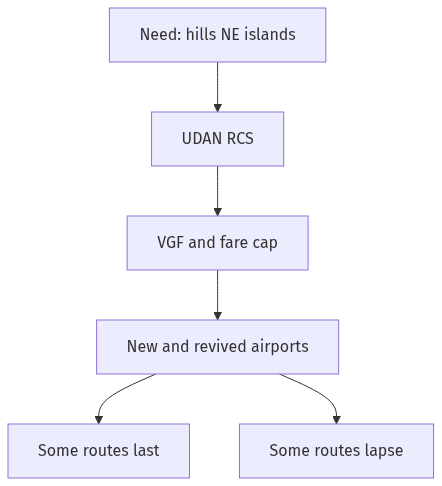
Regional air connectivity is needed for hills, islands, the Northeast and smaller cities that lack dense rail-air markets. It supports medical access, tourism, perishables and a strategic civilian strip in border States. UDAN (2016) auctions routes with viability-gap funding, some fare caps and cheaper airport charges. Achievements: multiple bidding rounds, revived and new regional airports, and some helicopter or seaplane experiments. Limits: several awarded routes lapsed; a flight survives only with catchment demand after the subsidy window.
Model answer
Copper italics in this answer — like this — are the key facts. Each one is unpacked in the Facts & figures rail.
Introduction
A country that is wide, mountainous, islanded and unequal cannot put every district on a broad-gauge timetable tomorrow. Regional air connectivity is the faster way to tie a hill capital, a pilgrimage town or a small industrial city to a metro hub. The Union’s answer since 2016 has been UDAN — Ude Desh ka Aam Nagrik — a viability-gap scheme, not a free airline.
Body
Why regional air connectivity
Metro-to-metro aviation already works on density. The need is elsewhere. North-eastern States, Himachal, Uttarakhand, J&K, the island territories and the tribal centre lose doctors, investors and tourists to a two-day road. Air links cut perishable time for horticulture and medical evacuation. They support balanced regional growth so that a second-rung city can hold a firm that would otherwise sit in Bengaluru. They are also a strategic layer: a civilian airport that can take a ATR or a small jet is a backup strip in a border State. Rail and highway remain the mass mode. Aviation is the thin, high-value mesh. Without subsidy, those thin routes die, because a full-fare Airbus cannot live on forty seats.
- Peg: Last-mile for the Northeast, hills and islands is the core public-need case, not another Delhi–Mumbai frequency.
- Peg: Tourism, organs, pharma cold chain and administrative travel are the economic case.
How UDAN works
UDAN / RCS (Regional Connectivity Scheme), run by the Ministry of Civil Aviation with the Airports Authority of India, auctions routes. The winning airline gets a viability gap funding for a limited period, a cap on some fares, and extras such as reduced landing and parking at public airports. States are asked to join with GST and fuel concessions and to help with security and slots. The bargain is public money for a thin route, not a permanent nationalised airline.
- Peg: VGF plus a fare cap is the UDAN deal: the aam nagrik ticket is bought with a public top-up.
- Peg: State ATF/GST and land support decide whether a bid is only a Delhi PowerPoint.
Achievements and limits
Airports have been revived or built under the same political umbrella, including some civil enclaves. Several rounds of bidding have awarded routes to previously unserved or underserved airports; new airports and revived strips have entered the map in the hills and the Northeast; helicopter and seaplane windows were opened for terrain that cannot take a jet. Some routes sustained after VGF, which is the real success. Many others lapsed when an airline exited or traffic did not appear. UDAN has thickened the map. A route is still not a region until catchment roads, tourism and a second operator exist.
- Peg: Lapsed routes are part of the record; counting only inaugural flights would over-claim.
- Peg: The scheme is a market-plus-subsidy experiment, not a finished grid.
Flow diagram
Conclusion
India needs regional flights for hills, islands, the Northeast and second-rung cities that rail will not bind tomorrow. UDAN has auctioned VGF routes and revived airports, with real new links and real lapses. The scheme is a start on the map, not a finished grid.
Quick related
Students also ask
-
The world is facing an acute shortage of clean and safe alternative freshwater. What are the technologies which can solve this crisis? Briefly discuss any three such technologies, citing their key merits and demerits.
Next question on this syllabus topic (2024 · Q15). View answer →
-
Is UDAN a free ticket scheme?
No. Some seats are fare-capped. The airline still sells the rest, and the State pays a viability gap for a period.
-
Why do some UDAN routes close?
Because subsidy is time-bound and traffic may not appear. An inaugural flight is not the same as a durable market.
Same topic · past papers
UPSC has asked this before
These previous-year questions sit on the same topic. Open one to practise the earlier ask.
-
2025 · Q12 · GS III · 15 marks
Discuss the rationale of the Production Linked Incentive (PLI) scheme. What are its achievements? In what way can the functioning and outcomes of the scheme be improved? -
2021 · Q15 · GS III · 15 marks
What are the research and developmental achievements in applied biotechnology/? How will these achievements help to uplift the poorer sections of the society? -
2016 · Q12 · GS III · 12 marks
Discuss India's achievements in the field of Space Science and Technology. How the application of this technology has helped India in its socio-economic development?
More from this topic
Q17 · UPSC Mains 2026 · GS III · 15 marks · Solution
What are the challenges to solid waste management in India? Discuss the governmental policy framework on solid waste management. Discuss the success/failure cases of Delhi and Indore cities highlighting the salient features of their solid waste management initiatives.
Indian Economy
• Rapid urbanization has made solid waste management a critical environmental and public health crisis in India. • Key challenges include lack of source segregation, inadequate processing infrastructure, reliance on unprotected informal workers, and financially weak urban local bodies. • The policy framework relies on the SWM Rules 2016, Swachh Bharat Mission (Urban), and Plastic Waste Management Rules 2016. • Indore succeeded through 100% source segregation, zero dump-site remediation, and strict enforcement with digital monitoring. • Delhi failed due to overloaded legacy landfills (Ghazipur, Bhalswa), lack of decentralization, and fragmented municipal governance. • A successful transition requires moving to a circular economy focused on source segregation, decentralized processing, and polluter accountability.
Q16 · UPSC Mains 2026 · GS III · 15 marks · Solution
What is Agentic Artificial Intelligence (AI)? Explain its working. Describe its applications with suitable examples. Discuss the advantages, risks and challenges associated with agentic AI systems.
Indian Economy
Agentic Artificial Intelligence represents an advanced paradigm where AI systems operate with autonomy, setting goals and executing complex workflows without constant human prompts. Unlike traditional generative AI that merely responds to queries, agentic AI uses perception, planning, memory, and tool-use to achieve multi-step objectives. Its applications span across autonomous software engineering, supply chain optimization, and automated financial trading. While offering massive productivity gains and dynamic problem-solving, these systems pose significant risks including lack of transparency, alignment failures, security vulnerabilities, and ethical dilemmas. Governance frameworks and robust guardrails are essential to harness their potential safely.
Q15 · UPSC Mains 2026 · GS III · 15 marks · Solution
Mention salient features of 'Mission Drishti'. Discuss the imaging techniques used in the satellite launched on 3rd May 2026. Why is it being considered world's first satellite of its kind?
Indian Economy
Mission Drishti represents a major leap in India's space-based Earth observation capabilities, launched on 3rd May 2026. The mission employs advanced multi-spectral and hyperspectral imaging techniques to capture high-resolution data across various atmospheric and terrestrial layers. It is hailed as a global first due to its unique integration of real-time onboard edge computing with quantum encryption for secure data transmission. The satellite significantly enhances resource management, disaster response, and strategic surveillance. It aligns with India's policy of leveraging space technology for sustainable development and national security.