
Revision summary
PPP is needed because public budgets cannot finance all long-life infrastructure on time, and private partners bring capital and operating skill. Risk and revenue are split by contract: the State keeps policy and often land; the concessionaire takes construction and commercial risk. Railway station redevelopment uses that split: trains stay with Indian Railways; buildings and retail can be private. IRSDC and railway SPVs bid packages; Habibganj (Rani Kamalapati) is an early example. PM Gati Shakti is meant to connect those stations to other modes. Small-town stations may still need public viability support.
Model answer
Copper italics in this answer — like this — are the key facts. Each one is unpacked in the Facts & figures rail.
Introduction
Roads, rails, ports and stations cost more than one budget year can comfortably carry. Public-private partnership (PPP) brings private capital, construction skill and operating discipline into assets the State still owns or regulates. Railway station redevelopment is a visible test of that bargain: land and passenger rights stay public; buildings, retail and maintenance can be private.
Body
Why PPP is required in infrastructure
- Public funds must also pay for welfare, defence and interest; they cannot finance every greenfield corridor on time.
- Private firms bring design-build-operate experience, faster procurement of plant, and a stake in keeping the asset working after inauguration.
- User charges, land monetisation and availability payments can spread cost across decades instead of one vote of account.
- Risk of delay, cost overrun and demand shortfall can be allocated by contract: construction to the concessionaire, policy and land to the State.
- India already uses PPP in highways (Hybrid Annuity Model), ports, airports and some urban metro stretches; stations are the same logic applied to passenger nodes.
- PM Gati Shakti (2021) is the Union’s multi-ministry map so those PPP assets actually connect, not sit as isolated packages.
Role of PPP in railway station redevelopment
- Indian Railways holds large city-centre land. Redevelopment aims to turn a crowded platform into a multimodal hub with concourses, lifts, toilets, parking and last-mile links.
- Under station redevelopment, a private partner typically designs, finances and builds the station and commercial real estate, then recovers cost from retail, offices, hotels and advertising while Railways keeps train operations.
- The Indian Railway Stations Development Corporation (IRSDC) and later railway special-purpose vehicles were created to bid out such packages; Habibganj (Rani Kamalapati) in Bhopal is an early completed example, with Gandhinagar and other stations in the pipeline.
- PPP is meant to raise passenger amenity without a matching jump in the railway capital budget, and to plug stations into city buses, metro and Gati Shakti logistics.
- Limits are real: land title, heritage buildings, fare politics, and the fact that a station’s commercial rent may not pay for a full rebuild in a small town. Those stations still need public money or a viability gap.
Comment
- PPP is required where the asset is large, long-lived and can earn or save cash. It is not a substitute for a clear public specification of safety and access.
- Station redevelopment works when the concession is bankable and the city can absorb the commercial floor; it fails if it is only a real-estate play that ignores platforms.
Flow diagram
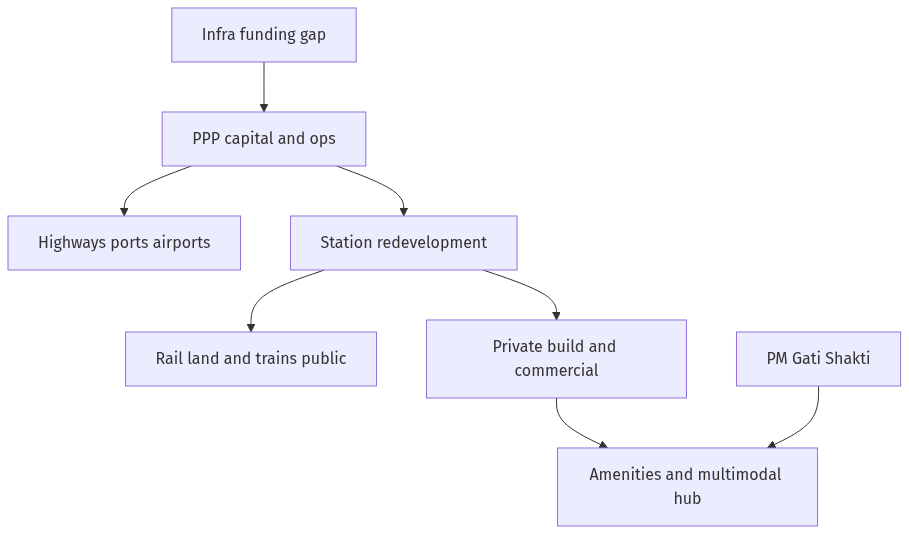
Conclusion
Infrastructure needs PPP because the State cannot fund and run every long-life asset alone. Station redevelopment is that model at the passenger door: private build and commercial recovery, public trains and land. It succeeds only where contracts, city planning and Gati Shakti connectivity move together.
Quick related
Students also ask
-
"Investment in infrastructure is essential for more rapid and inclusive economic growth. "Discuss in the light of India's experience.
Next question on this syllabus topic (2021 · Q12). View answer →
-
Does PPP mean the railway is privatised?
No. Train operations and usually the land remain with Indian Railways. The private role is buildings, commercial space and station services under a concession.
-
Why do some station bids fail?
Because commercial rent may not recover a full rebuild, land titles are messy, or heritage and city rules block floor space.
Same topic · past papers
UPSC has asked this before
These previous-year questions sit on the same topic. Open one to practise the earlier ask.
More from this topic
Q11 · UPSC Mains 2026 · GS III · 15 marks · Solution
Explain the key challenges for India's energy security. What measures do you suggest for ensuring energy security along with economic growth and sustainability?
Infrastructure
India faces severe energy security challenges due to high import dependence for crude oil and gas, coal supply bottlenecks, and grid integration issues for renewables. To balance growth and sustainability, policy must combine domestic fossil fuel efficiency with rapid solar and green hydrogen scaling. Key steps include expanding strategic petroleum reserves, modernising transmission infrastructure, and promoting energy efficiency across industrial sectors. Ensuring energy access while reducing carbon intensity requires robust green financing and domestic manufacturing. Ultimately, India's long-term resilience depends on decoupling economic expansion from carbon emissions through systemic policy reforms.
Q6 · UPSC Mains 2026 · GS III · 10 marks · Solution
Differentiate between a Fast Breeder Reactor (FBR) and a thermal nuclear reactor. In the context of first indigenously developed prototype FBR at Kalpakkam, explain the term 'criticality'. What are its implications for clean energy future of our country?
Infrastructure
• Thermal reactors use slowed-down neutrons and uranium fuel with water coolant, while Fast Breeder Reactors (FBRs) use fast unmoderated neutrons, MOX fuel, and liquid sodium coolants to breed more fuel than they consume. • Reactor 'criticality' is the stable operating state where a nuclear fission chain reaction becomes self-sustaining, meaning neutron production equals neutron loss ($k_{eff} = 1$). • The recent first criticality of the 500 MWe Prototype Fast Breeder Reactor (PFBR) at Kalpakkam marks India's successful entry into commercial-scale fast reactor operations. • This milestone bridges the crucial gap between the second and third stages of India’s nuclear power roadmap, unlocking the path to utilize vast domestic thorium reserves. • FBR technology multiplies energy output from limited uranium resources, ensuring long-term domestic fuel independence. • It provides reliable, continuous baseload clean energy to effectively complement intermittent renewable sources like solar and wind. • Overall, the PFBR significantly accelerates India's transition toward national net-zero emission targets and energy security.
Q6 · UPSC Mains 2025 · GS III · 10 marks · Solution
How can India achieve energy independence through clean technology by 2047? How can biotechnology play a crucial role in this endeavour?
Infrastructure
India still imports most of its crude, so 2047 independence means much lower import intensity, not a sealed border. Clean electricity from solar, wind, storage and nuclear, plus green hydrogen and efficiency, are the main path. Electric mobility cuts oil only if the grid is cleaner. Biotechnology helps through biogas, second-generation ethanol from residue, industrial enzymes and less energy-intensive farming. Fuel-from-food is a poor version of that biotech role.