
Revision summary
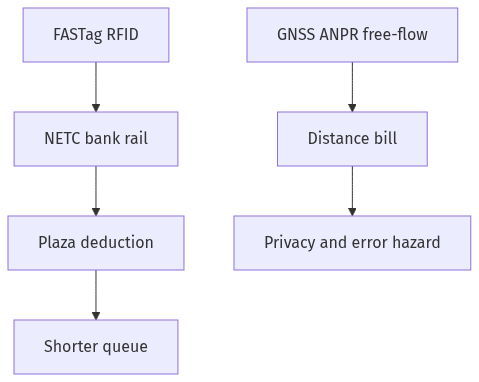
Electronic toll collection on Indian highways uses RFID FASTag, settled on NPCI’s NETC rail. Advantages are less cash leakage, less idling and a digital trail. Limitations are failed reads, double deduction, lane mixing and plaza-only coverage. The proposed seamless step is GNSS-based free-flow tolling, often with ANPR, so the car need not stop. The transition hazard is continuous location tracking, spoofing and hard-to-dispute bills unless data rules and refunds are strong.
Model answer
Copper italics in this answer — like this — are the key facts. Each one is unpacked in the Facts & figures rail.
Introduction
- Indian national highways moved from cash booths to FASTag: a radio-frequency identification sticker on the windscreen, read in the lane, settled through banks on the National Electronic Toll Collection platform. The aim was a shorter queue. The next aim is a highway that does not stop the car at all. Each step trades a little privacy and billing risk for speed.
Body
FASTag and what it already does
The working technology is passive RFID. The tag is linked to a prepaid or bank account. A roadside reader identifies the vehicle class and deducts a toll. NPCI’s NETC switches the payment among banks. NHAI and State concessionaires run the plazas. Advantages are real: less idling, less cash leakage, a digital trail against under-reporting, and some fuel and time saved. Limitations are also real: a failed read still creates a queue; double deduction and wrong-class charges produce grievances; a driver without a working tag is a lane problem; local roads and some State plazas lagged the national mandate; privacy is limited today because the tag mainly proves presence at a plaza, not a continuous track.
- Peg: FASTag became the default on national highway plazas after a nationwide push in the late 2010s.
- Peg: NETC is the payment rail; RFID is the sensor.
Seamless transition and its hazard
- The proposed next step is barrier-free electronic tolling: GNSS / GPS-based distance charging, often paired with automatic number-plate recognition cameras at validation points, so the car does not halt at a boom. A satellite trace can bill actual kilometres, which is fairer on a long corridor than a flat plaza fee. The potential hazard is not science fiction. Continuous location is a richer personal dataset than a plaza beep. It can be abused for surveillance, commercial profiling, or a leak. Spoofing and jamming of GNSS, and camera errors, can create wrong bills. A poor connectivity stretch can drop a trip record. If a back-end dispute system is weak, seamless hardware becomes a new harassment. Governance therefore has to travel with the sensor: data minimisation, retention limits, audit of who queries a vehicle path, and a fast refund. Technology without that is a faster plaza and a slower citizen.
- Peg: GNSS plus ANPR is the usual global kit for free-flow tolling; India has announced this direction for national highways.
- Peg: The hazard is location privacy and billing error, not the RFID sticker itself.
Flow diagram
Conclusion
Electronic tolling today is RFID FASTag on NETC. It cut cash and some queues, and it still fails at the reader. GNSS free-flow can make the highway seamless if billing and data protection are built in. Without them the hazard is tracking and a wrong charge with no boom to argue at.
Quick related
Students also ask
-
Why is Public Private Partnership (PPP) required in infrastructural projects ? Examine the role of PPP model in the redevelopment of Railway Stations in India.
Next question on this syllabus topic (2022 · Q1). View answer →
-
Is FASTag GPS tracking?
No. A plaza RFID read is a point event. GNSS free-flow would be a path, which is why privacy rules must tighten with it.
-
Does seamless tolling remove all booths?
Enforcement cameras and occasional validation points still exist. The boom is what is supposed to go.
Same topic · past papers
UPSC has asked this before
These previous-year questions sit on the same topic. Open one to practise the earlier ask.
More from this topic
Q11 · UPSC Mains 2026 · GS III · 15 marks · Solution
Explain the key challenges for India's energy security. What measures do you suggest for ensuring energy security along with economic growth and sustainability?
Infrastructure
India faces severe energy security challenges due to high import dependence for crude oil and gas, coal supply bottlenecks, and grid integration issues for renewables. To balance growth and sustainability, policy must combine domestic fossil fuel efficiency with rapid solar and green hydrogen scaling. Key steps include expanding strategic petroleum reserves, modernising transmission infrastructure, and promoting energy efficiency across industrial sectors. Ensuring energy access while reducing carbon intensity requires robust green financing and domestic manufacturing. Ultimately, India's long-term resilience depends on decoupling economic expansion from carbon emissions through systemic policy reforms.
Q6 · UPSC Mains 2026 · GS III · 10 marks · Solution
Differentiate between a Fast Breeder Reactor (FBR) and a thermal nuclear reactor. In the context of first indigenously developed prototype FBR at Kalpakkam, explain the term 'criticality'. What are its implications for clean energy future of our country?
Infrastructure
• Thermal reactors use slowed-down neutrons and uranium fuel with water coolant, while Fast Breeder Reactors (FBRs) use fast unmoderated neutrons, MOX fuel, and liquid sodium coolants to breed more fuel than they consume. • Reactor 'criticality' is the stable operating state where a nuclear fission chain reaction becomes self-sustaining, meaning neutron production equals neutron loss ($k_{eff} = 1$). • The recent first criticality of the 500 MWe Prototype Fast Breeder Reactor (PFBR) at Kalpakkam marks India's successful entry into commercial-scale fast reactor operations. • This milestone bridges the crucial gap between the second and third stages of India’s nuclear power roadmap, unlocking the path to utilize vast domestic thorium reserves. • FBR technology multiplies energy output from limited uranium resources, ensuring long-term domestic fuel independence. • It provides reliable, continuous baseload clean energy to effectively complement intermittent renewable sources like solar and wind. • Overall, the PFBR significantly accelerates India's transition toward national net-zero emission targets and energy security.
Q6 · UPSC Mains 2025 · GS III · 10 marks · Solution
How can India achieve energy independence through clean technology by 2047? How can biotechnology play a crucial role in this endeavour?
Infrastructure
India still imports most of its crude, so 2047 independence means much lower import intensity, not a sealed border. Clean electricity from solar, wind, storage and nuclear, plus green hydrogen and efficiency, are the main path. Electric mobility cuts oil only if the grid is cleaner. Biotechnology helps through biogas, second-generation ethanol from residue, industrial enzymes and less energy-intensive farming. Fuel-from-food is a poor version of that biotech role.