
Revision summary
India still imports most of its crude, so 2047 independence means much lower import intensity, not a sealed border. Clean electricity from solar, wind, storage and nuclear, plus green hydrogen and efficiency, are the main path. Electric mobility cuts oil only if the grid is cleaner. Biotechnology helps through biogas, second-generation ethanol from residue, industrial enzymes and less energy-intensive farming. Fuel-from-food is a poor version of that biotech role.
Model answer
Copper italics in this answer — like this — are the key facts. Each one is unpacked in the Facts & figures rail.
Introduction
India's energy independence by 2047 means substantially reducing dependence on imported fossil fuels while ensuring secure, affordable and clean energy for a growing economy. This requires rapid deployment of renewables, storage, green hydrogen, electric mobility and nuclear power, complemented by biotechnology-based solutions that convert biological resources and waste into energy and improve energy efficiency.
Body
Achieving Energy Independence through Clean Technology
- Renewable energy expansion: Rapid scaling of solar, onshore and offshore wind can reduce dependence on fossil-fuel-based electricity. Rooftop solar and decentralised systems can further democratise energy access.
- Energy storage and smart grids: Battery Energy Storage Systems (BESS), pumped hydro and smart grids can address the intermittency of renewable energy and provide reliable power during periods of peak demand.
- Green hydrogen: The National Green Hydrogen Mission can help decarbonise hard-to-abate sectors such as fertilisers, refining, steel and heavy transport, reducing dependence on fossil-fuel-based hydrogen.
- Electric mobility: Electrification of transport can reduce India's oil-import dependence. Domestic battery manufacturing and development of critical-mineral supply chains are essential for reducing technological dependence.
- Nuclear energy: Expansion of nuclear power can provide firm, low-carbon electricity and complement variable renewable sources. Small modular reactors and indigenous nuclear technologies can strengthen long-term energy security.
- Energy efficiency: Efficient buildings, industrial processes, appliances and transport systems can reduce overall energy demand, making energy independence easier to achieve.
Role of Biotechnology
- Second-generation biofuels: Biotechnology enables conversion of agricultural residues and other lignocellulosic biomass into 2G ethanol, reducing dependence on food crops and simultaneously addressing agricultural-waste problems.
- Compressed Biogas (CBG): Microbial processes can convert cattle dung, food waste and other organic waste into biogas/CBG, creating a decentralised renewable fuel while supporting a circular economy.
- Bio-hydrogen: Microorganisms and algae can produce hydrogen through biological pathways, providing a potential alternative pathway for clean hydrogen production.
- Improved energy crops: Biotechnology can develop drought-resistant and resource-efficient crops, potentially providing more reliable biomass feedstock while reducing pressure on water and arable land.
- Industrial enzymes and biocatalysts: Enzymes can reduce the temperature, energy requirement and processing time of several industrial reactions, improving overall energy efficiency.
- Algae-based carbon utilisation: Microalgae can potentially capture CO₂ and convert it into useful biomass, biofuels and other products, linking biotechnology with carbon management.
Key Challenges
- Technology commercialisation: Many advanced clean-energy and biotechnology technologies remain at early stages of development and face difficulties in moving from laboratories to commercial scale.
- High capital requirements: Clean-energy infrastructure and biotechnology projects often require large upfront investment and patient capital.
- Import dependence: Critical components such as advanced batteries, solar technologies and semiconductor-related inputs can create new forms of technological dependence.
- Biomass logistics: Fragmented collection, transportation and processing of agricultural residues can limit the commercial viability of bioenergy.
- Resource trade-offs: Biofuel feedstocks such as sugarcane can create pressure on land and groundwater if not managed sustainably.
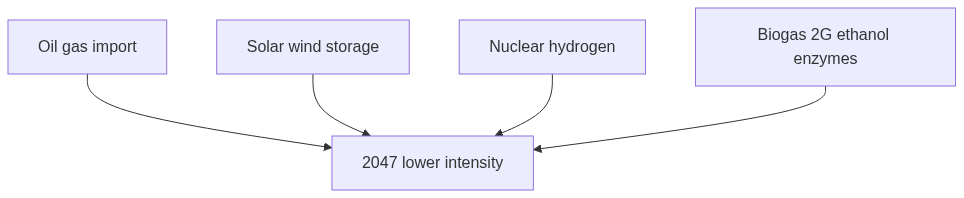
Thus, energy independence requires an integrated transition in which clean electricity reduces fossil-fuel dependence, while biotechnology converts waste and biological resources into fuels, materials and efficiency gains.
Flow diagram
Conclusion
India's 2047 energy independence will depend not on a single technology but on an integrated clean-energy ecosystem. Renewable energy, storage, green hydrogen, electric mobility and nuclear power can reduce fossil-fuel dependence, while biotechnology can convert waste into energy, improve industrial efficiency and develop advanced biofuels. Bridging the lab-to-market gap, strengthening domestic manufacturing and ensuring sustainable resource use will be crucial for achieving a secure, affordable and low-carbon energy future.
Quick related
Students also ask
-
What is the technology being employed for electronic toll collection on highways. What are its advantages and limitations? What are the proposed changes that will make this process seamless? Would this transition carry any potential hazard?
Next question on this syllabus topic (2024 · Q6). View answer →
-
Will India stop importing oil in 2047?
Unlikely in full. The honest target is a much smaller oil share in a bigger economy.
-
Is ethanol blending energy independence?
It can cut the petrol bill. If the ethanol is from food crops, it can raise food and water stress.
Same topic · past papers
UPSC has asked this before
These previous-year questions sit on the same topic. Open one to practise the earlier ask.
More from this topic
Q11 · UPSC Mains 2026 · GS III · 15 marks · Solution
Explain the key challenges for India's energy security. What measures do you suggest for ensuring energy security along with economic growth and sustainability?
Infrastructure
India faces severe energy security challenges due to high import dependence for crude oil and gas, coal supply bottlenecks, and grid integration issues for renewables. To balance growth and sustainability, policy must combine domestic fossil fuel efficiency with rapid solar and green hydrogen scaling. Key steps include expanding strategic petroleum reserves, modernising transmission infrastructure, and promoting energy efficiency across industrial sectors. Ensuring energy access while reducing carbon intensity requires robust green financing and domestic manufacturing. Ultimately, India's long-term resilience depends on decoupling economic expansion from carbon emissions through systemic policy reforms.
Q6 · UPSC Mains 2026 · GS III · 10 marks · Solution
Differentiate between a Fast Breeder Reactor (FBR) and a thermal nuclear reactor. In the context of first indigenously developed prototype FBR at Kalpakkam, explain the term 'criticality'. What are its implications for clean energy future of our country?
Infrastructure
• Thermal reactors use slowed-down neutrons and uranium fuel with water coolant, while Fast Breeder Reactors (FBRs) use fast unmoderated neutrons, MOX fuel, and liquid sodium coolants to breed more fuel than they consume. • Reactor 'criticality' is the stable operating state where a nuclear fission chain reaction becomes self-sustaining, meaning neutron production equals neutron loss ($k_{eff} = 1$). • The recent first criticality of the 500 MWe Prototype Fast Breeder Reactor (PFBR) at Kalpakkam marks India's successful entry into commercial-scale fast reactor operations. • This milestone bridges the crucial gap between the second and third stages of India’s nuclear power roadmap, unlocking the path to utilize vast domestic thorium reserves. • FBR technology multiplies energy output from limited uranium resources, ensuring long-term domestic fuel independence. • It provides reliable, continuous baseload clean energy to effectively complement intermittent renewable sources like solar and wind. • Overall, the PFBR significantly accelerates India's transition toward national net-zero emission targets and energy security.
Q5 · UPSC Mains 2025 · GS III · 10 marks · Solution
The fusion energy programme in India has steadily evolved over the past few decades. Mention India's contributions to the international fusion energy project - International Thermonuclear Experimental Reactor (ITER). What will be the implications of the success of this project for the future of global energy?
Infrastructure
Fusion joins light nuclei and could, in theory, give large low-carbon power without a fission-style chain reaction. ITER in France is the global experiment; India is a member supplying about a tenth of in-kind components such as the cryostat and cooling systems. Indian tokamaks and the Institute for Plasma Research built the domestic base. ITER success would prove the physics, not deliver cheap power in 2030. The climate implication is a possible later baseload, beside renewables that are needed now.