
Revision summary
Upstream marketing bottlenecks are small lots, APMC/agent opacity, weak grading, trader-tied credit, and thin MSP outside wheat and paddy. e-NAM without assaying does not give real price discovery. Downstream bottlenecks are cold-chain gaps, low processing, many margin layers, weak traceability for export, and logistics for perishables. GST eased some inter-State tax friction; physical cold movement remains the constraint. FPOs, warehouse receipts, SAMPADA parks and FSSAI compliance connect the two ends; one portal cannot.
Model answer
Copper italics in this answer — like this — are the key facts. Each one is unpacked in the Facts & figures rail.
Introduction
Agricultural marketing is the journey from the farm gate to the plate. Upstream is what the farmer faces before and at first sale: inputs, aggregation, mandi rules, and price discovery. Downstream is what happens after that first sale: storage, processing, retail and export. India has both a mandi-and-APMC problem and a cold-chain-and-brand problem. They are not the same bottleneck.
Body
Upstream bottlenecks (farm to first buyer)
- Small marketable surplus: tiny holdings mean the farmer cannot fill a truck; the village aggregator sets the effective price.
- APMC / mandi frictions: in many States the first sale is still tied to a notified market, with licensed commission agents, weighment opacity, and delayed payment.
- Poor price discovery: even where e-NAM exists, lots are not graded, so the screen price is not a real bid for that farmer’s bag.
- Information and bargaining: limited knowledge of distant prices; weak Farmer Producer Organisations in many crops, so the trader’s working capital wins.
- Quality at gate: mixed lots, high moisture, no assaying; processors will not bid, so only the local trader will.
- Transport from village to mandi: bad roads, no small trucks, and loading losses. Gati Shakti helps corridors more than the last two kilometres.
- Credit tied to the buyer: input-trader linkage forces sale to the same man, which is a marketing constraint disguised as finance.
- MSP procurement is real for wheat and paddy in surplus belts and thin for most horticulture; upstream horticulture still meets a glut with no buyer.
Downstream bottlenecks (first buyer to consumer/export)
- Storage and wastage: inadequate scientific godowns and cold chain for fruit, vegetables, milk and fish; seasonal gluts rot before they become stock.
- Processing gap: a low organised processing share means downstream demand does not pull a steady farm price (see food-processing policy: SAMPADA, FSSAI).
- Fragmented wholesale-retail: many layers of arhatiya, wholesale and kirana; each layer takes a margin and does not pass quality signals back to the farm.
- Standards and traceability: export rejection on residue and packaging; domestic organised retail needs barcodes and FSSAI compliance that small packers lack.
- Logistics cost and time: inter-State barriers have eased with GST, but perishable reefer movement, last-mile urban wholesale, and port dwell still add cost.
- Consumer-end concentration: a few large buyers can squeeze processors, who then squeeze farmers—downstream market power.
- Risk and futures: thin, poorly understood derivative markets; farmers rarely hedge; downstream firms also face price spikes without storage.
What links the two
- Without grading at the farm, downstream brands cannot contract. Without downstream plants, upstream reform only changes who exploits the farmer.
- e-NAM, warehouse receipts, FPOs, and mega food parks are useful only as a chain, not as isolated portals.
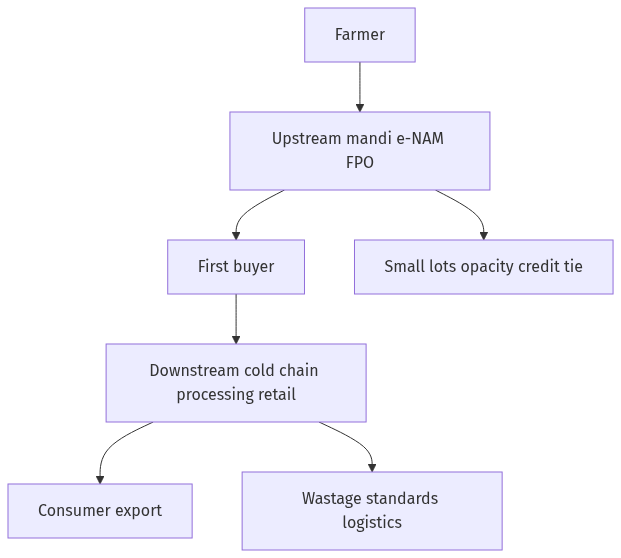
Flow diagram
Conclusion
Upstream, the farmer is stuck with small lots, mandi opacity, and a trader-creditor. Downstream, produce dies in heat, is barely processed, and meets export standards late. Fixing one end without the other only relocates the margin. Grading, FPOs, cold chain and processing have to move together.
Quick related
Students also ask
-
Launched on 25th December, 2021, James Webb Space Telescope has been much in the news since then. What are its unique features which make it superior to its predecessor Space Telescopes ? What are the key goals of this mission ? What potential benefits does it hold for the human race?
Next question on this syllabus topic (2022 · Q15). View answer →
-
Is abolishing mandis enough?
No. Without roads, grading and a processor, the farmer still meets one local buyer, just outside the yard.
-
Why split upstream and downstream?
Because the farmer’s first-sale problem and the city’s wastage-and-brand problem need different tools, then a join.
Same topic · past papers
UPSC has asked this before
These previous-year questions sit on the same topic. Open one to practise the earlier ask.
More from this topic
Q17 · UPSC Mains 2026 · GS III · 15 marks · Solution
What are the challenges to solid waste management in India? Discuss the governmental policy framework on solid waste management. Discuss the success/failure cases of Delhi and Indore cities highlighting the salient features of their solid waste management initiatives.
Indian Economy
• Rapid urbanization has made solid waste management a critical environmental and public health crisis in India. • Key challenges include lack of source segregation, inadequate processing infrastructure, reliance on unprotected informal workers, and financially weak urban local bodies. • The policy framework relies on the SWM Rules 2016, Swachh Bharat Mission (Urban), and Plastic Waste Management Rules 2016. • Indore succeeded through 100% source segregation, zero dump-site remediation, and strict enforcement with digital monitoring. • Delhi failed due to overloaded legacy landfills (Ghazipur, Bhalswa), lack of decentralization, and fragmented municipal governance. • A successful transition requires moving to a circular economy focused on source segregation, decentralized processing, and polluter accountability.
Q16 · UPSC Mains 2026 · GS III · 15 marks · Solution
What is Agentic Artificial Intelligence (AI)? Explain its working. Describe its applications with suitable examples. Discuss the advantages, risks and challenges associated with agentic AI systems.
Indian Economy
Agentic Artificial Intelligence represents an advanced paradigm where AI systems operate with autonomy, setting goals and executing complex workflows without constant human prompts. Unlike traditional generative AI that merely responds to queries, agentic AI uses perception, planning, memory, and tool-use to achieve multi-step objectives. Its applications span across autonomous software engineering, supply chain optimization, and automated financial trading. While offering massive productivity gains and dynamic problem-solving, these systems pose significant risks including lack of transparency, alignment failures, security vulnerabilities, and ethical dilemmas. Governance frameworks and robust guardrails are essential to harness their potential safely.
Q15 · UPSC Mains 2026 · GS III · 15 marks · Solution
Mention salient features of 'Mission Drishti'. Discuss the imaging techniques used in the satellite launched on 3rd May 2026. Why is it being considered world's first satellite of its kind?
Indian Economy
Mission Drishti represents a major leap in India's space-based Earth observation capabilities, launched on 3rd May 2026. The mission employs advanced multi-spectral and hyperspectral imaging techniques to capture high-resolution data across various atmospheric and terrestrial layers. It is hailed as a global first due to its unique integration of real-time onboard edge computing with quantum encryption for secure data transmission. The satellite significantly enhances resource management, disaster response, and strategic surveillance. It aligns with India's policy of leveraging space technology for sustainable development and national security.