
Revision summary
Recent Indian growth was partly an employment and participation rebound after the pandemic, not only a productivity surge. Much of the extra activity was self-employment and informal work, which can raise GDP while output per worker stagnates. A durable pattern is labour-intensive tradable manufacturing and services whose productivity already exceeds agriculture. Gati Shakti, food processing, care, logistics, skilling and MSME credit should move workers into those sectors. Public works can bridge shocks; they should not be the long-run growth model. Do not protect jobs by blocking tools.
Model answer
Copper italics in this answer — like this — are the key facts. Each one is unpacked in the Facts & figures rail.
Introduction
Growth can come from more people working, from each worker producing more, or from both. In several recent Indian years, headline GDP recovered while surveys showed a rebound in labour force participation and employment—especially self-employment and rural work—after the pandemic shock. That is growth led in part by labour activity, not only by a productivity boom in a few firms. The policy task is more jobs and rising output per worker.
Body
How growth was led by labour activity
- After 2020, output rebound coincided with people returning to the labour force: women and men who had left paid work re-entered, and usual-status and weekly-status employment recovered in Periodic Labour Force Survey releases.
- A large share of that activity was self-employment and unpaid family work in agriculture and petty trade, not factory payrolls. More hands in the field raise aggregate labour input even if each hand produces little extra.
- Construction and informal services absorbed labour when formal hiring was cautious; their output shows up in GDP as activity more than as machines.
- Contact-intensive services (trade, hospitality, transport) grew by putting people back to work as mobility returned—hours and headcount, not only capital deepening.
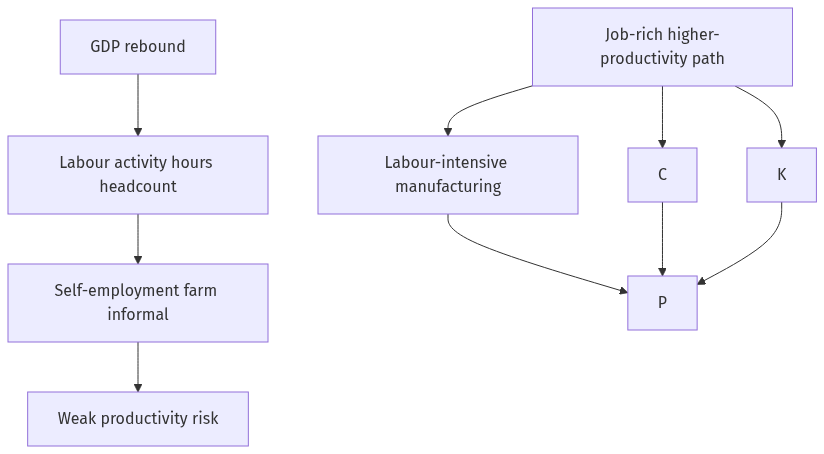
- This pattern can lift GDP while labour productivity (GDP per worker) stays flat or dips, because the extra workers enter low-productivity tasks. That is the warning inside the good employment print.
Why that mix is incomplete
- East Asian catch-up paired labour absorption with manufacturing productivity. A pure activity rebound risks job-rich stagnation: everyone busy, few earning a rising real wage.
- Women’s re-entry into unpaid farm work is activity; it is not the same as regular wage jobs.
Growth pattern for more jobs without sacrificing productivity
- Labour-intensive tradables with rising productivity: apparel, leather, food processing, electronics assembly that learns (PLI plus MSME suppliers), not only one capital-heavy refinery.
- Care, logistics, housing and repair: urban jobs that machines do not yet replace, paired with skilling and toolkits so output per worker rises.
- Farm to non-farm in the same district: food processing, warehousing and construction under PM Gati Shakti so surplus farm labour leaves disguised unemployment into higher-value work, not into idle migration.
- Formalisation that does not kill the unit: EPFO-linked hiring incentives, easier compliance, and credit (CGTMSE, TReDS) so a firm can add a second shift instead of staying a one-person shop.
- Public employment as a bridge, not a destination: MGNREGA and urban wage programmes stabilise activity; skills and apprenticeships must move workers into higher-productivity private or public services.
- Do not chase jobs by freezing technology. Productivity comes from tools, power, logistics and skills. The pattern is more firms that hire and upgrade, not a ban on machines.
Rule of thumb
- Raise employment elasticity in sectors whose productivity is already above agriculture, and raise productivity inside those sectors with clusters and power—not by packing more unpaid family labour onto the same plot.
Flow diagram
Conclusion
Recent growth partly reflected more people working again, often in low-productivity self-employment. That lifts GDP and activity; it does not guarantee rising living standards. The needed pattern is labour-intensive manufacturing and services that still invest in skills, power and logistics so jobs and productivity rise together.
Quick related
Students also ask
-
What are the main bottlenecks in upstream and downstream process of marketing of agricultural products in India ?
Next question on this syllabus topic (2022 · Q13). View answer →
-
If more people work, is that automatically good growth?
It is better than mass idleness. If they work in disguised farm unemployment, living standards barely move.
-
Does productivity growth kill jobs?
In one firm it can. At economy scale, higher productivity raises demand and new tasks if workers can move. The aim is both, not a freeze on machines.
Same topic · past papers
UPSC has asked this before
These previous-year questions sit on the same topic. Open one to practise the earlier ask.
More from this topic
Q17 · UPSC Mains 2026 · GS III · 15 marks · Solution
What are the challenges to solid waste management in India? Discuss the governmental policy framework on solid waste management. Discuss the success/failure cases of Delhi and Indore cities highlighting the salient features of their solid waste management initiatives.
Indian Economy
• Rapid urbanization has made solid waste management a critical environmental and public health crisis in India. • Key challenges include lack of source segregation, inadequate processing infrastructure, reliance on unprotected informal workers, and financially weak urban local bodies. • The policy framework relies on the SWM Rules 2016, Swachh Bharat Mission (Urban), and Plastic Waste Management Rules 2016. • Indore succeeded through 100% source segregation, zero dump-site remediation, and strict enforcement with digital monitoring. • Delhi failed due to overloaded legacy landfills (Ghazipur, Bhalswa), lack of decentralization, and fragmented municipal governance. • A successful transition requires moving to a circular economy focused on source segregation, decentralized processing, and polluter accountability.
Q16 · UPSC Mains 2026 · GS III · 15 marks · Solution
What is Agentic Artificial Intelligence (AI)? Explain its working. Describe its applications with suitable examples. Discuss the advantages, risks and challenges associated with agentic AI systems.
Indian Economy
Agentic Artificial Intelligence represents an advanced paradigm where AI systems operate with autonomy, setting goals and executing complex workflows without constant human prompts. Unlike traditional generative AI that merely responds to queries, agentic AI uses perception, planning, memory, and tool-use to achieve multi-step objectives. Its applications span across autonomous software engineering, supply chain optimization, and automated financial trading. While offering massive productivity gains and dynamic problem-solving, these systems pose significant risks including lack of transparency, alignment failures, security vulnerabilities, and ethical dilemmas. Governance frameworks and robust guardrails are essential to harness their potential safely.
Q15 · UPSC Mains 2026 · GS III · 15 marks · Solution
Mention salient features of 'Mission Drishti'. Discuss the imaging techniques used in the satellite launched on 3rd May 2026. Why is it being considered world's first satellite of its kind?
Indian Economy
Mission Drishti represents a major leap in India's space-based Earth observation capabilities, launched on 3rd May 2026. The mission employs advanced multi-spectral and hyperspectral imaging techniques to capture high-resolution data across various atmospheric and terrestrial layers. It is hailed as a global first due to its unique integration of real-time onboard edge computing with quantum encryption for secure data transmission. The satellite significantly enhances resource management, disaster response, and strategic surveillance. It aligns with India's policy of leveraging space technology for sustainable development and national security.