
Revision summary
JWST launched on 25 December 2021 on Ariane 5. It is an infrared telescope at Sun–Earth L2 with a ~6.5 m gold-coated beryllium mirror and a five-layer sunshield. Hubble is smaller, in low Earth orbit, and strong in visible/UV; Spitzer was a smaller infrared precursor. Goals are first light, galaxy assembly, star-planet formation in dust, and exoplanet spectroscopy. Benefits are astrophysics, technology, and complementarity with Hubble and ground observatories. Fuel at L2 limits life.
Model answer
Copper italics in this answer — like this — are the key facts. Each one is unpacked in the Facts & figures rail.
Introduction
The James Webb Space Telescope (JWST) lifted off on 25 December 2021 on an Ariane 5 from French Guiana. It is the successor in ambition to Hubble, not a copy. Hubble looks mainly in visible and ultraviolet from low Earth orbit. Webb looks in the infrared from a distant cold perch, with a much larger mirror, to see the first galaxies, nearby exoplanet atmospheres, and star nurseries inside dust.
Body
Unique features versus predecessors
- Wavelength: optimised for near- and mid-infrared. Dust-obscured star formation and highly redshifted early galaxies are faint in Hubble’s visible band and bright to Webb.
- Mirror: a deployable beryllium primary about 6.5 metres across (segmented, gold-coated), far larger than Hubble’s 2.4-metre glass, so collecting area and resolution at infrared wavelengths jump.
- Orbit: Sun–Earth Lagrange point L2, about 1.5 million km out, not low Earth orbit. Hubble can be serviced; Webb was designed not to be. L2 lets a huge sunshield keep the optics cold.
- Sunshield: a five-layer tennis-court-scale shade so the telescope stays at cryogenic temperature; mid-infrared instruments need that cold.
- Deployment: folded for launch, then unfolded in space (mirror, shield, tower)—a complexity Hubble did not attempt.
- Partnership: NASA lead with ESA and CSA; Hubble was also NASA–ESA, but Webb’s infrared instrument suite (NIRCam, NIRSpec, MIRI, FGS/NIRISS) is a new generation.
- Spitzer was an infrared predecessor but smaller and warmer in later years; Webb is the leap in aperture and L2 cooling.
Key goals
- First light and reionisation: galaxies and quasars in the early universe, when the first stars lit up.
- Assembly of galaxies over cosmic time.
- Star and planet formation behind dust clouds.
- Exoplanet atmospheres by transit spectroscopy: water, carbon dioxide, and other molecules.
- Solar-system infrared studies (objects too cool or dusty for Hubble’s best band).
Potential benefits
- Science: rewrite galaxy-formation timelines; characterise potentially habitable-zone atmospheres (biosignature claims will still need extreme caution).
- Technology spin-off: cryogenics, lightweight optics, deployable structures, detectors.
- Inspiration and STEM, and a public window on origins questions.
- Complementarity: Hubble still does UV/visible; ground ELTs and ALMA fill other bands. Webb does not retire them.
Caution
- L2 is not a place for astronaut repair. Mission life is limited by station-keeping fuel and instrument health, even if early fuel estimates were generous.
Flow diagram
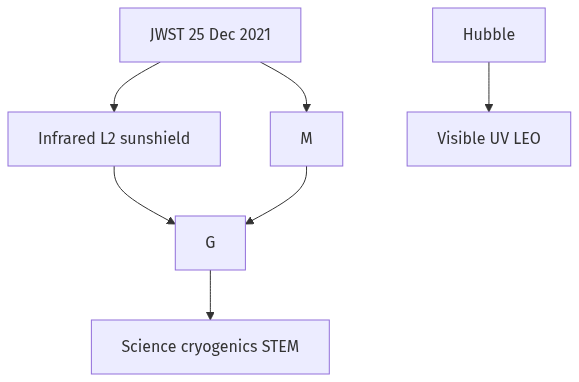
Conclusion
JWST, launched 25 December 2021, is a cold infrared observatory at L2 with a 6.5-metre deployable mirror—unlike Hubble’s smaller visible/UV telescope in low orbit. Its goals are first galaxies, dusty birth sites, and exoplanet airs. Benefits are knowledge, detectors, and a complement to Hubble, not a replacement of every wavelength.
Quick related
Students also ask
-
What is the basic principle behind vaccine development? How do vaccines work? What approaches were adopted by the Indian vaccine manufacturers to produce COVID-19 vaccines ?
Next question on this syllabus topic (2022 · Q16). View answer →
-
Did Webb replace Hubble?
No. Hubble still uniquely covers UV and much visible work. Webb opens deep infrared.
-
Why L2 instead of low Earth orbit?
To keep the telescope behind a sunshield, cold and stable for infrared, away from Earth’s heat and light.
Same topic · past papers
UPSC has asked this before
These previous-year questions sit on the same topic. Open one to practise the earlier ask.
-
2021 · Q5 · GS III · 10 marks
How is S-400 air defence system technically superior to any other system presently available in the world?
More from this topic
Q17 · UPSC Mains 2026 · GS III · 15 marks · Solution
What are the challenges to solid waste management in India? Discuss the governmental policy framework on solid waste management. Discuss the success/failure cases of Delhi and Indore cities highlighting the salient features of their solid waste management initiatives.
Indian Economy
• Rapid urbanization has made solid waste management a critical environmental and public health crisis in India. • Key challenges include lack of source segregation, inadequate processing infrastructure, reliance on unprotected informal workers, and financially weak urban local bodies. • The policy framework relies on the SWM Rules 2016, Swachh Bharat Mission (Urban), and Plastic Waste Management Rules 2016. • Indore succeeded through 100% source segregation, zero dump-site remediation, and strict enforcement with digital monitoring. • Delhi failed due to overloaded legacy landfills (Ghazipur, Bhalswa), lack of decentralization, and fragmented municipal governance. • A successful transition requires moving to a circular economy focused on source segregation, decentralized processing, and polluter accountability.
Q16 · UPSC Mains 2026 · GS III · 15 marks · Solution
What is Agentic Artificial Intelligence (AI)? Explain its working. Describe its applications with suitable examples. Discuss the advantages, risks and challenges associated with agentic AI systems.
Indian Economy
Agentic Artificial Intelligence represents an advanced paradigm where AI systems operate with autonomy, setting goals and executing complex workflows without constant human prompts. Unlike traditional generative AI that merely responds to queries, agentic AI uses perception, planning, memory, and tool-use to achieve multi-step objectives. Its applications span across autonomous software engineering, supply chain optimization, and automated financial trading. While offering massive productivity gains and dynamic problem-solving, these systems pose significant risks including lack of transparency, alignment failures, security vulnerabilities, and ethical dilemmas. Governance frameworks and robust guardrails are essential to harness their potential safely.
Q15 · UPSC Mains 2026 · GS III · 15 marks · Solution
Mention salient features of 'Mission Drishti'. Discuss the imaging techniques used in the satellite launched on 3rd May 2026. Why is it being considered world's first satellite of its kind?
Indian Economy
Mission Drishti represents a major leap in India's space-based Earth observation capabilities, launched on 3rd May 2026. The mission employs advanced multi-spectral and hyperspectral imaging techniques to capture high-resolution data across various atmospheric and terrestrial layers. It is hailed as a global first due to its unique integration of real-time onboard edge computing with quantum encryption for secure data transmission. The satellite significantly enhances resource management, disaster response, and strategic surveillance. It aligns with India's policy of leveraging space technology for sustainable development and national security.