
Revision summary
COVID management used molecular tests, sequencing, and clinical imaging to see the disease. Aarogya Setu, GIS war rooms, and dashboards aided tracing and communication, with privacy and coverage gaps. Telemedicine, oxygen logistics, and PPE/ventilator ramps were care-side technology. Vaccine platforms and later CoWIN were the biomedical and digital scale-up. Apps did not replace primary care, oxygen, or equitable access.
Model answer
Copper italics in this answer — like this — are the key facts. Each one is unpacked in the Facts & figures rail.
Introduction
COVID-19 was a virus plus a systems test. Technology did not invent oxygen or nurses. It did compress time: sequencing the pathogen, tracing contacts, moving lab results, targeting containment, and later delivering vaccines. India’s 2020 management mixed old public health with new digital and biomedical tools — with real gains and real exclusion.
Body
Knowing the pathogen and the case
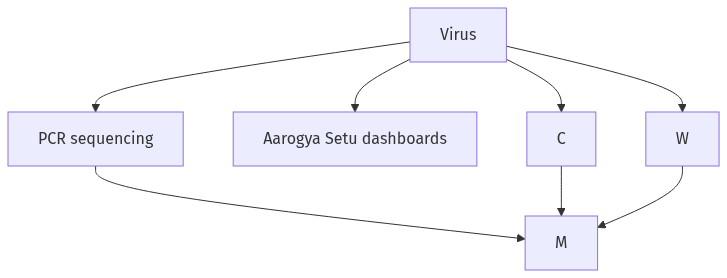
- Genomic sequencing (global GISAID; Indian labs under ICMR and later INSACOG) identified SARS-CoV-2 and tracked variants — a first-year science aid that older pandemics lacked at this speed.
- RT-PCR, TrueNat, CBNAAT, and antigen RDTs scaled testing; machines, reagents, and ICMR protocols were the bottleneck as much as ‘AI’.
- Tele-radiology and CT in some hospitals helped clinical triage when RT-PCR lagged.
Finding, isolating, and informing
- Aarogya Setu Bluetooth/GPS contact tracing and later status checks: useful in dense formal settings, weaker for feature-phone India and for privacy critics.
- ITIHAS / telecom analytics and State war-room GIS for hotspot mapping.
- ICMR and State dashboards, media briefings, and SMS advisories — information technology as risk communication, sometimes also as confusion when data lagged.
- Quarantine apps and geo-fencing in some States: aid to administration, contested as surveillance.
Care, oxygen, and logistics
- Hospital bed and oxygen dashboards (painfully incomplete in the first wave, then a 2021 lesson) are technology as logistics, not as medicine.
- Telemedicine guidelines (2020) let follow-up and mild-case advice continue through lockdown.
- eSanjeevani and private tele-consults reduced crowding for non-COVID care in pockets.
- Industry: ventilator and PPE production ramps, 3D-printed parts, and CSIR–industry consortia — manufacturing technology under a public demand shock.
Vaccines, cold chain, and payments
- Platform science (inactivated, viral vector; globally also mRNA with lipid nanoparticles) plus Indian manufacturing (Serum Institute, Bharat Biotech) was the decisive biomedical technology.
- CoWIN (rolled out for vaccination) is digital public infrastructure for slots, certificates, and later a model of scale — still a 2021 peak, designed in the pandemic year.
- UPI and DBT kept transfers and rations moving when offices closed; ONORC used ePOS identity to feed migrants.
Limits and justice
- Digital tools missed the undocumented and the smartphone-poor. A QR code is not a primary health centre.
- Technology could not fix oxygen plants not built, contractual health staff, or crowded housing.
- Over-claiming ‘AI defeated COVID’ insults epidemiology: distance, masks, testing, and vaccination did the work; software was a multiplier.
What to lock in for national development
- Treat genomic surveillance, oxygen telemetry, telemedicine, and open health data standards as standing infrastructure, not a wartime gadget.
- Keep privacy and exclusion audits on health apps so the next outbreak does not trade rights for a dashboard.
Flow diagram
Conclusion
Technology aided COVID management through tests, genomes, tracing apps, telemedicine, manufacturing ramps, digital payments, and vaccine platforms. It multiplied public health; it did not replace beds, oxygen, or trust. The lasting lesson is to keep those labs, cold chains, and inclusive digital rails ready before the next pathogen.
Quick related
Students also ask
-
What are the key features of the National Clean Air Programme (NCAP) initiated by the Government of India?
Next question on this syllabus topic (2020 · Q17). View answer →
-
Did Aarogya Setu control the pandemic?
It was one tracing aid in a smartphone slice of the population. Testing, isolation, and later vaccines did more.
-
Is genomic sequencing enough?
Sequencing without testing, isolation, and vaccination is a research diary. It is an aid to strategy, not a strategy.
Same topic · past papers
UPSC has asked this before
These previous-year questions sit on the same topic. Open one to practise the earlier ask.
More from this topic
Q17 · UPSC Mains 2026 · GS III · 15 marks · Solution
What are the challenges to solid waste management in India? Discuss the governmental policy framework on solid waste management. Discuss the success/failure cases of Delhi and Indore cities highlighting the salient features of their solid waste management initiatives.
Indian Economy
• Challenges: volume growth, mixed waste, land, informal exclusion, weak finance. • SWM Rules 2016 mandate segregation, collection, processing, user fees. • Plastic/C&D/e-waste rules and SBM Urban complete the framework. • Swachh Survekshan creates competitive accountability. • Indore: strong segregation, collection, processing, enforcement. • Delhi: huge volumes, legacy dumps, fires, fragmented stress. • Lesson: behaviour + processing beat trucks-only strategies. • Biomining and bulk-generator compliance are essential for metros.
Q16 · UPSC Mains 2026 · GS III · 15 marks · Solution
What is Agentic Artificial Intelligence (AI)? Explain its working. Describe its applications with suitable examples. Discuss the advantages, risks and challenges associated with agentic AI systems.
Indian Economy
• Agentic AI pursues goals via plan–act–observe loops, not one-shot replies. • Working parts: planning, tools, memory, guardrails, stop conditions. • Uses: grievance assist, compliance, agri/disaster fusion, cyber SOCs, tutoring. • Advantages: speed, consistency, expert leverage, continuous monitoring. • Risks: harmful actions from hallucinations, injection attacks, privacy leaks. • India challenges: languages, liability, data law, compute cost, evaluation. • Govern with human approval for high stakes, logs and allow-listed tools. • Sandboxes beat unsupervised autonomy over money and rights.
Q15 · UPSC Mains 2026 · GS III · 15 marks · Solution
Mention salient features of 'Mission Drishti'. Discuss the imaging techniques used in the satellite launched on 3rd May 2026. Why is it being considered world's first satellite of its kind?
Indian Economy
• Mission Drishti is GalaxEye's EO satellite launched 3 May 2026. • Marketed as world's first OptoSAR combining optical + all-weather radar. • Described as India's largest privately built satellite in that category. • Imaging: X-band SAR (Stripmap/Spotlight) plus 7-band MSI. • Fusion on one platform avoids two-satellite parallax/time errors. • Fused resolution marketed near 1.8 m; SAR spotlight finer (~0.9 m claimed). • Orbit: sun-synchronous LEO ~500 km class; revisit ~4 days (company). • Novelty is integrated commercial OptoSAR—not inventing SAR/optical physics.