
Revision summary
Prohibitive labour is hazardous, dirty, dull, or extreme work in mines, radiation, explosives, fire, underwater, space, furnaces, and isolation wards. Robots can take that load if power, parts, safety, and worker reskilling are funded. Premier institutes need mission testbeds, DRDO-ISRO-CSIR problem statements, and long chairs, not one-year gadgets. Industry must buy qualified Indian machines so research has a market. Score labs on field deployment with users such as NDRF and hospitals.
Model answer
Copper italics in this answer — like this — are the key facts. Each one is unpacked in the Facts & figures rail.
Introduction
Prohibitive labour is work that is too dangerous, dirty, dull, or physically extreme for people to do day after day. Robots can take that load if they are maintained, powered, and governed well — that is the sustainable part. India also needs premier institutes to move from imported kits to substantive innovation that creates jobs in design, not only in watching a foreign machine.
Body
Areas of prohibitive labour robots can take
- Mining and tunnelling: roof collapse, gas, dust, and heat make human gangs costly in lives; tele-operated loaders and inspection crawlers can cut exposure.
- Nuclear, chemical, and radiation work: fuel handling, waste rooms, and leak inspection are legally and medically prohibitive; robots already serve reactors and can serve chemical plants.
- Explosives and bomb disposal: army and police robots keep a human at a stand-off distance from an IED or unexploded ordnance.
- Fire, high-rise, and disaster rubble: heat and collapse kill first responders; drones and tracked robots can map and deliver before people enter.
- Underwater and offshore: deep diving, hull inspection, and pipeline work exceed safe human dive time; remotely operated vehicles are the sustainable crew.
- Space and high altitude: extra-vehicular and planetary work cannot be a daily human job; ISRO-class robotics is the only path.
- Hot shops and foundries: furnaces, welding fumes, and repetitive heavy lifts cause injury; industrial arms with guards can run three shifts.
- Contagion and hospital isolation: sample handling and ward disinfection in an epidemic is prohibitive for staff; medical robots reduce infection.
- Dull logistics: night warehouse picking and sewer inspection are not heroic, but they destroy health; cobots can take the grind if labour law and reskilling sit beside them.
What “sustainably managed” requires
- Robots fail without power, spare parts, and skilled maintainers; a one-time import is not a sustainable substitute for labour.
- Safety cages, kill switches, and liability rules must travel with the machine, or the factory only shifts the accident.
- Displaced workers need redeployment into programming, repair, and quality — otherwise robotics is only a social cut, not a national gain.
Initiatives that can propel premier-institute research
- Mission-mode centres in IITs, IISc, and NITs with shared testbeds (mines, hospitals, farms, bomb suites) so students solve a real constraint, not a toy maze.
- DRDO, ISRO, DAE, and CSIR should place paid problem statements and long fellowships in those labs, with IP rules that still let a start-up form.
- Department of Science and Technology and MeitY grants should fund five-year chairs, not one-year gadgets, and should demand open hardware where security allows.
- Industry chairs and Make in India defence and factory offsets should buy Indian arms and sensors if they pass a public test, so research has a buyer.
- Interdisciplinary batches: mechanical, computer science, electronics, and design must share a robotics studio; isolation of departments is why prototypes die.
- International twin labs and internships (with export-control honesty) raise quality; copying a kit without a publication and a field trial does not.
- Ethics and labour boards inside the same institutes so “gainful” includes workers who will live with the robot.
- School-to-IIT pipelines (Atal labs, olympiads) only help if the IIT then has workshops with machining and electronics, not only slides.
Way forward
- Pick five national use-cases — mine rescue, bomb disposal, sewer, hospital isolation, and farm spraying — and score institutes on field hours, not papers alone.
- Create a public robotics proving ground and a fast import window for research parts that now sit in customs.
- Tie fellowships to deployment with a user (NDRF, a mine, a hospital), then let the team spin out a firm.
Flow diagram
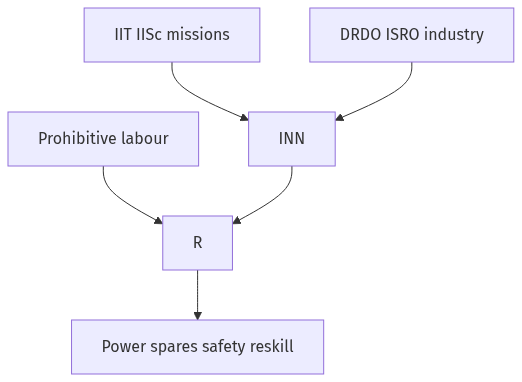
Conclusion
- Robots should take work that kills, poisons, or wears people out: mines, radiation, bombs, fire, deep water, space, furnaces, and contagion. That is sustainable only with maintenance, safety law, and reskilling. Premier institutes will innovate if missions, testbeds, defence and industry buyers, and long fellowships replace short imported demos.
Quick related
Students also ask
-
Discuss the advantage and security implication of cloud hosting of servers vis-a-vis in house machine based hosting for government business.
Next question on this syllabus topic (2015 · Q13). View answer →
-
Will robots only destroy factory jobs?
They will cut some shop-floor roles. The public case is to remove lethal work and to create design and maintenance jobs, which needs planned reskilling.
-
Is buying foreign robots enough?
It can save lives quickly. Substantive innovation still needs Indian institutes, parts, and a domestic buyer, or the country stays a user.
Same topic · past papers
UPSC has asked this before
These previous-year questions sit on the same topic. Open one to practise the earlier ask.
More from this topic
Q17 · UPSC Mains 2026 · GS III · 15 marks · Solution
What are the challenges to solid waste management in India? Discuss the governmental policy framework on solid waste management. Discuss the success/failure cases of Delhi and Indore cities highlighting the salient features of their solid waste management initiatives.
Indian Economy
• Challenges: volume growth, mixed waste, land, informal exclusion, weak finance. • SWM Rules 2016 mandate segregation, collection, processing, user fees. • Plastic/C&D/e-waste rules and SBM Urban complete the framework. • Swachh Survekshan creates competitive accountability. • Indore: strong segregation, collection, processing, enforcement. • Delhi: huge volumes, legacy dumps, fires, fragmented stress. • Lesson: behaviour + processing beat trucks-only strategies. • Biomining and bulk-generator compliance are essential for metros.
Q16 · UPSC Mains 2026 · GS III · 15 marks · Solution
What is Agentic Artificial Intelligence (AI)? Explain its working. Describe its applications with suitable examples. Discuss the advantages, risks and challenges associated with agentic AI systems.
Indian Economy
• Agentic AI pursues goals via plan–act–observe loops, not one-shot replies. • Working parts: planning, tools, memory, guardrails, stop conditions. • Uses: grievance assist, compliance, agri/disaster fusion, cyber SOCs, tutoring. • Advantages: speed, consistency, expert leverage, continuous monitoring. • Risks: harmful actions from hallucinations, injection attacks, privacy leaks. • India challenges: languages, liability, data law, compute cost, evaluation. • Govern with human approval for high stakes, logs and allow-listed tools. • Sandboxes beat unsupervised autonomy over money and rights.
Q15 · UPSC Mains 2026 · GS III · 15 marks · Solution
Mention salient features of 'Mission Drishti'. Discuss the imaging techniques used in the satellite launched on 3rd May 2026. Why is it being considered world's first satellite of its kind?
Indian Economy
• Mission Drishti is GalaxEye's EO satellite launched 3 May 2026. • Marketed as world's first OptoSAR combining optical + all-weather radar. • Described as India's largest privately built satellite in that category. • Imaging: X-band SAR (Stripmap/Spotlight) plus 7-band MSI. • Fusion on one platform avoids two-satellite parallax/time errors. • Fused resolution marketed near 1.8 m; SAR spotlight finer (~0.9 m claimed). • Orbit: sun-synchronous LEO ~500 km class; revisit ~4 days (company). • Novelty is integrated commercial OptoSAR—not inventing SAR/optical physics.