
Revision summary
Make in India needs actual factories that meet export quality and hire at scale. Skill India, PMKVY, NSDC and NSQF are meant to supply shop-floor skills and apprentices. Without skills, India stays a cheap-assembly site; without jobs, skilling is wasted. Rigid Industrial Disputes and inspector overlap push firms toward contract labour or no hire. Labour reform must simplify law and allow adjustment while keeping portable social security.
Model answer
Copper italics in this answer — like this — are the key facts. Each one is unpacked in the Facts & figures rail.
Introduction
Make in India (September 2014) asks firms to design, make and export from India in 25 sectors. A factory does not appear from a logo. It needs workers who can run machines and labour law that lets a firm hire, redeploy and, when needed, close without a year in court. Skill India (15 July 2015) and labour reforms are therefore not side slogans. They are conditions for the programme to succeed.
Body
Make in India without skills fails
- Global firms compare India with Vietnam and China on unit labour cost and quality, not only on cheap wages.
- A large youth cohort with weak shop-floor, numerical and soft skills cannot staff electronics, auto, textiles or defence lines at export quality.
- Skill India, Pradhan Mantri Kaushal Vikas Yojana, National Skill Development Corporation and the National Skills Qualifications Framework are meant to certify those skills at scale.
- Apprenticeship reform (amended Apprentices Act) links the classroom to the factory; without it, Make in India stays at assembly of imported kits.
- Skill without a factory job is wasted; a factory without skill stays low-value. The two programmes must pull each other.
Why radical labour reforms matter
- India still runs a thicket of central labour laws (Factories, Industrial Disputes, Contract Labour, and others) with inspector overlap and criminal penalties for routine slips.
- Chapter V-B of the Industrial Disputes Act makes lay-off, retrenchment and closure in larger units subject to prior government permission, which deters hiring on the rolls.
- Firms respond with contract labour, micro size below thresholds, or capital in place of people — which is the jobless-growth story.
- Rajasthan (2014) and some other States raised thresholds and simplified compliance; the Union’s Shram Suvidha portal and unified returns are a start, not a finished code.
- Radical reform means rationalisation into fewer codes, easier compliance, and freedom to adjust workforce with notice and social security, not a race to fire without cause.
Logical link
- Investors will not Make in India if they cannot find certified workers or if every extra hire is a legal hostage.
- Workers will not accept flexibility unless EPFO, ESI and portable benefits travel with the job.
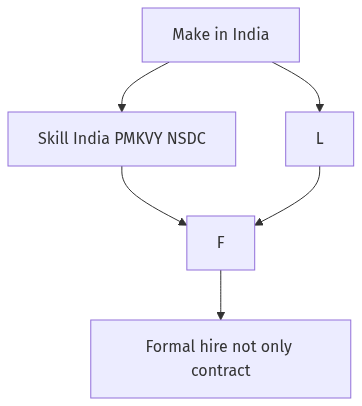
- Success is therefore joint: Skill India fills the quality gap; labour reform fills the quantity and formality gap.
Flow diagram
Conclusion
Make in India succeeds only if plants can staff quality lines and adjust employment lawfully. Skill India supplies the first; radical but fair labour reform supplies the second. One without the other leaves either empty certificates or empty factories.
Quick related
Students also ask
-
There is a clear acknowledgement that Special Economic Zones (SEZs) are a tool of industrial development, manufacturing and exports. Recognising this potential, the whole instrumentality of SEZs require augmentation. Discuss the issue plaguing the success of SEZs with respect to taxation, governing laws and administration.
Next question on this syllabus topic (2015 · Q10). View answer →
-
Can Make in India succeed with only tax incentives?
No. Plants still need skilled workers and predictable hiring-and-exit rules, which incentives do not create.
-
Does labour reform mean ending worker protection?
It should mean fewer overlapping laws and lawful flexibility with notice and social security, not unprotected dismissal.
Same topic · past papers
UPSC has asked this before
These previous-year questions sit on the same topic. Open one to practise the earlier ask.
More from this topic
Q17 · UPSC Mains 2026 · GS III · 15 marks · Solution
What are the challenges to solid waste management in India? Discuss the governmental policy framework on solid waste management. Discuss the success/failure cases of Delhi and Indore cities highlighting the salient features of their solid waste management initiatives.
Indian Economy
• Challenges: volume growth, mixed waste, land, informal exclusion, weak finance. • SWM Rules 2016 mandate segregation, collection, processing, user fees. • Plastic/C&D/e-waste rules and SBM Urban complete the framework. • Swachh Survekshan creates competitive accountability. • Indore: strong segregation, collection, processing, enforcement. • Delhi: huge volumes, legacy dumps, fires, fragmented stress. • Lesson: behaviour + processing beat trucks-only strategies. • Biomining and bulk-generator compliance are essential for metros.
Q16 · UPSC Mains 2026 · GS III · 15 marks · Solution
What is Agentic Artificial Intelligence (AI)? Explain its working. Describe its applications with suitable examples. Discuss the advantages, risks and challenges associated with agentic AI systems.
Indian Economy
• Agentic AI pursues goals via plan–act–observe loops, not one-shot replies. • Working parts: planning, tools, memory, guardrails, stop conditions. • Uses: grievance assist, compliance, agri/disaster fusion, cyber SOCs, tutoring. • Advantages: speed, consistency, expert leverage, continuous monitoring. • Risks: harmful actions from hallucinations, injection attacks, privacy leaks. • India challenges: languages, liability, data law, compute cost, evaluation. • Govern with human approval for high stakes, logs and allow-listed tools. • Sandboxes beat unsupervised autonomy over money and rights.
Q15 · UPSC Mains 2026 · GS III · 15 marks · Solution
Mention salient features of 'Mission Drishti'. Discuss the imaging techniques used in the satellite launched on 3rd May 2026. Why is it being considered world's first satellite of its kind?
Indian Economy
• Mission Drishti is GalaxEye's EO satellite launched 3 May 2026. • Marketed as world's first OptoSAR combining optical + all-weather radar. • Described as India's largest privately built satellite in that category. • Imaging: X-band SAR (Stripmap/Spotlight) plus 7-band MSI. • Fusion on one platform avoids two-satellite parallax/time errors. • Fused resolution marketed near 1.8 m; SAR spotlight finer (~0.9 m claimed). • Orbit: sun-synchronous LEO ~500 km class; revisit ~4 days (company). • Novelty is integrated commercial OptoSAR—not inventing SAR/optical physics.