
Revision summary
Poverty and malnutrition reinforce each other and show up as stunting, wasting, anaemia and lost learning. The loop is intergenerational through low birth weight and adolescent anaemia. Infection and dirty water turn a calorie into a wasted calorie. Breaks: diverse PDS, ICDS and POSHAN, mid-day meals, toilets and tap water, MGNREGA and women’s income, National Health Mission. Convergence at the panchayat beats siloed schemes. The first thousand days are the human-capital investment. Article 47 already names nutrition as a primary duty of the State.
Model answer
Copper italics in this answer — like this — are the key facts. Each one is unpacked in the Facts & figures rail.
Introduction
- A child who is stunted at two is already paying an adult tax: weaker cognition, more illness, lower wages. A household that is poor feeds that child too little and too poorly. The child then grows into a low-productivity adult, which is human capital lost. Poverty and malnutrition are not two files. They are a loop.
Body
The vicious cycle
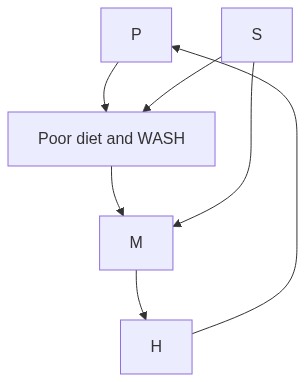
Poverty and malnutrition reproduce each other in the same body and then in the next.
- Peg: Poverty means low dietary diversity, early marriage, unpaid women’s labour, and a house without a toilet.
- Peg: Malnutrition — calorie, protein, micronutrient, and the double burden of obesity with anaemia — raises health spend and cuts school attendance.
- Peg: National Family Health Survey findings of stunting, wasting and women’s anaemia, and Annual Status of Education Report learning gaps, sit on the same bodies: height-for-age is a wage forecast.
- Peg: Infection eats nutrients; the loop is intergenerational when an anaemic adolescent girl becomes a low-birth-weight mother.
Steps that break it
The break is several pipes into the same household, not a new scheme name each year.
- Peg: Food: a public distribution system that issues pulses and millets, not only grain; ICDS and POSHAN Abhiyaan that reach the third trimester; PM POSHAN as an attendance and protein tool.
- Peg: Care: ASHA and ANM, iron-folic acid, deworming, exclusive breastfeeding windows.
- Peg: Water and sanitation: toilets that are used, tap water, drains — because diarrhoea is a nutrition policy.
- Peg: Income and health: MGNREGA in drought months, women’s groups, maternity cash that arrives before birth, and National Health Mission work on tuberculosis and sickle cell, because a wasting child is often a sick child.
Governance of the break
Schemes fail when they do not meet in the same child.
- Peg: Convergence of women-and-child, health and rural development at the Gram Panchayat beats siloed photographs.
- Peg: Growth monitoring that is not a forged register, and State nutrition gaps used as a political KPI, are how the first thousand days become infrastructure equal to a highway.
Flow diagram
Conclusion
Poverty feeds malnutrition; malnutrition reproduces poverty in the next body. The break is food diversity, care, sanitation and women’s income in the same household, not a new scheme name each year.
Quick related
Students also ask
-
Can the vicious cycle of gender inequality, poverty and malnutrition be broken through microfinancing of women SHGs? Explain with examples.
Next question on this syllabus topic (2021 · Q8). View answer →
-
Is calorie enough to break the cycle?
No. Protein, iron, sanitation and infection control decide whether the calorie stays in the child.
-
Does growth automatically end malnutrition?
Not if growth is unequal and the PDS remains cereal-heavy. Several richer States still show anaemia.
Same topic · past papers
UPSC has asked this before
These previous-year questions sit on the same topic. Open one to practise the earlier ask.
-
2021 · Q8 · GS II · 10 marks
Can the vicious cycle of gender inequality, poverty and malnutrition be broken through microfinancing of women SHGs? Explain with examples. -
2019 · Q15 · GS II · 15 marks
Individual Parliamentarian's role as the national lawmaker is on a decline, which in turn, has adversely impacted the quality of debates and their outcome. Discuss.(15).
More from this topic
Q16 · UPSC Mains 2025 · GS II · 15 marks · Solution
Inequality in the ownership pattern of resources is one of the major causes of poverty. Discuss in the context of 'paradox of poverty'
Poverty and Hunger
Paradox of poverty: national or local natural and growth wealth beside household want, because ownership is concentrated. Land, forest, water, minerals and schooling are the asset bases. Mining States and landless hamlets are the Indian picture; caste and gender structure titles. FRA, PESA, Samata and coparcenary judgments attack ownership; MPI and DBT measure or cushion, they do not reassign the lease. Governance of the file and the Gram Sabha is the GS2 core.
Q8 · UPSC Mains 2021 · GS II · 10 marks · Solution
Can the vicious cycle of gender inequality, poverty and malnutrition be broken through microfinancing of women SHGs? Explain with examples.
Poverty and Hunger
SHG microfinance can interrupt gender inequality, poverty and malnutrition by giving women cash, savings and bargaining power. SEWA links credit to organising; Kudumbashree links neighbourhood groups to livelihoods and the panchayat. NABARD linkage and DAY-NRLM took the model to national scale. Over-lending, as in the Andhra stress, can deepen poverty; nutrition still needs PDS and health. Use SHG finance as a lever beside titles, food and care services, not as a substitute Welfare State.
Q7 · UPSC Mains 2019 · GS II · 10 marks · Solution
There is a growing divergence in the relationship between poverty and hunger in India. The shrinking of social expenditure by the government is forcing the poor to spend more on Non- Food essential items squeezing their food - budget.- Elucidate.
Poverty and Hunger
Headcount poverty can fall while stunting, anaemia and calorie quality stay poor. That is the poverty–hunger divergence. Thin public health and schooling force private non-food spending. Food is the residual head, so hunger survives a better poverty line. NFSA, NHM, RTE meals, ICDS and MGNREGA must rise in real terms to protect the food budget.