
Revision summary
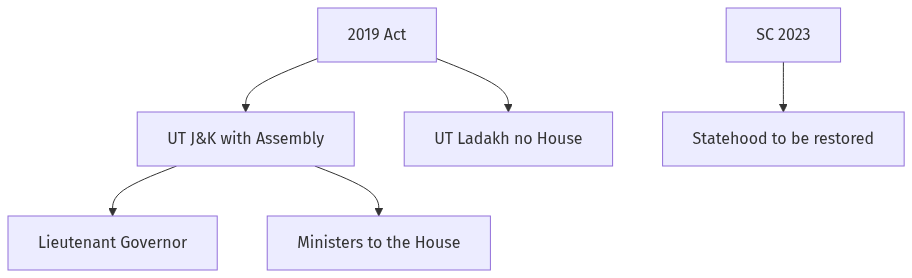
The 2019 Act replaced the State legislature with a J&K UT Assembly and a legislature-less Ladakh. The House legislates on assigned State and Concurrent subjects; police and public order stay with the Union. A Council of Ministers is responsible to the Assembly; the LG holds discretionary pockets. In Re Article 370 (2023) upheld abrogation and pointed back to statehood. 2024 elections revived the Assembly as a working UT legislature, not yet a full State Vidhan Sabha.
Model answer
Copper italics in this answer — like this — are the key facts. Each one is unpacked in the Facts & figures rail.
Introduction
The Jammu and Kashmir Reorganisation Act, 2019 converted the former State into two Union Territories: Jammu & Kashmir with a Legislative Assembly and Ladakh without a legislature. The J&K Assembly is therefore a UT legislature, with narrower powers than a full State Assembly, particularly over Police and Public Order.
Body
Nature of the J&K Legislative Assembly
- Union Territory Legislature: The Assembly functions under the Jammu and Kashmir Reorganisation Act, 2019 and is not a full State legislature.
- Unicameral: The earlier Legislative Council was abolished; J&K now has only a Legislative Assembly.
- Composition: After the 2022 delimitation, the Assembly has 90 elected constituencies(24 seats reserved for Pakistan-occupied Kashmir (PoK)).
- ST Reservation: 9 seats are reserved for Scheduled Tribes.
- Lieutenant Governor (LG) Nominations: The LG is empowered to nominate members representing Kashmiri Migrants, Displaced Persons, and Women if they are deemed under-represented in the Assembly.
- Five-year term: The Assembly has a normal five-year tenure, unless dissolved earlier.
- Lieutenant Governor: The LG represents the Union and exercises powers assigned under the Reorganisation Act.
- 2024 elections: Elections restored an elected legislature after the UT's formation.
Powers and Functions
Legislative Powers
- State List: The Assembly can legislate on matters in the State List except Police and Public Order.
- Example: Subjects such as health, education and local government fall within its legislative field, subject to the constitutional framework.
- Significant Power over Land: Unlike the National Capital Territory (NCT) of Delhi, the J&K Legislative Assembly retains legislative power over "Land".
- Concurrent List: It can also legislate on applicable Concurrent List subjects.
- Parliamentary supremacy: Parliament retains power to legislate for the Union Territory.
Financial Powers
- Budget: The Assembly considers and votes on the UT's annual financial statement.
- Expenditure: It exercises control over public expenditure through grants and appropriation.
Executive Functions
- Council of Ministers: The Chief Minister-led Council of Ministers is responsible to the Assembly.
- Legislative accountability: The Assembly exercises control through questions, debates, motions and committees.
- Example: The elected House can question the government on development, employment, health and other UT matters.
- LG's role: The Lieutenant Governor retains important powers in matters assigned to the Union and in specified discretionary areas.
Key Limitations
- Police and Public Order: These remain outside the Assembly's legislative domain and under Union control.
- Parliamentary control: Parliament can legislate for J&K even in areas within the Assembly's legislative field.
- Limited autonomy: The Assembly therefore has less autonomy than a full State legislature.
Constitutional and Political Significance
- In Re: Article 370 (2023): The Supreme Court upheld the constitutional changes and directed that steps be taken towards restoration of statehood.
- Democratic representation: The 2024 elections restored an elected representative institution.
- Hybrid federal model: J&K combines an elected legislature with substantial Union oversight.
- Example: The Assembly can represent regional concerns such as jobs, development and local governance, while Police and Public Order remain with the Union.
Flow diagram
Conclusion
The post-2019 J&K Legislative Assembly represents democratic governance within a Union Territory framework. Its legislative, financial and accountability functions provide local representation, while Union control over Police and Public Order and the LG's role limit its autonomy. The central challenge is to balance security, democratic representation and restoration of statehood.
Quick related
Students also ask
-
Women's social capital complements in advancing empowerment and gender equity. Explain.
Next question on this syllabus topic (2025 · Q6). View answer →
-
Is the J&K Assembly the same as Delhi’s?
Both are UT legislatures under a Union officer. The statutes differ. Delhi’s fights over services are not a copy-paste of the 2019 J&K Act.
-
Did 2024 elections restore the old State?
They restored an elected House for the UT. Statehood still needs a parliamentary political decision the Court has urged.
Same topic · past papers
UPSC has asked this before
These previous-year questions sit on the same topic. Open one to practise the earlier ask.
More from this topic
Q15 · UPSC Mains 2026 · GS II · 15 marks · Solution
To what extent do pressure groups, social movements and corporate lobbies deepen pluralistic democracy in India by representing excluded interests? Analyse whether the growing convergence of corporate wealth and political power poses a threat to the autonomy of formal democratic institutions.
Governance and Policy
• Civil society groups and grassroots movements go beyond periodic elections to channel marginalized voices into policy spaces. • Social movements on tribal rights and environmental protection have successfully forced the state to create protective legislation. • Representation is uneven due to a severe resource asymmetry between well-funded corporate lobbies and unorganized labor. • Some interest groups act as elite fronts, subverting public welfare for narrow sectarian gains. • Corporate financial dominance through opaque funding creates severe risks of policy capture and quid pro quo corruption. • Strengthening transparency in political funding and reinforcing regulatory autonomy are essential to safeguard democratic governance.
Q12 · UPSC Mains 2026 · GS II · 15 marks · Solution
What is meant by judicial legislation? In this context, discuss the verdicts of the apex court allowing "passive euthanasia" and a "living will".
Governance and Policy
• Judicial legislation occurs when courts create binding rules to fill policy voids caused by legislative inaction. • The Supreme Court legalized passive euthanasia under Article 21, recognizing the right to die with dignity. • The *Common Cause* (2018) judgment permitted the withdrawal of life support for terminally ill patients with strict medical safeguards. • A living will is an advanced medical directive allowing individuals to pre-state their treatment preferences before incapacitation. • The Supreme Court simplified living will procedures in 2023, replacing complex magistrate approvals with basic notary attestation. • While court guidelines provide immediate relief, they underscore the need for a comprehensive parliamentary statute on end-of-life care. • Codifying these judicial norms through formal legislation ensures democratic legitimacy, ethical debate, and administrative clarity.
Q6 · UPSC Mains 2026 · GS II · 10 marks · Solution
Does India's tribal development policy reflect the aspirations for a socially grounded and equity-based governance? Justify your answer.
Governance and Policy
• India's tribal policy balances constitutional protections with socio-economic development goals. • Fifth and Sixth Schedules provide decentralized autonomy and safeguard tribal lands. • Articles 275(1) and 335 ensure grants-in-aid and reservations to bridge gaps. • PESA (1996) and FRA (2006) mark shifts toward rights-based and culturally sensitive governance. • Gram sabhas are empowered over minor forest produce and community forest rights. • Implementation is hindered by forced displacement without consent and bureaucratic inertia. • True equity requires empowering local institutions rather than relying solely on welfare delivery.