
Revision summary
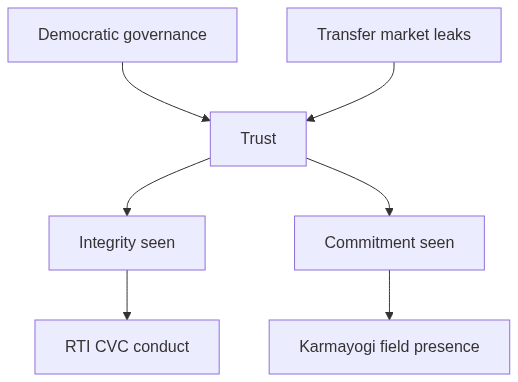
Democratic governance depends on daily trust in those who implement the law. Perception of integrity and commitment is part of that trust, not an optional brand. Instruments: conduct rules, CVC, RTI, asset declarations, Mission Karmayogi, cleaner recruitment. Politicised transfers and exam leaks destroy the perception faster than a training module can rebuild it. Open postings and visible punishment are how a cadre earns the doctrine the question names. Unseen integrity does not sustain a republic that now films the tehsil.
Model answer
Copper italics in this answer — like this — are the key facts. Each one is unpacked in the Facts & figures rail.
Introduction
Democratic governance is not only a vote every five years. It is the daily belief that the file will move without a bribe and that the order is not a faction’s errand. Civil servants are the face of that belief. If the public thinks they are neither honest nor committed, the doctrine collapses into elections plus cynicism. The question is about perception, which is harsher than a vigilance statistic.
Body
Perception as a democratic input
A republic cannot watch every clerk; it relies on reputational capital.
- Peg: Nolan’s principles — selflessness, integrity, accountability, openness — and the Second Administrative Reforms Commission ethics chapter said standards must be seen.
- Peg: Right to Information, social audits and smartphones mean that a rude tehsil is a video, not a rumour.
- Peg: Perception is therefore a governance input, not a public-relations campaign.
Integrity and commitment
Integrity is the file; commitment is presence.
- Peg: Integrity needs conduct rules, asset declarations, Central Vigilance Commission and lokayukta paths, and a transfer policy that is not a marketplace.
- Peg: Commitment is competence plus presence: the officer who stays in the district, knows the scheme, and does not outsource the poor to a contractor.
- Peg: Mission Karmayogi tries to rebuild capacity; capacity without integrity is a more efficient rent-seeker.
What wrecks the picture, and what repairs it
The steel frame’s self-image will not wait out a leak or a transfer market.
- Peg: Pliable postings, unions that defend the indifferent, and paper leaks in recruitment tell the young that even the gate is rigged.
- Peg: Media trials can be unfair; they are also how a democracy audits a closed cadre.
- Peg: Repair is public: transparent transfer boards, reasoned speaking orders, live service-delivery dashboards, protection for honest officers, and visible punishment that is not only for the unconnected.
Flow diagram
Conclusion
Democratic governance needs a civil service the public believes is honest and at work. That belief is built by open process and punished deviance, not by a lecture on the steel frame.
Quick related
Students also ask
-
Who are entitled to receive free legal aid? Assess the role of the National Legal Services Authority(NALSA) in rendering free legal aid in India.
Next question on this syllabus topic (2023 · Q2). View answer →
-
Is a good image the same as integrity?
No. Spin without clean files collapses. But in a democracy, unseen integrity does not sustain trust.
-
Should officers be insulated from all politics?
They serve a political executive. Insulation is from illegal orders and from a transfer market, not from policy.
Same topic · past papers
UPSC has asked this before
These previous-year questions sit on the same topic. Open one to practise the earlier ask.
More from this topic
Q15 · UPSC Mains 2026 · GS II · 15 marks · Solution
To what extent do pressure groups, social movements and corporate lobbies deepen pluralistic democracy in India by representing excluded interests? Analyse whether the growing convergence of corporate wealth and political power poses a threat to the autonomy of formal democratic institutions.
Governance and Policy
• Civil society groups and grassroots movements go beyond periodic elections to channel marginalized voices into policy spaces. • Social movements on tribal rights and environmental protection have successfully forced the state to create protective legislation. • Representation is uneven due to a severe resource asymmetry between well-funded corporate lobbies and unorganized labor. • Some interest groups act as elite fronts, subverting public welfare for narrow sectarian gains. • Corporate financial dominance through opaque funding creates severe risks of policy capture and quid pro quo corruption. • Strengthening transparency in political funding and reinforcing regulatory autonomy are essential to safeguard democratic governance.
Q12 · UPSC Mains 2026 · GS II · 15 marks · Solution
What is meant by judicial legislation? In this context, discuss the verdicts of the apex court allowing "passive euthanasia" and a "living will".
Governance and Policy
• Judicial legislation occurs when courts create binding rules to fill policy voids caused by legislative inaction. • The Supreme Court legalized passive euthanasia under Article 21, recognizing the right to die with dignity. • The *Common Cause* (2018) judgment permitted the withdrawal of life support for terminally ill patients with strict medical safeguards. • A living will is an advanced medical directive allowing individuals to pre-state their treatment preferences before incapacitation. • The Supreme Court simplified living will procedures in 2023, replacing complex magistrate approvals with basic notary attestation. • While court guidelines provide immediate relief, they underscore the need for a comprehensive parliamentary statute on end-of-life care. • Codifying these judicial norms through formal legislation ensures democratic legitimacy, ethical debate, and administrative clarity.
Q6 · UPSC Mains 2026 · GS II · 10 marks · Solution
Does India's tribal development policy reflect the aspirations for a socially grounded and equity-based governance? Justify your answer.
Governance and Policy
• India's tribal policy balances constitutional protections with socio-economic development goals. • Fifth and Sixth Schedules provide decentralized autonomy and safeguard tribal lands. • Articles 275(1) and 335 ensure grants-in-aid and reservations to bridge gaps. • PESA (1996) and FRA (2006) mark shifts toward rights-based and culturally sensitive governance. • Gram sabhas are empowered over minor forest produce and community forest rights. • Implementation is hindered by forced displacement without consent and bureaucratic inertia. • True equity requires empowering local institutions rather than relying solely on welfare delivery.